
The U.S.-Israel attack on Iran will have immediate effects on all of us.
Crude oil prices jumped in futures trading Sunday evening, March 1. Brent crude, the global benchmark, surged more than 10% in early trading, hitting $80.11 per 42-gallon barrel.
Light sweet crude, the U.S. benchmark, was up 8.4% to $72.51.
Futures trading suggests the Dow Jones industrials could fall more than 550 points at the open. The S&P 500 is looking at a 76-point loss, with the tech-heavy Nasdaq-100 Index looking at slumping 259 points.
The open was a bit more dramatic than analyst Andy Lipow of Lipow Oil Associates expected. Lipow told CNBC he thought oil prices would jump at least $3 to $5 a barrel when trading opened.
The oil-price gains may just be the start. One analyst suggested the Brent price might rise to as high $100 per barrel, a level last seen in the summer of 2022.
That would be a gain of nearly 38% on the year, if the prediction of Barclay’s analyst Amarpreet Singh holds, The Wall Street Journal reported. Singh’s guesstimate (let’s give him the benefit of the doubt that he’s offering a worst-case scenario) may be an outlier. His base case is for Brent to hold around $80 a barrel.
Watch price signs when you fill up your gas tank
How quickly that will translate into the price of gasoline at your local retailer wasn’t clear. But you can expect prices to start to rise perhaps as early as Monday, March 2.
The longer the attacks on Iran continue, you can bet retail prices will move higher. President Donald Trump said he thought the attacks would end in four weeks or less.
What would happen politically inside Iran was totally unclear on Sunday, March 1. The government is in disarray after Supreme Leader Ayatollah Ali Khamenei was killed in an Israeli attack on his headquarters on Saturday, Feb. 28.
Related: What happens to oil prices if bombs and bullets fly in Iran
The predominantly Muslim country with a population of about 92 million has been ruled by fundamentalist Islamists since overthrowing the Shah in 1979.
I should note that oil prices also surged after the first U.S.-Israeli attacks on Iranian nuclear facilities in June. But they fell back quicky, as it became clear Iran’s defenses were weak. The oil-price decline sent stocks surging as well.
Three U.S service members were killed on Sunday and another five personnel were injured in related incidents, officials said.
The U.S.-Israeli attacks continued Sunday. So, too, did Iranian missile shots at Israel, nations across the Persian Gulf, and U.S. military bases scattered around the Gulf.
Passengers on cruise ships sailing the Persian Gulf have watched the attacks and explosions, but there have been no reports of cruise ships being hit.
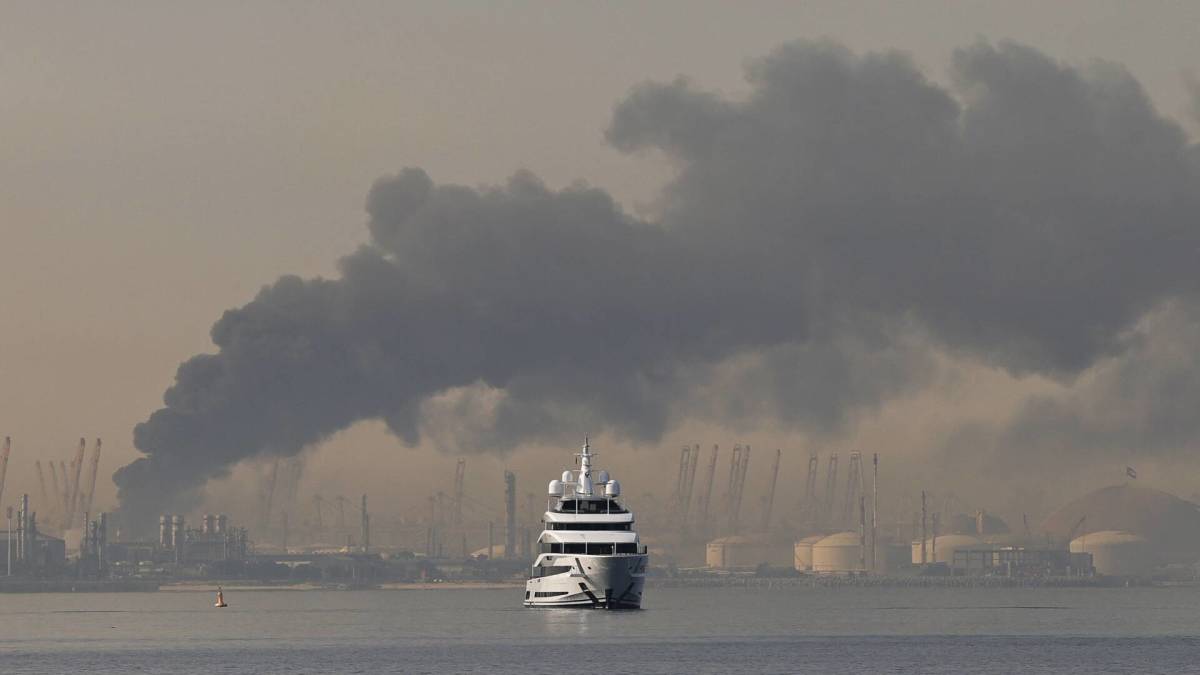
Getty Images
Retail gas prices should shoot higher after Iran attacks
If the violence continues and, worse, results in limits on oil exports from the Persian Gulf, you will see retail gas prices rise and stay high.
Retail gas prices in the United States averaged about $2.984 per gallon early Sunday, according to AAA’s daily fuel gauge report.
More Oil and Gas:
- Energy giant sends blunt $20 billion message on dividend growth
- 147-year-old oil giant just raised dividend 4% in 2026
- Top energy stocks to buy amid Venezuela chaos
That’s up about 5% so far in 2026. Some of the gain is due to oil refiners starting to make blends for use in the summer.
But a larger portion of the gains have occurred as tensions rose about the Middle East.
Can oil tankers get through the Strait of Hormuz?
The looming question is what may be happening in and around the key Strait of Hormuz. The strait is the outlet through which oil tankers must pass to get from the Persian Gulf into the Gulf of Oman and then into the Indian Ocean and to global markets.
In normal times, about 20% of the world’s crude oil passes through the 22-mile wide strait daily.
Related: Every major analyst’s S&P 500 price target for 2026
There seemed to be confusion what was happening in the strait. Iran said it wasn’t blocking the strait. But there were reports that shots have been fired at at least three tankers. As a result, ships were anchored beyond either entrance to the strait, not willing to take the risk.
“The majority of vessels in the area either performed U-turns, began idling, or diverted toward alternative routes outside the Strait,” Dimitris Ampatzidis, senior risk analyst at maritime-intelligence company Kpler, told CNN.
Energy stocks surge as Iranian tensions rise
0f the 22 stocks in the S&P 500 Energy sector, 21 are higher so far in 2026, according to Barchart.com data.
Two of the biggest oil companies, Exxon Mobil (XOM) and Chevron (CVX), were up 3.5% and 1.5% in the last week. Both have big investments in the Middle East, and Chevron is expanding its presence in Iraq.
For the year, the two stocks are up 26.7% and 22.5%, respectively, ranking 7th and 11th in the sector, respectively.
Among oil-service companies with global operations, leaders are:
- Baker Hughes, up 43.3%
- SLB Ltd, formerly Schlumberger, up 33.8%
- Halliburton, up 27.4%
The Energy Sector is the top performer of the 11 S&P 500 sectors, up 24.4%. It rose 2.2% this past week.
The Iranian tensions clearly have boosted the shares, but many investors have chosen to bet on energy this year as they diversified away from the Magnificent 7 technology stocks.
The tech sector of the S&P 500 is down 5.6% so far this year, second worst among the sectors, just ahead of financial stocks.
Related: Big Oil supermajor stuns with blunt Venezuela message