Section 1: Foundations of Accounting
6 lessons in this module. Work through each lesson top to bottom; download the templates and worksheets inside each lesson.
What Is Accounting and Why It Matters matters because it’s a core skill every US bookkeeper and accountant relies on to keep the books accurate and decision-ready. This lesson covers the mechanics, a clear worked example, and the common mistakes that trip up beginners.
Apply the concepts of what is accounting and why it matters to a real US-market scenario, using the downloadable template attached.
What Is Accounting — and Why Does It Matter?
Accounting is the systematic process of identifying, recording, measuring, classifying, and communicating financial information so that decision-makers — managers, investors, lenders, and regulators — can act with confidence. If money flows in or out of a business, accounting captures it.
Think of accounting as the financial scoreboard of a business. Just as a baseball scoreboard tells you the score, the inning, and the runs needed to win, a set of accounts tells you what a business owns, what it owes, how much it earned, and how cash moved during a period.
The Two Main Branches
Financial accounting produces reports for external users — shareholders, banks, and tax authorities. These reports follow standardized rules (GAAP or IFRS) so that anyone can compare one company’s results with another’s.
Managerial accounting produces reports for internal users — the managers who run the business day to day. These reports are flexible, forward-looking, and confidential.
Key Accounting Terms You Must Know
- Assets — Resources owned or controlled by the business that have future economic value (cash, equipment, receivables).
- Liabilities — Obligations the business owes to outsiders (bank loans, supplier invoices, tax payable).
- Equity (Owner’s Equity / Shareholders’ Equity) — The residual interest in assets after all liabilities are subtracted. In simple terms: what the owners actually own.
- Revenue — Income earned by delivering goods or services to customers.
- Expenses — Costs incurred to generate revenue.
- Net Income (Profit) — Revenue minus all expenses for a period.
The Accounting Period
Financial results are always measured over a defined time window — a month, a quarter, or a financial year. This “periodicity” concept lets stakeholders track trends over time. A business cannot simply report “total lifetime profit” — context requires time boundaries.
The Going-Concern Assumption
Unless there is evidence to the contrary, accountants assume the business will continue operating indefinitely. This assumption justifies recording long-lived assets at cost rather than liquidation value, and spreading costs over their useful life rather than expensing them immediately.
Cash vs. Accrual Accounting
Cash-basis accounting records transactions only when cash changes hands. If you sell goods in December but the customer pays in January, you record the sale in January. This method is simple and suits very small businesses.
Accrual-basis accounting records revenue when it is earned and expenses when they are incurred, regardless of when cash moves. This gives a more accurate picture of economic activity in a period and is required under GAAP/IFRS for most businesses.
Example: A web-design agency completes a $200,000 project in March and invoices the client. The client pays in April. Under accrual accounting, revenue is recorded in March. Under cash-basis accounting, revenue is recorded in April.
Why Accurate Accounting Protects You
Poor accounting leads to tax errors, bank-loan rejections, investor distrust, and — in severe cases — business failure. Good accounting gives you visibility, builds credibility, and helps you catch fraud or errors early. It is the foundation every other business decision rests on.
Lesson Summary
- Accounting records, classifies, and communicates financial information.
- Financial accounting is for external users; managerial accounting is for internal users.
- Core terms: assets, liabilities, equity, revenue, expenses, net income.
- Accrual accounting matches revenue and expenses to the period they relate to — more accurate than cash-basis.
Why Every Business Needs Accounting
Imagine running a lemonade stand. You spend $10 on lemons and sugar, sell $25 worth of cups, and end the day with $15 in your pocket. Congratulations — you just did accounting. For a $10-billion company, the numbers are bigger but the logic is identical: track what comes in, track what goes out, and know where you stand.
Without accounting, a business cannot answer three critical questions:
- Are we profitable? Revenue minus expenses = profit or loss.
- Can we pay our bills? Cash available vs. obligations due.
- What is the business worth? Total assets minus total liabilities = owner’s equity.
The Three Branches of Accounting
| Branch | Who Uses It? | Primary Output | Example |
|---|---|---|---|
| Financial Accounting | Investors, banks, regulators | Financial statements (income statement, balance sheet) | Annual report filed with the SEC |
| Managerial Accounting | Internal managers | Budgets, cost reports, forecasts | Monthly department cost report |
| Tax Accounting | Business owners, tax authorities | Tax returns, compliance filings | Corporate income tax return |
A Day in the Life: Real-World Example
Scenario: Sarah opens a freelance graphic design business on January 1 with $5,000 of her own savings.
| Date | Event | Accounting Impact |
|---|---|---|
| Jan 1 | Deposits $5,000 into business bank account | Assets ↑ $5,000 | Equity ↑ $5,000 |
| Jan 5 | Buys a laptop for $1,200 cash | Assets: Cash ↓ $1,200, Equipment ↑ $1,200 |
| Jan 15 | Completes a $2,000 logo project; client pays immediately | Assets: Cash ↑ $2,000 | Revenue ↑ $2,000 |
| Jan 20 | Pays $300 for software subscriptions | Assets: Cash ↓ $300 | Expenses ↑ $300 |
| Jan 31 | End of month net income? | Revenue $2,000 − Expenses $300 = $1,700 profit |
Accounting isn’t about memorising rules — it’s about telling the truth in numbers. Every transaction leaves a trail, and accounting is how you follow it. Master the basics in this course and you’ll never look at a business the same way again.
GAAP vs IFRS — Two Sets of Rules
Businesses in the United States follow Generally Accepted Accounting Principles (GAAP), maintained by the Financial Accounting Standards Board (FASB). Most of the rest of the world follows International Financial Reporting Standards (IFRS), maintained by the International Accounting Standards Board (IASB).
The core concepts are very similar — both require honest, consistent, and comparable financial reporting. The key differences show up in areas like inventory valuation, revenue recognition timing, and how leases are treated. As a beginner, you’ll learn GAAP principles in this course, which form the foundation used across the US business world.
What Is Accounting — Practice Worksheet — Download, print, and complete to reinforce this lesson.
Multi-sheet workbook · pre-built formulas · plug in your own numbers · yours to keep.
Disclaimer. This lesson is educational. The worked example uses representative numbers and does not constitute personalized financial, tax, legal, or investment advice. Trading and investing involve risk including loss of principal. US tax rates change annually — verify against the current IRS publications and your specific state’s tax code. See our Financial Disclaimer for the full statement.
Debits and Credits Explained Simply matters because it’s a core skill every US bookkeeper and accountant relies on to keep the books accurate and decision-ready. This lesson covers the mechanics, a clear worked example, and the common mistakes that trip up beginners.
Apply the concepts of debits and credits explained simply to a real US-market scenario, using the downloadable template attached.
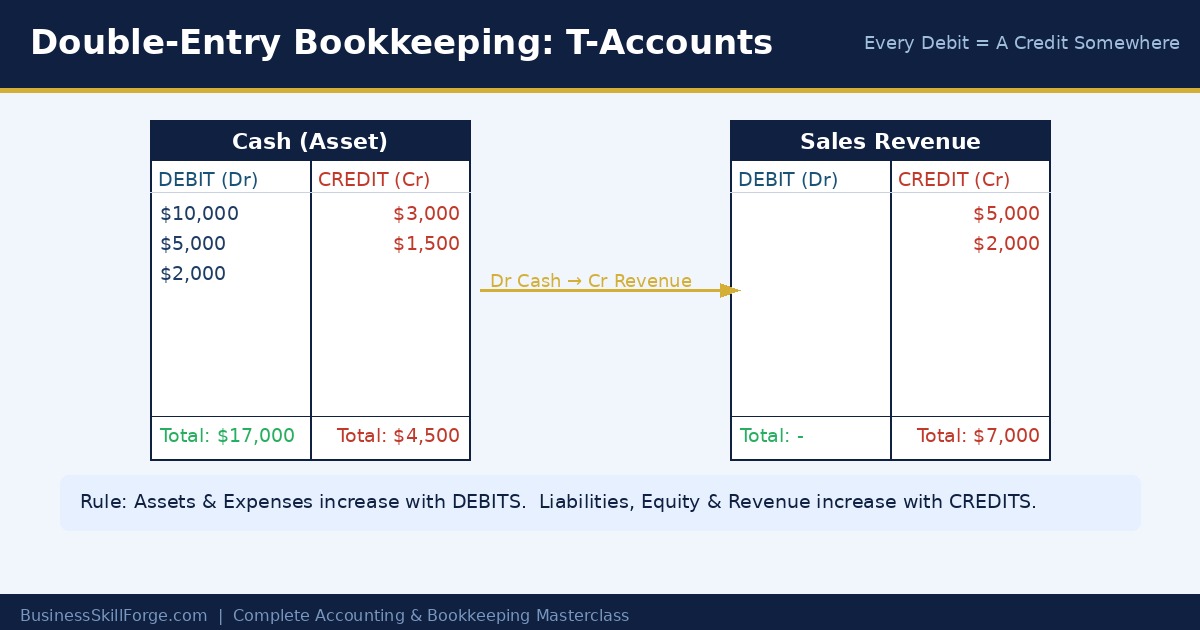
Debits and Credits: The Language of Double-Entry Bookkeeping
Every financial transaction has two sides. Double-entry bookkeeping records both sides of every transaction, ensuring the books stay in balance. This system, invented in 15th-century Italy, is still the global standard today.
The Core Rule
For every transaction, the total amount debited must equal the total amount credited. This is not optional — it is a mathematical identity. If your debits and credits don’t balance, an error has been made.
What “Debit” and “Credit” Actually Mean
Despite popular misconception, debit does not mean “money going out” and credit does not mean “money coming in.” The terms simply refer to the left side (debit) and right side (credit) of a ledger account called a T-account.
| Account Type | Increased by | Decreased by |
|---|---|---|
| Assets | Debit (Dr) | Credit (Cr) |
| Liabilities | Credit (Cr) | Debit (Dr) |
| Owner’s Equity | Credit (Cr) | Debit (Dr) |
| Revenue | Credit (Cr) | Debit (Dr) |
| Expenses | Debit (Dr) | Credit (Cr) |
Memory trick: DEAD CLIC — Debits increase Expenses, Assets, and Drawings; Credits increase Liabilities, Income, and Capital.
Journal Entries: Recording Transactions
A journal entry records a transaction chronologically. Each entry shows the date, accounts debited, accounts credited, and a brief description.
Example 1: You start a business by depositing $500,000 cash into the business bank account.
Dr. Cash (Asset ↑) $500,000
Cr. Owner’s Capital (Equity ↑) $500,000
Cash increases (debit); owner’s equity increases (credit).
Example 2: You buy office supplies for $8,000 cash.
Dr. Office Supplies Expense $8,000
Cr. Cash $8,000
Expense increases (debit); cash decreases (credit).
Example 3: You sell consulting services worth $25,000 on credit (invoice sent, not yet paid).
Dr. Accounts Receivable $25,000
Cr. Service Revenue $25,000
Asset (receivable) increases; revenue increases.
T-Accounts
A T-account is a visual representation of a ledger account with a left (debit) side and a right (credit) side. After posting all journal entries, the balance of each account is calculated by subtracting the smaller side from the larger side.
The Trial Balance
After posting all journal entries, a trial balance is prepared — a list of every account and its balance. The total of all debit balances must equal the total of all credit balances. A balanced trial balance is the first check that no mathematical errors have been made.
Lesson Summary
- Double-entry: every transaction has equal debits and credits.
- Assets and expenses increase with debits; liabilities, equity, and revenue increase with credits.
- Journal entries record each transaction in date order.
- The trial balance confirms debit totals = credit totals.
The Golden Rule: Every Transaction Has Two Sides
Double-entry bookkeeping was invented in 15th-century Italy — and it’s still the global standard today. The core insight is simple: every financial event simultaneously affects two accounts in equal and opposite ways. This is why accounting books always “balance.”
The confusion usually comes from the words debit and credit. Forget what you know from credit cards for a moment. In accounting:
| Account Type | Increases With | Decreases With | Memory Trick |
|---|---|---|---|
| Assets | Debit | Credit | Assets are what you OWN → Debits grow them |
| Liabilities | Credit | Debit | Liabilities are what you OWE → Credits grow them |
| Equity | Credit | Debit | Equity = owner’s claim → Credits grow it |
| Revenue | Credit | Debit | Revenue grows equity → Credits grow it |
| Expenses | Debit | Credit | Expenses shrink equity → Debits grow them |
Worked Example: 5 Transactions, Step by Step
Let’s record five real transactions for TechFix LLC, a small computer repair shop:
| # | Transaction | Account Debited | Amount | Account Credited | Amount |
|---|---|---|---|---|---|
| 1 | Owner invests $20,000 cash | Cash | $20,000 | Owner’s Capital | $20,000 |
| 2 | Buys repair equipment for $4,000 cash | Equipment | $4,000 | Cash | $4,000 |
| 3 | Earns $800 by repairing a laptop (cash paid) | Cash | $800 | Service Revenue | $800 |
| 4 | Pays $200 electricity bill | Utilities Expense | $200 | Cash | $200 |
| 5 | Buys $500 of parts on credit (accounts payable) | Parts Inventory | $500 | Accounts Payable | $500 |
After all five entries, total debits = $25,500 and total credits = $25,500. The books balance! This self-checking mechanism is one of the greatest features of double-entry accounting — errors are much harder to hide.
The T-Account: Your Visual Thinking Tool
A T-account is a simple visual that shows debits on the left and credits on the right. Here’s what the Cash account looks like after the transactions above:
| CASH | |
|---|---|
| Debit (+) | Credit (−) |
| $20,000 (owner invest) | $4,000 (equipment) |
| $800 (revenue) | $200 (electricity) |
| Balance: $16,600 | |
The balance is calculated as: $20,000 + $800 − $4,000 − $200 = $16,600
Debits and Credits Practice Worksheet — Download, print, and complete to reinforce this lesson.
Multi-sheet workbook · pre-built formulas · plug in your own numbers · yours to keep.
Disclaimer. This lesson is educational. The worked example uses representative numbers and does not constitute personalized financial, tax, legal, or investment advice. Trading and investing involve risk including loss of principal. US tax rates change annually — verify against the current IRS publications and your specific state’s tax code. See our Financial Disclaimer for the full statement.
Your Financial Filing System matters because it’s a core skill every US bookkeeper and accountant relies on to keep the books accurate and decision-ready. This lesson covers the mechanics, a clear worked example, and the common mistakes that trip up beginners.
Apply the concepts of your financial filing system to a real US-market scenario, using the downloadable template attached.
Chart of Accounts: Organising Your Financial Records
A chart of accounts (COA) is the master list of every account a business uses to record its financial transactions. Think of it as the filing system for your entire accounting records — every transaction gets sorted into one of these folders.
Why a Chart of Accounts Matters
Without a COA, financial records become chaotic. Imagine a library with books scattered randomly — you could never find what you need. A well-designed COA ensures every dollar is classified consistently, making reports accurate and audits straightforward.
Standard Account Categories
- Assets (1000–1999) — What the business owns: cash, bank balances, receivables, inventory, equipment, property.
- Liabilities (2000–2999) — What the business owes: loans, payables, accrued expenses, tax liabilities.
- Equity (3000–3999) — Owners’ investment plus retained earnings.
- Revenue (4000–4999) — Income from sales and services.
- Expenses (5000–5999) — Costs of running the business: salaries, rent, utilities, marketing.
Sample Chart of Accounts for a Small Business
| Code | Account Name | Type |
|---|---|---|
| 1010 | Cash in Hand | Asset |
| 1020 | Bank Account | Asset |
| 1100 | Accounts Receivable | Asset |
| 1200 | Inventory | Asset |
| 1500 | Equipment | Asset |
| 2010 | Accounts Payable | Liability |
| 2100 | Bank Loan | Liability |
| 3000 | Owner’s Capital | Equity |
| 4000 | Sales Revenue | Revenue |
| 5010 | Salaries Expense | Expense |
| 5020 | Rent Expense | Expense |
| 5030 | Utilities Expense | Expense |
Designing Your COA: Best Practices
- Leave number gaps — Use 1010, 1020, 1030 rather than 1, 2, 3. Gaps allow you to insert new accounts later without renumbering everything.
- Be specific but not excessive — Too many accounts creates confusion; too few loses detail. Aim for clarity at the level your decisions require.
- Match your industry — A restaurant needs “Food and Beverage Cost”; a law firm needs “Legal Research Expenses.” Tailor accounts to your business model.
- Be consistent — Once you choose how to classify something, classify it the same way every time. Consistency makes trend analysis meaningful.
Sub-accounts and Parent Accounts
Large businesses use sub-accounts to get more detail without cluttering the main COA. For example, “Accounts Receivable” (parent) might have sub-accounts for each customer segment, while the parent shows the total.
Lesson Summary
- The COA is the master filing system for all financial transactions.
- Accounts are grouped into 5 types: Assets, Liabilities, Equity, Revenue, Expenses.
- Number gaps allow future expansion; consistency enables accurate analysis.
What Is a Chart of Accounts?
The chart of accounts (COA) is your business’s financial filing system — a numbered master list of every account used to record transactions. Think of it like the table of contents for your entire financial records. Without it, you’d have no consistent way to categorize income, track expenses, or produce financial statements.
Account numbers typically follow a predictable structure:
| Number Range | Category | Examples |
|---|---|---|
| 1000–1999 | Assets | Cash (1000), Accounts Receivable (1100), Equipment (1500) |
| 2000–2999 | Liabilities | Accounts Payable (2000), Bank Loan (2200), Accrued Expenses (2500) |
| 3000–3999 | Equity | Owner’s Capital (3000), Retained Earnings (3100) |
| 4000–4999 | Revenue | Service Revenue (4000), Product Sales (4100), Interest Income (4500) |
| 5000–5999 | Cost of Goods Sold | COGS (5000), Direct Materials (5100), Direct Labor (5200) |
| 6000–6999 | Operating Expenses | Salaries (6000), Rent (6100), Utilities (6200), Depreciation (6500) |
Sample Chart of Accounts: Maple Street Consulting
| Account # | Account Name | Type | Normal Balance |
|---|---|---|---|
| 1010 | Cash and Cash Equivalents | Asset | Debit |
| 1200 | Accounts Receivable | Asset | Debit |
| 1500 | Office Equipment | Asset | Debit |
| 1510 | Accumulated Depreciation | Asset (contra) | Credit |
| 2010 | Accounts Payable | Liability | Credit |
| 2300 | Salaries Payable | Liability | Credit |
| 3010 | Owner’s Equity | Equity | Credit |
| 3020 | Retained Earnings | Equity | Credit |
| 4010 | Consulting Revenue | Revenue | Credit |
| 6010 | Salaries Expense | Expense | Debit |
| 6020 | Office Rent Expense | Expense | Debit |
| 6030 | Software Subscriptions | Expense | Debit |
Leave gaps in your numbering (1010, 1020, 1030…) so you can insert new accounts without renumbering everything. A well-designed COA grows with your business.
COA vs General Ledger vs Trial Balance
Students often confuse these three related tools:
- Chart of Accounts: The list of account names and numbers (the index).
- General Ledger: The actual record of every transaction posted to each account (the database).
- Trial Balance: A summary of all ledger account balances at a point in time, used to check that debits = credits (the report).
The COA defines the structure; the ledger holds the data; the trial balance checks the arithmetic. All three work together in every accounting cycle.
Chart of Accounts Practice Worksheet — Download, print, and complete to reinforce this lesson.
Multi-sheet workbook · pre-built formulas · plug in your own numbers · yours to keep.
Disclaimer. This lesson is educational. The worked example uses representative numbers and does not constitute personalized financial, tax, legal, or investment advice. Trading and investing involve risk including loss of principal. US tax rates change annually — verify against the current IRS publications and your specific state’s tax code. See our Financial Disclaimer for the full statement.
Recording Every Transaction matters because it’s a core skill every US bookkeeper and accountant relies on to keep the books accurate and decision-ready. This lesson covers the mechanics, a clear worked example, and the common mistakes that trip up beginners.
Apply the concepts of recording every transaction to a real US-market scenario, using the downloadable template attached.
Bookkeeping: The Day-to-Day Engine of Accounting
Bookkeeping is the disciplined, routine recording of every financial transaction a business makes. While accounting encompasses analysis, strategy, and reporting, bookkeeping is the foundational data-entry work that makes all of that possible. No good accounting exists without good bookkeeping.
The Bookkeeping Cycle
- Source Documents — Every transaction begins with evidence: invoices, receipts, bank statements, payroll records, contracts. These documents are the proof that something happened.
- Journal — Transactions are first recorded chronologically in a journal (the “book of original entry”). Each entry includes date, accounts, amounts, and a description.
- Ledger — Journal entries are then “posted” to the general ledger, where each account has its own running total (T-account). The ledger shows the cumulative balance of every account.
- Trial Balance — At period end, all ledger balances are listed. Total debits must equal total credits.
- Financial Statements — From the trial balance, the income statement, balance sheet, and cash-flow statement are prepared.
Types of Journals
High-volume businesses use specialized journals to reduce repetitive posting:
- Sales Journal — Records all credit sales.
- Purchases Journal — Records all credit purchases.
- Cash Receipts Journal — Records all cash inflows.
- Cash Payments Journal — Records all cash outflows.
- General Journal — Catches everything else (adjusting entries, corrections).
Subsidiary Ledgers
The general ledger shows one total for “Accounts Receivable.” But how much does each customer owe individually? A subsidiary ledger maintains a separate account for each customer (or supplier), and the total of all subsidiary accounts must equal the general ledger control account.
Common Bookkeeping Errors and How to Catch Them
- Transposition error — Writing $2,340 as $2,430. Tip: if the difference in your trial balance is divisible by 9, a transposition is likely.
- Wrong account — Debiting “Equipment” instead of “Repairs Expense.” Review source documents carefully.
- Omission — Forgetting to record a transaction entirely. Regular bank reconciliation catches these.
- Duplicate entry — Recording the same invoice twice. Match each entry to a unique source document.
Manual vs. Software Bookkeeping
Today, most businesses use accounting software (QuickBooks, Xero, NetSuite) that automates ledger posting and trial balance preparation. However, understanding manual bookkeeping is essential — software only works correctly if the person entering data understands the underlying principles.
Lesson Summary
- Bookkeeping records every transaction using source documents → journal → ledger → trial balance.
- Specialised journals and subsidiary ledgers handle high-volume transactions efficiently.
- Common errors (transposition, omission, duplication) are caught through bank reconciliation and regular reviews.
Single-Entry vs. Double-Entry: A Critical Distinction
In single-entry bookkeeping, you record each transaction once — like a personal checkbook. Simple, but it only tracks cash and offers no self-checking mechanism. In double-entry bookkeeping, every transaction is recorded in at least two accounts, keeping the accounting equation perpetually balanced. Every serious business uses double-entry.
| Feature | Single-Entry | Double-Entry |
|---|---|---|
| Complexity | Simple | Moderate |
| Error detection | Poor — no internal check | Excellent — must balance |
| Financial statements | Cash only | Full statements (IS, BS, CF) |
| Who uses it | Sole traders, hobby businesses | All incorporated businesses, banks, investors |
| Fraud resistance | Low | High |
The Journal: Your First Record
The general journal is where transactions are first recorded, in chronological order. Each entry includes: date, accounts affected, debit/credit amounts, and a brief description (narration). Here are five journal entries for BluePrint Architecture Studio:
| Date | Account | Debit ($) | Credit ($) | Description |
|---|---|---|---|---|
| Mar 1 | Cash | 50,000 | Owner invests $50,000 to start business | |
| Mar 1 | Owner’s Capital | 50,000 | ||
| Mar 3 | Office Rent Expense | 3,500 | Paid March office rent | |
| Mar 3 | Cash | 3,500 | ||
| Mar 8 | Accounts Receivable | 12,000 | Invoiced client for design work | |
| Mar 8 | Service Revenue | 12,000 | ||
| Mar 15 | Supplies | 800 | Bought drafting supplies on credit | |
| Mar 15 | Accounts Payable | 800 | ||
| Mar 22 | Cash | 12,000 | Received full payment from client | |
| Mar 22 | Accounts Receivable | 12,000 |
From Journal to Ledger: Posting
After journalising, each entry is posted to its respective account in the general ledger. The ledger accumulates all activity for each account so you can see the running balance at any time.
(1) Transpositions — writing $943 instead of $934. (2) Missing the second entry (only debiting, forgetting to credit). (3) Posting to the wrong account. (4) Wrong sign — debiting when you should credit. A trial balance catches most of these automatically.
Bookkeeping and Recording Practice Worksheet — Download, print, and complete to reinforce this lesson.
Multi-sheet workbook · pre-built formulas · plug in your own numbers · yours to keep.
Disclaimer. This lesson is educational. The worked example uses representative numbers and does not constitute personalized financial, tax, legal, or investment advice. Trading and investing involve risk including loss of principal. US tax rates change annually — verify against the current IRS publications and your specific state’s tax code. See our Financial Disclaimer for the full statement.
Why It Always Balances matters because it’s a core skill every US bookkeeper and accountant relies on to keep the books accurate and decision-ready. This lesson covers the mechanics, a clear worked example, and the common mistakes that trip up beginners.
Apply the concepts of why it always balances to a real US-market scenario, using the downloadable template attached.
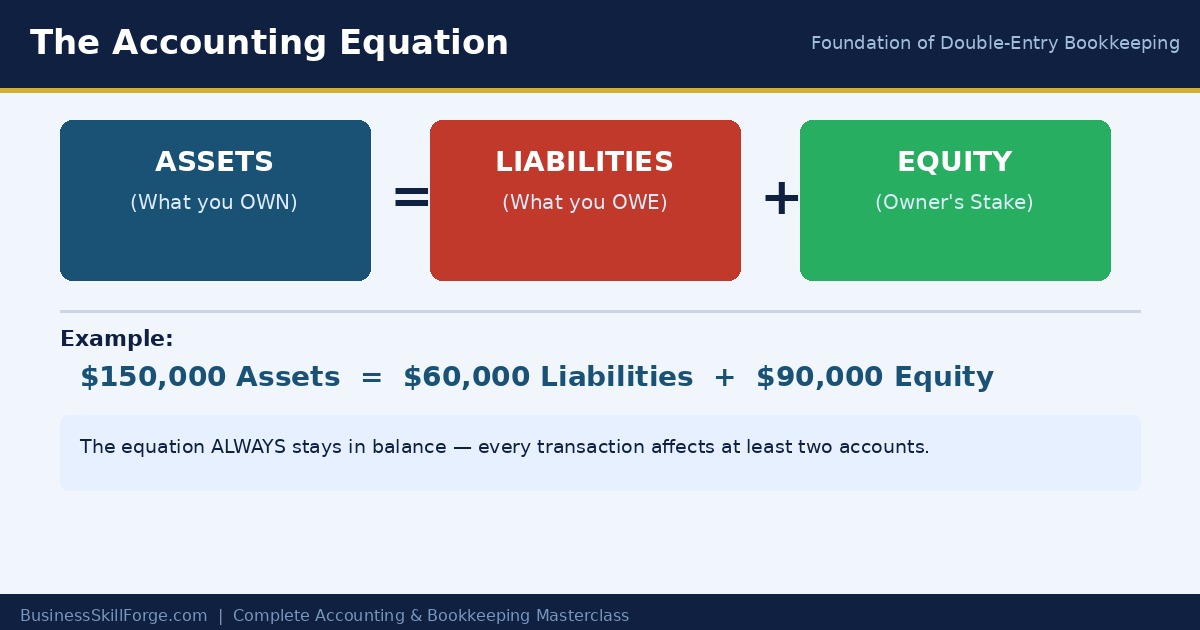
What Is the Accounting Equation?
The accounting equation is the bedrock of all bookkeeping and financial accounting. It states:
Assets = Liabilities + Owner’s Equity
Every single financial transaction that a business records must keep this equation in balance. If it ever goes out of balance, you know a mistake has been made somewhere. Think of it as the ultimate error-check in accounting.
Breaking Down Each Component
Assets — What the Business Owns
Assets are everything of value that the business owns or controls. They can be physical things you can touch, or intangible items like patents.
- Current assets — Cash, accounts receivable, inventory (expected to be used within one year)
- Non-current assets — Buildings, equipment, vehicles, long-term investments
Example: A bakery’s assets include its oven ($8,000), cash in the register ($2,000), and flour inventory ($500).
Liabilities — What the Business Owes
Liabilities are the business’s financial obligations — money it owes to other parties.
- Current liabilities — Accounts payable, short-term loans, credit card balances (due within one year)
- Non-current liabilities — Mortgages, long-term bank loans, bonds payable
Example: The bakery financed its oven with a $5,000 bank loan — that’s a liability.
Owner’s Equity — The Owner’s Stake
Equity is what’s left over for the owner after all debts are paid. It represents the owner’s claim on the business’s assets.
Equity = Assets − Liabilities
Equity increases when the business earns profit or the owner invests more money. It decreases when the business makes a loss or the owner withdraws funds (drawings).
Why the Equation Always Stays in Balance
The magic of the accounting equation is that it always balances, no matter what transaction occurs. This is because of the double-entry bookkeeping principle — every transaction has at least two effects that keep the equation balanced.
Let’s walk through three examples:
| Transaction | Assets | Liabilities | Equity |
|---|---|---|---|
| Starting position | $0 | $0 | $0 |
| Owner invests $10,000 cash | +$10,000 | — | +$10,000 |
| Balance | $10,000 | $0 | $10,000 |
| Borrow $5,000 from bank | +$5,000 | +$5,000 | — |
| Balance | $15,000 | $5,000 | $10,000 |
| Buy equipment for $3,000 cash | +$3,000 / −$3,000 | — | — |
| Balance | $15,000 | $5,000 | $10,000 |
Notice that in every single case, Assets ($15,000) = Liabilities ($5,000) + Equity ($10,000). The equation never breaks.
The Expanded Accounting Equation
As you advance, you’ll encounter the expanded form, which breaks equity into its components:
Assets = Liabilities + Owner’s Capital + Revenue − Expenses − Drawings
This expanded form shows exactly what drives changes in equity:
- Capital invested by the owner increases equity
- Revenue earned increases equity
- Expenses incurred decrease equity
- Drawings (money taken out by owner) decrease equity
The Accounting Equation in Financial Statements
The accounting equation is directly visible in the Balance Sheet — one of the four core financial statements. The left side of the balance sheet lists all assets, and the right side lists all liabilities and equity. Both sides must always be equal.
Key Takeaways
- The accounting equation (Assets = Liabilities + Equity) is the foundation of all accounting
- Every transaction affects at least two parts of the equation — keeping it balanced
- Assets are what you own; liabilities are what you owe; equity is what belongs to the owner
- The equation never breaks — if it does, an error has been made
- The expanded equation shows how revenue, expenses, and drawings flow into equity
Accounting Equation Practice Worksheet — Download, print, and complete to reinforce this lesson.
Multi-sheet workbook · pre-built formulas · plug in your own numbers · yours to keep.
Disclaimer. This lesson is educational. The worked example uses representative numbers and does not constitute personalized financial, tax, legal, or investment advice. Trading and investing involve risk including loss of principal. US tax rates change annually — verify against the current IRS publications and your specific state’s tax code. See our Financial Disclaimer for the full statement.
The Rules Behind the Numbers matters because it’s a core skill every US bookkeeper and accountant relies on to keep the books accurate and decision-ready. This lesson covers the mechanics, a clear worked example, and the common mistakes that trip up beginners.
Apply the concepts of the rules behind the numbers to a real US-market scenario, using the downloadable template attached.
Accounting Principles: The Rules That Keep Financial Reports Trustworthy
Accounting principles are the foundational guidelines that ensure financial statements are prepared consistently, honestly, and comparably across different businesses and time periods. Without agreed-upon principles, every company could present its numbers however it liked — making comparison impossible and investors powerless.
Generally Accepted Accounting Principles (GAAP)
In the United States and many other countries, GAAP sets the standard for financial reporting. US GAAP is maintained by the Financial Accounting Standards Board (FASB) and codified in the FASB Accounting Standards Codification (ASC). It differs from IFRS in several material areas — most notably LIFO (allowed under US GAAP, banned under IFRS), impairment reversals, and R&D capitalization.
The Key Principles Every Accountant Follows
1. Revenue Recognition Principle
Revenue is recorded when it is earned, not when cash is received. A business that completes a project in March records the revenue in March — even if the client pays in May.
2. Matching Principle
Expenses are matched to the revenue they help generate, in the same accounting period. If a salesperson earns a commission in December on a sale made in December, the commission expense belongs in December — not January when it is paid.
3. Cost Principle (Historical Cost)
Assets are recorded at their original purchase cost, not their current market value (with exceptions for investments and some financial instruments). This provides objectivity and verifiability.
4. Full Disclosure Principle
Financial statements must include all information that would influence the decisions of a reasonable reader — either in the numbers themselves or in the footnotes. Hidden liabilities or undisclosed risks violate this principle.
5. Materiality Principle
Only information significant enough to influence a decision needs to follow strict accounting treatment. A $500 stapler may technically be an asset, but expensing it immediately is acceptable because the distortion is immaterial.
6. Conservatism (Prudence) Principle
When uncertain, choose the treatment that results in lower reported profit or asset values. Anticipate losses; do not anticipate gains. This prevents overstating financial health.
7. Consistency Principle
Once an accounting method is chosen (e.g., straight-line depreciation), it should be applied consistently from period to period. Changes are allowed but must be disclosed and justified.
8. Going-Concern Principle
Unless there is evidence of imminent closure, the business is assumed to continue indefinitely. This justifies spreading asset costs over their useful lives rather than writing them off immediately.
Practical Example: Matching Principle in Action
A company pre-pays $120,000 for a 12-month insurance policy starting 1 April. Under the matching principle, $10,000 is expensed each month, not the full $120,000 in April. The remaining pre-paid portion is an asset on the balance sheet.
Lesson Summary
- Accounting principles ensure consistency, honesty, and comparability in financial reporting.
- Key principles: revenue recognition, matching, historical cost, full disclosure, materiality, conservatism, consistency, going-concern.
- Violating these principles misleads stakeholders and can have legal consequences.
The 10 Core Accounting Principles — With Real Examples
| Principle | What It Means | Real-World Example |
|---|---|---|
| 1. Revenue Recognition | Record revenue when earned, not when cash arrives | A law firm completes a $5,000 case in Dec but invoices in Jan → record in Dec |
| 2. Matching Principle | Expenses match the revenue they helped generate | Sales commissions for Dec sales are expensed in Dec, even if paid in Jan |
| 3. Historical Cost | Assets recorded at purchase price, not current market value | Land bought for $100K stays on books at $100K even if now worth $200K |
| 4. Full Disclosure | Disclose anything that affects a user’s financial decision | Pending lawsuit disclosed in footnotes even if outcome uncertain |
| 5. Going Concern | Assume business continues operating indefinitely | Depreciate equipment over 10 years because you expect to use it |
| 6. Consistency | Use the same methods period after period | Use FIFO every year, not FIFO one year and LIFO the next |
| 7. Materiality | Only strict compliance needed for items that matter | A $5 stapler can be expensed immediately; a $500,000 machine must be capitalized |
| 8. Conservatism | When uncertain, choose the more cautious option | Recognize potential losses immediately but wait for revenue until it’s certain |
| 9. Objectivity | Records based on verifiable evidence | Use purchase invoice as basis for asset entry, not the CEO’s opinion of value |
| 10. Time Period | Divide economic activity into specific reporting periods | Monthly P&L, quarterly earnings, annual tax return |
Accrual vs. Cash Basis — The Biggest Decision in Accounting
How a business recognizes revenue and expenses determines when transactions appear in financial statements.
| Scenario | Cash Basis | Accrual Basis |
|---|---|---|
| Dec: Complete $8,000 project; invoice sent; payment due Jan 15 | Record $0 revenue in Dec | Record $8,000 revenue in Dec |
| Dec: Receive $3,000 deposit for Jan work | Record $3,000 revenue in Dec | Record $0 revenue in Dec (it’s a liability: deferred revenue) |
| Dec: Pay Jan rent of $2,000 in advance | Record $2,000 expense in Dec | Record $0 expense in Dec (prepaid asset, expense in Jan) |
| Dec: Employees earn $5,000, paid Jan 3 | Record $0 expense in Dec | Record $5,000 salaries payable in Dec |
The IRS generally requires accrual accounting once a business’s average annual gross receipts for the prior three years exceed $32M (the 2026 inflation-adjusted threshold under IRC §448(c)). Smaller businesses — including most that carry inventory — can choose cash or accrual. Accrual gives a more accurate picture of financial health; cash basis is simpler. Almost all meaningful financial analysis uses accrual-basis statements.
Accounting Principles Practice Worksheet — Download, print, and complete to reinforce this lesson.
Multi-sheet workbook · pre-built formulas · plug in your own numbers · yours to keep.
Disclaimer. This lesson is educational. The worked example uses representative numbers and does not constitute personalized financial, tax, legal, or investment advice. Trading and investing involve risk including loss of principal. US tax rates change annually — verify against the current IRS publications and your specific state’s tax code. See our Financial Disclaimer for the full statement.
Keep exploring