SaaS Metrics: MRR, ARR, Churn and Net Revenue Retention
November 7, 2026 · Aditya Gupta

The core SaaS metrics are MRR, ARR, churn and net revenue retention. MRR (monthly recurring revenue) is the subscription revenue you can expect every month, ARR is that figure times twelve, churn measures the customers or revenue you lose, and net revenue retention shows whether your existing customers are growing or shrinking as a group.
Those four numbers answer different questions. MRR tells you the size of the business today. Churn tells you how leaky it is. Net revenue retention tells you whether the customers you already have are a growth engine or a drag. This guide works through each one with a single example company so you can see how they connect, and where people get them wrong.
What MRR and ARR actually measure
Monthly recurring revenue (MRR) is the normalized monthly value of all active subscriptions. It’s a run rate, not an accounting figure. It isn’t revenue under GAAP or IFRS and it isn’t cash. A customer who pays $1,200 up front for an annual plan adds $1,200 to your bank balance, $100 to recognized revenue each month, and $100 to MRR.
Annual recurring revenue (ARR) is MRR multiplied by 12. Some companies with mostly annual contracts calculate ARR directly from contract values instead, which gives the same answer when contracts are clean. ARR is the number investors and buyers tend to quote, because SaaS businesses are often valued as a multiple of it. MRR is the number operators watch, because it moves fast enough to show you what happened this month.
Neither one is defined by an accounting standard, so every company sets its own rules. That’s fine for internal use, as long as the rules are written down and applied the same way every month. Public companies face a higher bar: the SEC’s 2020 guidance on key performance metrics says it would generally expect a clear definition of a metric and how it’s calculated, plus an explanation of why it’s useful and how management uses it. A small company can borrow that discipline for free.
Our glossary has a short definition of MRR if you need one to share with your team.
How to calculate MRR, step by step
The simple version is: add up the monthly value of every active, paying subscription. For a business with 400 customers each paying $50 a month, MRR is $20,000.
The useful version breaks the month into movements, so you can see why MRR changed. Take a two-founder invoicing app that starts March with 400 customers and $20,000 of MRR. During March:
- 50 new customers sign up at $50 a month: new MRR of $2,500.
- Existing customers upgrade to higher plans or add seats worth $500 a month: expansion MRR.
- A few customers downgrade, removing $150 a month: contraction MRR.
- 8 customers cancel, taking $400 a month with them: churned MRR.
| MRR movement | Amount | Running total |
|---|---|---|
| Starting MRR (March 1) | $20,000 | $20,000 |
| + New MRR | $2,500 | $22,500 |
| + Expansion MRR | $500 | $23,000 |
| − Contraction MRR | $150 | $22,850 |
| − Churned MRR | $400 | $22,450 |
| Ending MRR (March 31) | $22,450 |
Net new MRR for the month is $2,450, which is 12.25% growth on the starting figure. The customer count went from 400 to 442 (400 + 50 − 8).
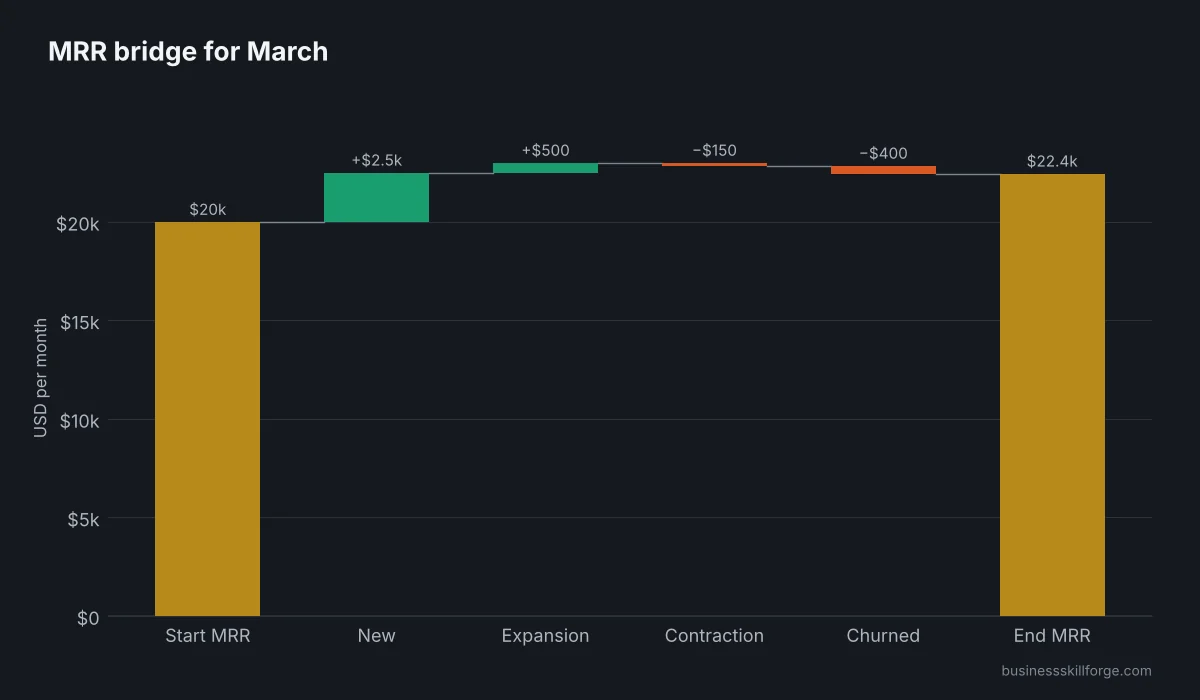
Build this as a monthly bridge in a spreadsheet and keep the history. A single MRR figure tells you very little. A bridge tells you whether growth came from new sales, from existing customers buying more, or was held back by cancellations.
What counts in MRR and what doesn’t
Most arguments about MRR come down to a handful of edge cases. A sensible default set of rules:
- Annual and quarterly plans: divide the contract value by the number of months. A $3,000 annual plan is $250 of MRR.
- Discounts: use the price the customer actually pays. If someone is on 30% off for six months, their MRR is the discounted amount until the discount ends.
- Free trials and free plans: zero. They count once the first paid period starts.
- One-off fees (setup, onboarding, training): exclude them. They’re revenue, not recurring revenue.
- Usage-based charges: either exclude them or report them as a separate line. Mixing a volatile usage component into MRR makes the trend hard to read.
- Taxes: exclude sales tax and VAT. You collect them for the government; they’re not yours.
- Reactivations: a former customer who comes back is usually tracked as reactivation MRR, not new MRR, so your new-customer numbers stay honest.
How to calculate ARR, and when to avoid the label
The invoicing app ends March with $22,450 of MRR, so its ARR is $22,450 × 12 = $269,400. You can run the arithmetic both ways with our monthly to annual revenue converter.
ARR is a snapshot projected forward. It assumes nothing changes for twelve months, which never happens, so treat it as a measure of current scale rather than a forecast. It’s most meaningful when the business really does sell annual contracts. For a company selling month-to-month plans, MRR is the more honest headline number.
Don’t call total revenue “ARR” if a large part of it is one-off projects, consulting or hardware. A business with $269,400 of subscription run rate and $150,000 of implementation fees has $269,400 of ARR, not $419,400.
Customer churn vs revenue churn
“Churn” gets used for two different numbers, and they can tell very different stories.
Customer churn rate is the share of customers at the start of a period who cancel during it. For the invoicing app: 8 cancellations ÷ 400 starting customers = 2.0% monthly customer churn. New customers who join during the month stay out of the denominator, because they weren’t there at the start.
Gross revenue churn is the MRR lost to cancellations and downgrades, divided by starting MRR. Here: ($400 + $150) ÷ $20,000 = 2.75%. It’s higher than customer churn because some of the loss came from downgrades, which don’t show up in a customer count at all.
Net revenue churn subtracts expansion from those losses. ($400 + $150 − $500) ÷ $20,000 = 0.25%. When expansion is bigger than churn and contraction combined, net revenue churn goes negative, which is the outcome SaaS founders talk about as “negative churn.”
| Metric | Formula | Invoicing app, March |
|---|---|---|
| Customer churn | Customers lost ÷ starting customers | 8 ÷ 400 = 2.0% |
| Gross revenue churn | (Churned + contraction MRR) ÷ starting MRR | $550 ÷ $20,000 = 2.75% |
| Net revenue churn | (Churned + contraction − expansion) ÷ starting MRR | $50 ÷ $20,000 = 0.25% |
| Monthly net revenue retention | (Start + expansion − contraction − churned) ÷ start | $19,950 ÷ $20,000 = 99.75% |
Customer churn matters most when customers are roughly the same size. Revenue churn matters more when they aren’t: losing three small accounts and keeping one large one that doubled its seats can look bad on a customer count and fine on revenue. Track both. The churn rate glossary entry has the short definitions.
Voluntary vs involuntary churn
Split cancellations into those where the customer chose to leave and those where a card failed and nobody fixed it. Involuntary churn is often a billing problem rather than a product problem. Card retry schedules, expiry reminders and a simple “update your card” email can win some of it back, and it’s usually the cheapest churn to reduce.
Why monthly churn doesn’t multiply by 12
A common mistake is to turn a monthly churn rate into an annual one by multiplying by 12. Churn compounds, because each month you’re losing a percentage of a smaller group. The correct conversion is:
Annual churn = 1 − (1 − monthly churn)^12
At 2% monthly churn, you keep 98% each month, so after twelve months you keep 0.98^12 = 78.5% of the starting customers. Annual churn is 21.5%, not 24%. The gap grows quickly at higher rates.
| Monthly churn | Monthly × 12 (wrong) | Compounded annual churn | Rough average lifetime |
|---|---|---|---|
| 1% | 12% | 11.4% | 100 months |
| 2% | 24% | 21.5% | 50 months |
| 3% | 36% | 30.6% | 33 months |
| 5% | 60% | 46.0% | 20 months |
| 7% | 84% | 58.1% | 14 months |

The last column uses the shortcut average lifetime ≈ 1 ÷ monthly churn. At 2% churn, the average customer stays about 50 months. At $50 a month, that’s roughly $2,500 of lifetime revenue before costs, which is the starting point for the lifetime value calculations in our guide to customer acquisition cost and lifetime value. The shortcut assumes churn stays constant, which it rarely does: new customers usually churn faster than customers who have been around for two years.
Net revenue retention and gross revenue retention
Net revenue retention (NRR) is the recurring revenue you keep from an existing group of customers over a period, including upgrades, as a percentage of what they paid at the start. It ignores new customers completely. That’s the point: it isolates how your installed base behaves.
NRR is usually measured over twelve months on a cohort. Say the invoicing app takes all customers active on January 1, who were paying $20,000 of MRR between them. Twelve months later, the same group of customers (excluding anyone who joined during the year) looks like this:
- Cancellations removed $3,600 of MRR.
- Downgrades removed $400.
- Upgrades and added seats contributed $5,600.
Their MRR is now $20,000 − $3,600 − $400 + $5,600 = $21,600. NRR is $21,600 ÷ $20,000 = 108%. The company would have grown 8% this year even if it had signed no new customers at all.

Gross revenue retention (GRR) is the same calculation with expansion left out. Here: ($20,000 − $3,600 − $400) ÷ $20,000 = 80%. GRR can never exceed 100%. It tells you how much of the base you keep before upselling covers the holes.
Read the two together. An NRR of 108% with a GRR of 80% means a fifth of the revenue base walks out each year and a smaller group of happy customers grows enough to cover it. That works, but it depends on continued expansion from a shrinking set of accounts. An NRR of 104% with GRR of 95% is a calmer business, even though its headline NRR is lower.
Common mistakes that inflate SaaS metrics
- Counting committed but unstarted contracts as MRR. A deal signed for a start date three months out is pipeline or bookings, not MRR.
- Counting annual payments as a month of MRR. A $1,200 annual payment is $100 of MRR. Booking it as $1,200 in the month it’s paid makes that month look spectacular and every other month look like churn.
- Leaving past-due accounts in MRR indefinitely. Set a rule, such as removing an account after a fixed number of days of failed payment, and stick to it.
- Measuring churn against ending customers. Using the end-of-month count (which includes new sign-ups) as the denominator shrinks the churn rate. Use the starting count.
- Calculating NRR with new customers mixed in. If January’s new customers are included in December’s numbers, NRR stops measuring retention and starts measuring sales.
- Quoting a blended churn rate that hides segments. Monthly-plan customers and annual-plan customers often churn at very different rates. Report them separately before you report a blend.
- Treating MRR as cash. MRR says nothing about when you get paid. A business with strong MRR and slow-paying invoiced customers can still run short of cash, which is the gap covered in cash flow vs profit.

How MRR connects to your accounting
MRR lives in your billing system. Revenue lives in your general ledger. They should be reconcilable, but they won’t match line for line.
The main differences are timing and scope. When the invoicing app sells a $1,200 annual plan, its books record $1,200 of cash and $1,200 of deferred revenue, a liability, then recognize $100 of revenue each month as the service is delivered. MRR shows $100 from day one. Recognized revenue will also include one-off fees that MRR excludes, and may be affected by refunds and credits that your MRR rules treat differently.
A monthly reconciliation keeps both numbers honest: start with recognized subscription revenue from the ledger, adjust for the known timing items, and check that you land close to MRR. A large unexplained gap usually means the billing data has stale accounts, duplicate subscriptions or plan changes that were never recorded.
What to do next
- Write down your definitions. One page: what counts as MRR, when an account is churned, how annual plans and discounts are treated, and which customers are in the NRR cohort.
- Build the monthly MRR bridge (starting, new, expansion, contraction, churned, reactivation, ending) and backfill it for as many months as your billing data allows.
- Report customer churn and revenue churn side by side, split by plan type or customer size if you have more than one segment.
- Measure NRR and GRR once a quarter on a trailing twelve-month cohort.
- Connect churn to unit economics. Retention drives lifetime value, which decides how much you can afford to spend acquiring a customer. Our unit economics glossary entry is a good place to start.
Key takeaways
- MRR is the normalized monthly value of active paid subscriptions, and ARR is MRR times 12; neither is revenue or cash.
- Break MRR into new, expansion, contraction and churned movements every month so you can see where growth comes from.
- Customer churn and revenue churn can differ sharply, so track both and always divide by the starting figure.
- Convert monthly churn to annual churn with 1 − (1 − monthly rate)^12, not by multiplying by 12.
- Net revenue retention above 100% means existing customers grow faster than they leave; read it next to gross revenue retention.
- Write your metric definitions down and apply them consistently, because no accounting standard sets them for you.
Frequently asked questions
What is the difference between MRR and revenue?
MRR is a run rate of active subscriptions, normalized to one month. Revenue is what your accounting records recognize as earned in a period. They differ because MRR excludes one-off fees, spreads annual plans evenly from day one and ignores accounting adjustments, while recognized revenue follows the accounting rules. A healthy business can reconcile the two each month, with the differences explained by timing and scope.
How do you calculate monthly churn rate?
Divide the number of customers who cancelled during the month by the number of customers you had at the start of the month. If you started with 400 customers and 8 cancelled, customer churn is 8 ÷ 400 = 2%. For revenue churn, divide the MRR lost to cancellations and downgrades by starting MRR. Don’t include customers who joined during the month in the denominator.
What does net revenue retention over 100% mean?
It means a group of existing customers is paying you more at the end of the period than at the start, after accounting for everyone who cancelled or downgraded. Upgrades and added seats have more than covered the losses. An NRR of 108% means that cohort grew 8% with no new customers. Check gross revenue retention alongside it to see how much churn the expansion is covering.
Should annual contracts be counted as MRR?
Yes, but spread evenly. Divide the annual contract value by 12, so a $3,000 annual plan contributes $250 of MRR each month. Don’t add the full payment to MRR in the month you receive it. The cash arrives up front and sits in deferred revenue on the balance sheet, but the recurring value of the contract is the monthly equivalent.
Is ARR just MRR times 12?
For most small subscription businesses, yes. ARR is the annualized value of current recurring subscriptions, so MRR of $22,450 means ARR of $269,400. Companies selling multi-year or annual contracts sometimes calculate ARR from contract values directly. Either way, it excludes one-off fees and is a snapshot of current scale, not a forecast of next year’s revenue.
Sources
This article is general education, not tax, legal, accounting or investment advice. Rules and thresholds differ by country and change over time, so check the specifics for your situation. See our financial disclaimer.
Get practical finance & accounting tips in your inbox
Join US professionals getting our best guides, templates and tools. Free. Unsubscribe anytime.