Small Business Financing Options: Loans, Credit Lines, Equity
November 8, 2026 · Aditya Gupta

Small business financing comes in two basic forms: debt, which you repay with interest, and equity, which you pay for by giving up a share of ownership. Within debt, the main options are term loans, lines of credit, government-backed loans, equipment finance and invoice finance. The right choice depends mostly on what the money is for and how quickly it will pay for itself.
Debt vs equity: the basic trade-off
Debt financing means borrowing money and paying it back, with interest, on a schedule. The lender doesn’t own any of your business, and once the debt is repaid the relationship ends. But the payments are due whether you have a good month or a bad one.
Equity financing means selling part of your business to an investor. There are no monthly payments, and if the business fails the investor usually loses their money rather than coming after you. In exchange, they own a slice of every future dollar of profit and of the business’s value if you ever sell.
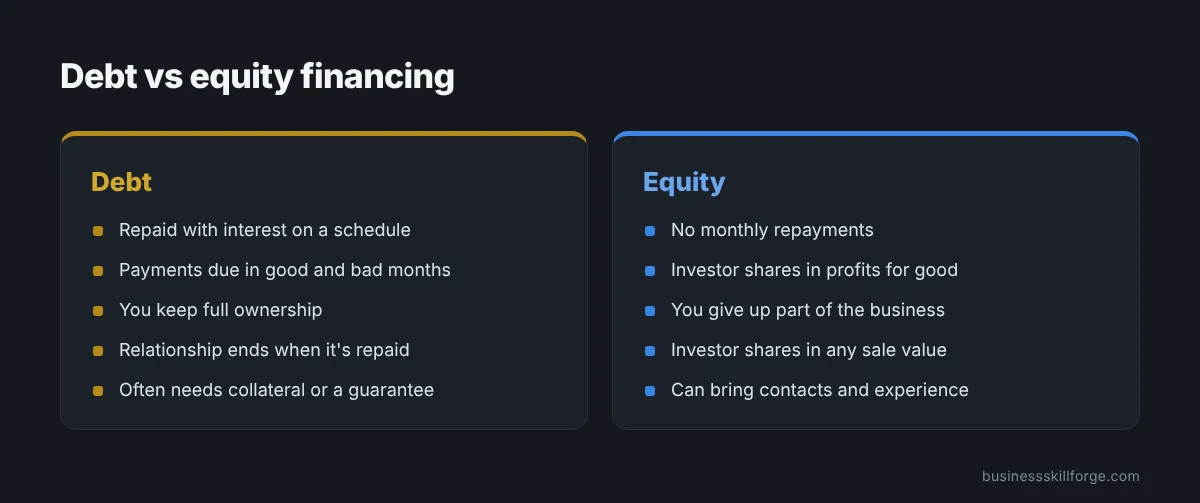
For most small businesses with steady revenue, debt is cheaper over time. Equity makes sense when a business is unproven, growing fast and can’t support regular repayments, or when the investor brings something besides money, such as industry contacts or experience.
The main small business financing options compared
| Option | How it works | Best for | Watch out for |
|---|---|---|---|
| Term loan | A lump sum repaid in fixed installments over a set number of years | Expansion, buying a business, large one-off projects | Fixed payments regardless of how trading goes; often a personal guarantee |
| Line of credit | A limit you draw from and repay as needed; interest only on what you’ve drawn | Seasonal gaps, timing differences, short-term working capital | Annual renewal; lender can reduce or cancel the limit |
| Government-backed loan | A bank loan partly guaranteed by a government program | Businesses that don’t quite meet a bank’s normal criteria | More paperwork and a longer approval process |
| Equipment finance | A loan or lease secured on the equipment itself | Vehicles, machinery, kitchen equipment, technology | Total cost over the term; terms that outlast the equipment’s useful life |
| Invoice finance or factoring | Advance against unpaid customer invoices | B2B businesses waiting on slow-paying customers | High effective annual cost; some arrangements involve the lender contacting your customers |
| Merchant cash advance | Lump sum repaid as a share of daily card sales | Rarely the best choice; fast cash when other options are closed | Very high effective cost hidden behind a “factor rate” |
| Business credit card | Revolving credit for day-to-day purchases | Small purchases paid off in full each month | Expensive if balances are carried |
| Equity investment | Cash in exchange for a share of ownership | High-growth businesses that can’t yet support repayments | Permanent loss of ownership and some control |
Match the financing to what it pays for
The single most useful rule in business financing: match the length of the financing to the life of what you’re buying.
- Short-term needs, like stocking up before a busy season or covering wages while waiting on customer payments, belong on a line of credit or invoice finance. The money comes back within weeks or months, and so should the borrowing.
- Long-lived assets, like an oven, a van or a building, belong on a term loan or equipment finance with a term no longer than the asset’s useful life.
- Uncertain, long-horizon bets, like building a product that won’t earn revenue for two years, are where equity fits.
Getting this wrong is one of the most common ways small businesses get into trouble. Buy a $60,000 van on a line of credit meant for seasonal stock, and the credit line is maxed out when you actually need it. Fund a three-month stock build with a five-year loan, and you keep paying interest long after the stock has sold.
Worked examples: what each option really costs
A term loan vs an investor
A wholesale bakery that supplies cafés needs $100,000 for a second deck oven and a delivery van. It expects the expansion to lift annual profit to about $150,000. It has two offers.
- Option A: a five-year term loan. To keep the arithmetic simple, assume a 10% annual interest rate (an illustrative figure, not a quote; rates vary by lender, borrower and market). The monthly payment is $2,124.70, and total interest over five years is $27,482.
- Option B: an investor puts in $100,000 for 20% of the business. No repayments. The investor receives 20% of profits, about $30,000 a year if the business distributes them.
| Year | Cumulative loan interest | Cumulative investor share of profit |
|---|---|---|
| 1 | $9,270 | $30,000 |
| 2 | $16,840 | $60,000 |
| 3 | $22,534 | $90,000 |
| 4 | $26,153 | $120,000 |
| 5 | $27,482 | $150,000 |
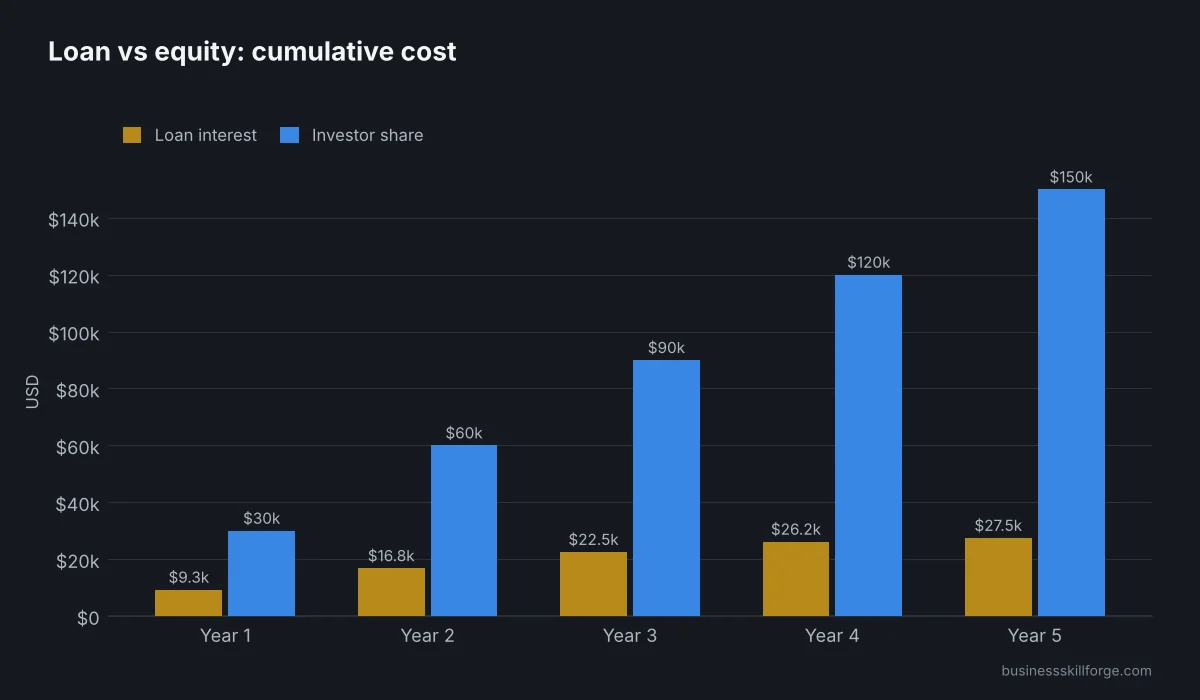
After five years the loan is gone and cost $27,482 in interest. The investor has received $150,000 and still owns 20%. If the owner sells the bakery for $1 million in year eight, another $200,000 goes to the investor. That gap is why debt is usually cheaper for a business with predictable cash flow.
The loan does carry a different kind of cost: $2,124.70 has to leave the bank account every month. In a bad quarter, the loan payment still falls due; the investor simply gets a smaller share. If the bakery’s cash flow can’t comfortably handle the payment, the cheaper option is also the riskier one. You can see how each payment splits between interest and principal in our guide to building a loan amortization schedule in Excel.
A line of credit for a timing gap
A line of credit is the right tool when cash goes out before it comes back in. Say a garden center needs $30,000 in February to stock up for spring, and it sells through that stock by June. It draws $30,000, then repays it from spring sales. Interest is charged only on the balance drawn, for the time it’s drawn. At an illustrative 12% a year, four months on $30,000 costs about $1,200. Once it’s repaid, the full limit is available again for next year.
The catch: lines of credit are usually reviewed every year, and the lender can reduce or withdraw the limit, often at exactly the moment business is weak. Don’t use one to fund permanent needs, and arrange it before you need it. Banks are much happier to lend to a business that doesn’t urgently need the money.
Government-backed loans
Several governments run programs that make it easier for banks to lend to small businesses by sharing the risk.
- US: The Small Business Administration does not make most loans itself. Its main program, the 7(a) loan, guarantees loans made by participating lenders and can be used for working capital, equipment, real estate and refinancing. 504 loans finance major fixed assets such as buildings and long-life equipment, and can’t be used for working capital or inventory. SBA microloans of up to $50,000 are made through nonprofit intermediary lenders.
- Canada: Under the Canada Small Business Financing Program, banks, credit unions and caisses populaires make the loans and the government shares in eligible losses if a loan defaults.
- UK: The British Business Bank’s Start Up Loans are government-backed, unsecured personal loans for people starting or growing a business, and come with free mentoring.
- Australia and elsewhere: Check your government’s business support site, as programs change often.
Program limits and terms change, so confirm the current details with the program or a participating lender before you plan around them.
Invoice finance and merchant cash advances: know the real cost
These products are quick to arrange and often marketed with fees that sound small. Convert them to an annual figure before you sign. That’s what the APR on a bank loan already does for you.
Invoice factoring example. A cleaning contractor has a $20,000 invoice due in 30 days. A factor advances 85%, or $17,000, and charges a 3% fee of $600 (illustrative figures). The cost is $600 for 30 days’ use of $17,000. Annualized, that’s $600 ÷ $17,000 × 365 ÷ 30 = about 43%.
Merchant cash advance example. A restaurant takes a $50,000 advance with a “factor rate” of 1.3, so it repays $65,000 through a share of its daily card sales. If that takes about eight months, the $15,000 cost works out to an APR-equivalent of roughly 75%. Because the cost is fixed, paying back faster in a busy season makes the annual cost even higher, not lower.
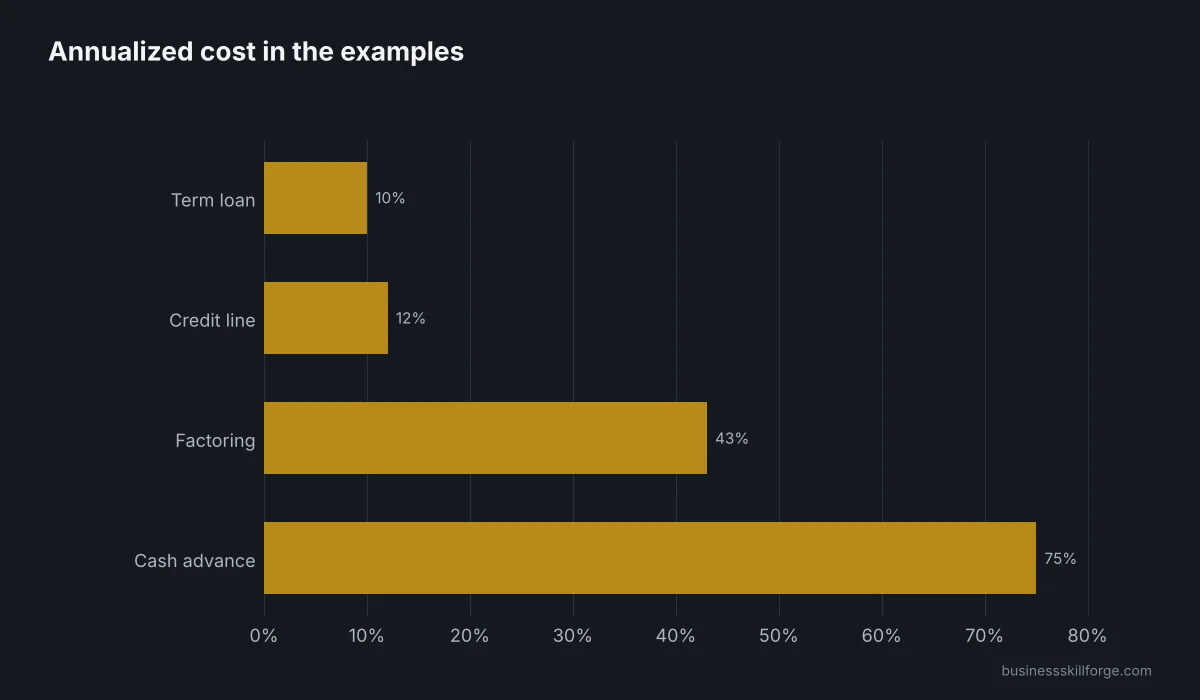
Neither product is automatically wrong. Factoring can make sense for a fast-growing B2B business whose customers pay slowly. But compare it with the cost of fixing the underlying problem, which is often how quickly you invoice and chase payment.
What lenders look at
Lenders mainly want to know whether you can make the payments. Expect them to ask about:
- Cash flow. Many lenders use a debt service coverage ratio: annual cash available for debt payments divided by annual debt payments. If a business has $60,000 a year of cash available for debt payments and carries a loan like the bakery’s, costing $25,496 a year, coverage is about 2.4 times.
- Financial statements. Usually two to three years of accounts, recent management accounts and a forecast.
- Credit history, both the business’s and often the owner’s.
- Time in business. Many banks prefer at least a couple of years of trading history.
- Collateral and guarantees. Assets the lender can claim if you default, and often a personal guarantee from the owner.
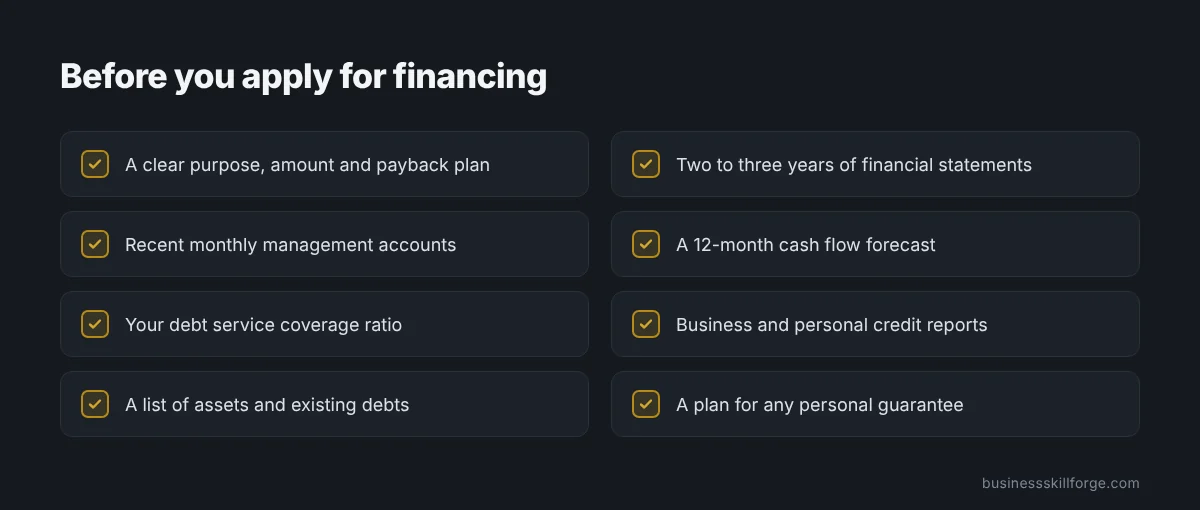
Read a personal guarantee carefully. It means that if the business can’t repay, the lender can pursue you personally, which can put your home and savings at risk even if your business is a limited company or LLC.
Common financing mistakes
- Comparing offers by monthly payment. A longer term lowers the payment and raises the total cost. Compare total cost and APR.
- Borrowing to cover ongoing losses. If the business loses money every month, a loan delays the problem and adds interest to it. Fix the cause first.
- Giving up equity too early. Selling 20% when the business is worth little is far more expensive than selling 10% once it has a track record.
- Ignoring covenants. Loan agreements often require you to keep certain ratios or limit other borrowing. Breaking a covenant can let the lender demand repayment.
- Arranging finance at the last minute. Urgent borrowers get worse terms and fewer options.
What to do next
Write down exactly what the money is for, how much you need and when it will pay for itself. That points you to the right product. Then get your last two years of accounts and a 12-month cash forecast in order, check your personal and business credit reports, and approach two or three lenders, including your own bank and a lender that participates in a government-backed program. Our loan eligibility calculator gives you a rough sense of what you could borrow, and our guide to managing working capital can reduce how much you need to borrow in the first place.
Key takeaways
- Small business financing is either debt, which you repay with interest, or equity, which you pay for with a permanent share of ownership.
- Match the financing term to what it pays for: credit lines for short-term gaps, term loans and equipment finance for long-lived assets.
- In the bakery example, a $100,000 loan costs $27,482 in interest over five years, while giving up 20% equity costs $150,000 of profit over the same period and a share of any sale.
- Convert factoring fees and merchant cash advance factor rates into an annual figure before signing, because the effective cost is often far higher than it looks.
- Government-backed programs in the US, Canada and the UK help banks lend to smaller businesses, but terms and limits change, so check the current details.
Frequently asked questions
What is the easiest type of business financing to get?
Products secured on something specific, like equipment finance or invoice finance, are often easier to qualify for because the lender has an asset to fall back on. Business credit cards and merchant cash advances are quick too, but usually much more expensive. Ease of approval and cost tend to move in opposite directions, so compare the annual cost before you accept.
Is a line of credit better than a term loan?
They do different jobs. A line of credit suits short-term, repeating needs like seasonal stock or waiting on customer payments, and you pay interest only on what you draw. A term loan suits one-off, long-lived purchases like equipment or expansion, with fixed repayments over several years. Using one for the other’s job usually costs more or causes cash problems.
How does an SBA loan work?
In most SBA programs, you borrow from a bank or other participating lender and the Small Business Administration guarantees part of the loan, which makes the lender more willing to approve it. The 7(a) program covers uses such as working capital, equipment and real estate. You apply through a lender, not directly to the SBA.
Should I give up equity or take on debt?
If your business has steady cash flow that can comfortably cover repayments, debt is usually cheaper because the cost ends when the loan is repaid. Equity suits businesses that are early-stage, growing fast or unable to support regular payments. Remember that equity is permanent: the investor shares in profits and in any sale value for as long as they own their stake.
What do lenders look for in a small business loan application?
Lenders mainly assess whether you can repay. They look at cash flow and debt service coverage, financial statements and forecasts, your business and personal credit history, how long you’ve been trading, and what collateral or personal guarantee you can offer. A clear explanation of what the money is for and how it will be repaid strengthens any application.
Sources
- 7(a) loans, US Small Business Administration
- 504 loans, US Small Business Administration
- Microloans, US Small Business Administration
- Canada Small Business Financing Act Comprehensive Review Report 2019–2024, Innovation, Science and Economic Development Canada
- Start Up Loans, Find Business Support (Scottish Government)
This article is general education, not tax, legal, accounting or investment advice. Rules and thresholds differ by country and change over time, so check the specifics for your situation. See our financial disclaimer.
Get practical finance & accounting tips in your inbox
Join US professionals getting our best guides, templates and tools. Free. Unsubscribe anytime.