Working Capital: What It Is and How to Manage It
October 30, 2026 · Aditya Gupta

Working capital is current assets minus current liabilities: the cash, receivables and inventory you have against the bills due within a year. Managing working capital means controlling how long cash sits in inventory and unpaid invoices versus how long you take to pay suppliers. Shortening that gap by a few days can free tens of thousands of dollars without any new sales.
This guide shows how to calculate working capital and its key ratios, uses one small distributor’s numbers to measure its cash conversion cycle, then puts a dollar figure on each lever you can pull. It also covers why fast-growing, profitable businesses so often run out of cash.
What working capital is and how to calculate it
Working capital is the money tied up in running the business day to day. The formula is simple:
Working capital = current assets − current liabilities
Current assets are things you expect to turn into cash within a year: cash itself, accounts receivable (customers who owe you), inventory and prepaid expenses. Current liabilities are obligations due within a year: accounts payable (suppliers you owe), accrued expenses like wages and taxes, short-term borrowing such as a credit line, and the portion of long-term loans due in the next 12 months.
Both figures come straight off the balance sheet. If you’re not sure where to find them, our guide on how to read a balance sheet walks through each section.
Working capital example: a small distributor
Take a kitchen-supply distributor that buys from manufacturers and sells to restaurants on 30-day terms. It does $1,440,000 of annual revenue, and its cost of goods sold is $1,008,000. Here’s its balance sheet at year-end:
| Current assets | Amount | Current liabilities | Amount |
|---|---|---|---|
| Cash | $42,000 | Accounts payable | $74,000 |
| Accounts receivable | $118,000 | Accrued expenses | $18,000 |
| Inventory | $96,000 | Credit line balance | $30,000 |
| Prepaid expenses | $6,000 | Loan due within 12 months | $12,000 |
| Total | $262,000 | Total | $134,000 |
Working capital is $262,000 − $134,000 = $128,000. That looks comfortable, but notice where it sits: only $42,000 is cash. The rest is $118,000 of invoices waiting to be paid and $96,000 of stock on shelves. Working capital can be positive while the bank account is tight, which is why the composition matters as much as the total.
Working capital ratios: current ratio and quick ratio
Two ratios turn the raw number into something you can compare over time:
- The current ratio is current assets divided by current liabilities. For the distributor: $262,000 ÷ $134,000 = 1.96.
- The quick ratio leaves out inventory and prepaid expenses, because they can’t pay a bill next week. It’s (cash + receivables) ÷ current liabilities: ($42,000 + $118,000) ÷ $134,000 = 1.19.
A current ratio below 1 means current liabilities exceed current assets, so the business depends on future sales or borrowing to pay what’s already due. A quick ratio well below the current ratio, as here, tells you a large share of working capital is inventory. Neither ratio has a universal “good” level. A grocery store and a software company will look completely different, so compare against your own history and similar businesses.
The cash conversion cycle: where working capital gets stuck
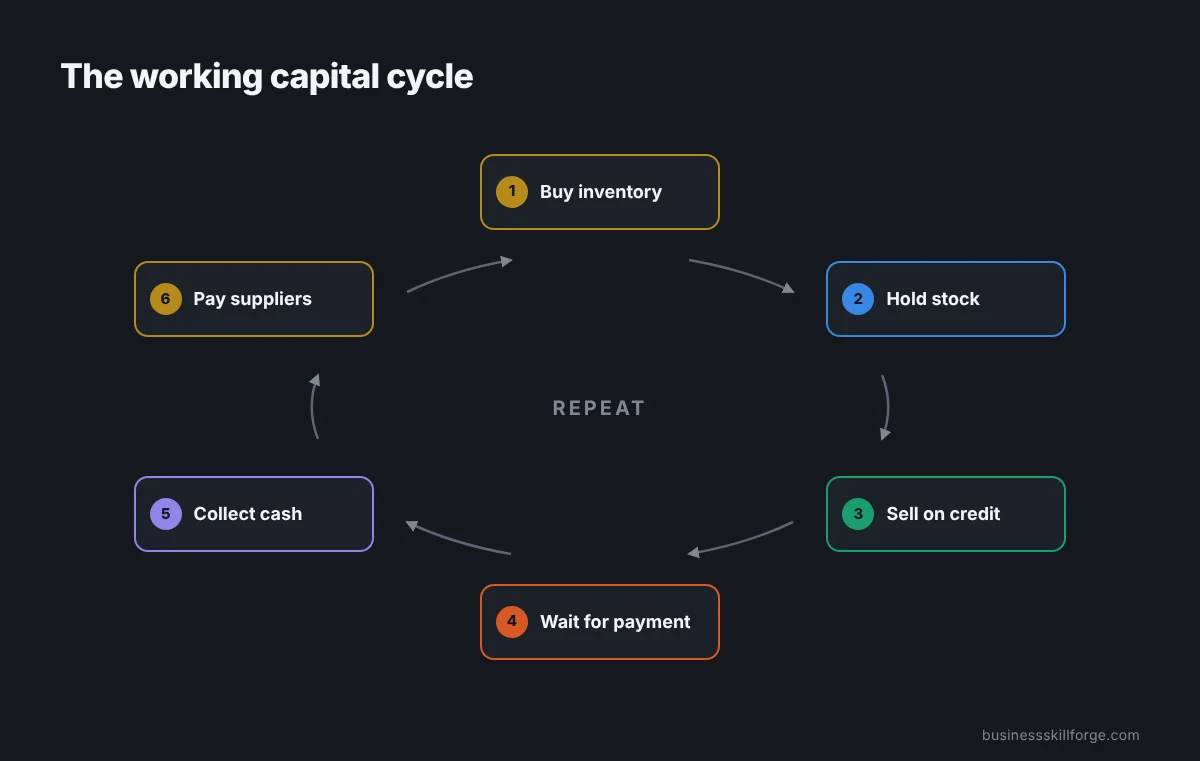
Ratios are a snapshot. The cash conversion cycle shows how long cash is tied up, in days, between paying for inventory and collecting from customers. It has three parts:
| Measure | Formula | Distributor |
|---|---|---|
| Days inventory outstanding (DIO) | Inventory ÷ COGS × 365 | $96,000 ÷ $1,008,000 × 365 = 35 days |
| Days sales outstanding (DSO) | Receivables ÷ revenue × 365 | $118,000 ÷ $1,440,000 × 365 = 30 days |
| Days payables outstanding (DPO) | Payables ÷ COGS × 365 | $74,000 ÷ $1,008,000 × 365 = 27 days |
| Cash conversion cycle | DIO + DSO − DPO | 35 + 30 − 27 = 38 days |

In plain terms: stock sits for about 35 days before it’s sold, customers take about 30 days to pay, and suppliers are paid after about 27 days. So for every sale, the distributor’s own cash is out for roughly 38 days. The longer that cycle, the more cash the business needs just to keep operating at its current size.
How to manage working capital: the three levers
Each day you take out of the cycle frees a measurable amount of cash. For the distributor, one day of sales is $1,440,000 ÷ 365 = about $3,945, and one day of cost of goods sold is $1,008,000 ÷ 365 = about $2,762.
| Lever | Change | Cash freed | Trade-off to watch |
|---|---|---|---|
| Collect faster | DSO 30 → 24 days | 6 × $3,945 ≈ $23,700 | Early-payment discounts cost margin |
| Hold less stock | DIO 35 → 28 days | 7 × $2,762 ≈ $19,300 | Stockouts lose sales |
| Pay suppliers later | DPO 27 → 35 days | 8 × $2,762 ≈ $22,100 | Lost supplier discounts or goodwill |
| Total | Cycle 38 → 17 days | ≈ $65,100 |
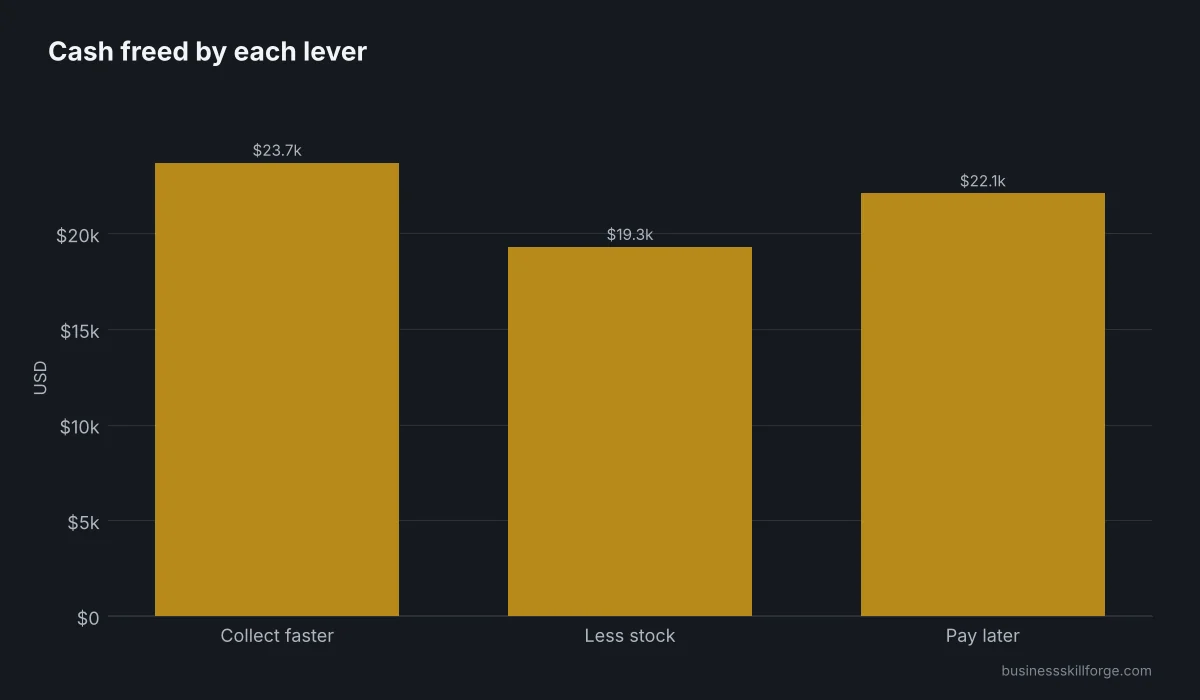
$65,100 is more than the distributor’s entire cash balance, released without selling one extra item.
Collect faster
Invoice the day the goods ship, not at month-end. Put the due date and payment link on the invoice. Chase on day 1 past due with a friendly email, not day 30. For larger accounts, ask for a deposit or progress payments. Our guide to days sales outstanding covers collection tactics in more detail.
Hold less inventory
Rank products by sales and look hard at the slow ones. A product that sells twice a year doesn’t need ten units on the shelf. Reorder more often in smaller quantities for fast movers if supplier minimums allow it, and clear dead stock even at a discount, because cash in the bank beats stock in the warehouse.
Pay suppliers on terms, not early
If a supplier gives you 30 days, pay on day 30, not day 10. Negotiating longer terms works best when you’re a reliable, growing customer. Be careful with early-payment discounts, though. Terms of “2/10, net 30” mean 2% off if you pay in 10 days instead of 30. Paying $10,000 on day 10 costs $9,800, so you’re effectively earning $200 for giving up $9,800 for 20 days. That works out to about 2% ÷ 98% × (365 ÷ 20), or roughly 37% a year. Very few uses of cash beat that, so if you can afford to pay early, take the discount and find your cash elsewhere in the cycle.
Why growing businesses run short of working capital
This catches profitable businesses off guard. If the distributor grows sales 25% and its cash conversion cycle stays at 38 days, its receivables, inventory and payables all grow by roughly 25% too.
Its net investment in those three items today is $118,000 + $96,000 − $74,000 = $140,000. At 25% higher sales, that becomes about $175,000. The business needs about $35,000 of extra cash to fund the growth, before any new hires or equipment, and that cash goes out before the extra profit comes in.
That’s how a business can be profitable on paper and still unable to make payroll. Profit shows up on the income statement; the cash is sitting in customers’ unpaid invoices and in stock. We explain the gap fully in cash flow vs profit. The practical fix is to arrange financing such as a credit line before the growth, not after the bank balance gets thin.
How much working capital is enough?
Enough to pay bills on time through your normal seasonal swings, with a buffer for a slow month or a late-paying customer. A practical test: could you cover one to two months of operating costs if collections stalled? Beyond that, extra working capital isn’t free. Idle cash earns little, and excess inventory costs storage, insurance and the risk of going obsolete.
Seasonal businesses need to plan for the peak, not the average. A garden-supply wholesaler might hold twice its normal inventory in early spring and carry its highest receivables in early summer. Its working capital need at the peak can be far above the year-end figure on the balance sheet, which is often taken at the quietest point of the year. Look at month-end balances across a full year to see the real range.
Some businesses run with negative working capital and are perfectly healthy. Restaurants are paid at the table but pay suppliers on terms. Subscription businesses often collect annual fees upfront. For them, customers fund the operation. Negative working capital is a warning sign only when it comes from overdue bills or short-term debt being used to cover losses.
Common working capital mistakes
- Watching profit, not the cycle. Profit can rise while DSO and inventory creep up and cash falls. Track the cash conversion cycle monthly.
- Funding long-term assets with short-term money. Buying a truck with the credit line drains the cushion meant for day-to-day swings.
- Counting all receivables as good. A 120-day-old invoice is a current asset on paper but may never be collected. Review the aging report.
- Forgetting lumpy liabilities. Quarterly tax payments, annual insurance premiums and year-end bonuses sit in accrued expenses or arrive as one large bill. A distributor with $42,000 in the bank and an $18,000 tax payment due next month has much less room than its working capital suggests.
- Ignoring the cost of customer terms. Offering 60-day terms to win a large account doubles the receivable days on that customer. At $20,000 a month of sales, that’s roughly another $20,000 of your cash funding their business.
- Stretching suppliers too far. Paying late damages terms and can cut off supply when you most need it.
What to do next
Pull your latest balance sheet and the last 12 months of revenue and cost of goods sold. Calculate working capital and your current ratio with our working capital calculator, then work out DIO, DSO and DPO with the formulas above. Multiply your daily sales and daily COGS by realistic improvements to see what each lever is worth to you.

If cash is already tight, a short rolling forecast will show when it gets tightest. Our guide to building a 13-week cash flow forecast covers that step by step.
Key takeaways
- Working capital is current assets minus current liabilities, but what it’s made of matters as much as the total.
- The cash conversion cycle (DIO + DSO − DPO) shows how many days your own cash is tied up in each sale.
- Multiply daily sales or daily cost of goods sold by the days saved to put a dollar value on each improvement.
- Growth consumes working capital, so profitable businesses need financing in place before sales jump.
- Negative working capital can be healthy when customers pay upfront, and dangerous when it comes from overdue bills.
Frequently asked questions
What is a good working capital ratio?
The working capital ratio, or current ratio, is current assets divided by current liabilities. Below 1 means you owe more in the next year than you hold in current assets. Higher isn’t always better, because a very high ratio can mean idle cash or excess stock. The right level depends heavily on the industry, so compare with your own history and similar businesses.
Can working capital be negative?
Yes. Negative working capital means current liabilities exceed current assets. It’s normal for businesses that collect from customers before paying suppliers, such as restaurants or subscription companies billing annually upfront. It’s a warning sign when it comes from overdue bills, maxed credit lines or short-term borrowing used to cover operating losses.
What is the difference between working capital and cash flow?
Working capital is a balance at a point in time: current assets minus current liabilities. Cash flow is movement over a period: cash in minus cash out. Changes in working capital drive cash flow. If receivables or inventory grow, cash flow falls even if profit is unchanged, because cash is now tied up in those assets.
How do you improve working capital quickly?
The fastest levers are usually collections and inventory. Invoice immediately, chase overdue accounts, and offer a payment link on every invoice. Sell off slow-moving stock and pause reorders on items with plenty on hand. Paying suppliers on their due date rather than early also helps, as long as you don’t give up valuable early-payment discounts.
Why does a growing business need more working capital?
More sales usually mean more receivables and more inventory, and both must be funded before customers pay. If the cash conversion cycle stays the same, the cash tied up rises roughly in line with sales. A business with $140,000 tied up in receivables and inventory net of payables needs about $35,000 more to grow 25%.
This article is general education, not tax, legal, accounting or investment advice. Rules and thresholds differ by country and change over time, so check the specifics for your situation. See our financial disclaimer.
Get practical finance & accounting tips in your inbox
Join US professionals getting our best guides, templates and tools. Free. Unsubscribe anytime.