Days Sales Outstanding (DSO): Formula and How to Get Paid Faster
October 31, 2026 · Aditya Gupta

Days sales outstanding (DSO) is the average number of days it takes your customers to pay you after you make a sale on credit. The formula is accounts receivable divided by credit sales, multiplied by the number of days in the period. If you invoice on 30-day terms and your DSO is 48, customers are paying you about 18 days late on average.
What days sales outstanding tells you
Every unpaid invoice is money you’ve earned but can’t spend. DSO turns your accounts receivable balance into a number of days, which is easier to track and compare than a dollar figure that moves with sales.
DSO is only relevant if you sell on credit: you deliver the work or goods and invoice for it later. A coffee shop that’s paid at the till has a DSO of roughly zero. A marketing agency, a wholesaler, a commercial cleaning firm or a freelance consultant billing monthly can have tens of thousands of dollars sitting in receivables at any time, and DSO is one of the most useful numbers they can watch.
A rising DSO is an early warning. It often shows up months before a cash crunch, because profit on the income statement looks fine while the bank balance quietly shrinks. If that gap is new to you, our explainer on cash flow vs profit covers why it happens.
How to calculate DSO
The standard formula is:
DSO = (Accounts receivable ÷ Credit sales for the period) × Days in the period
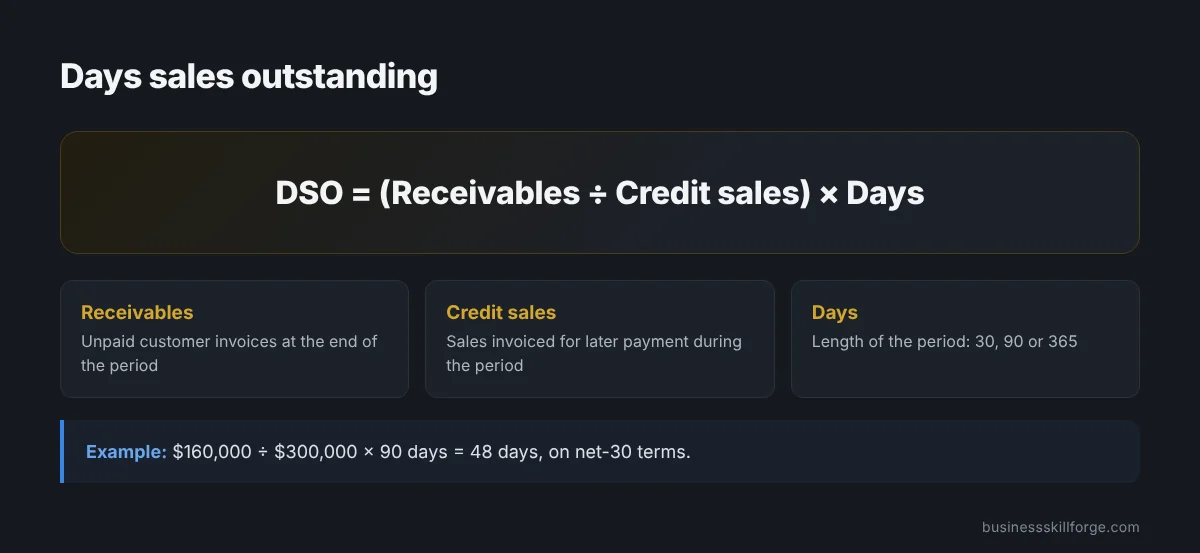
Take a B2B marketing agency that bills about $1.2 million a year, all on net-30 invoices. For the third quarter:
| Input | Amount |
|---|---|
| Accounts receivable at September 30 | $160,000 |
| Credit sales, July to September | $300,000 |
| Days in the period (rounded) | 90 |
| DSO | 48 days |
$160,000 ÷ $300,000 = 0.533, and 0.533 × 90 = 48 days. With 30-day terms, that means invoices are being paid roughly 18 days after they fall due.
A few practical rules make the number reliable:
- Use credit sales only. If some customers pay upfront by card, leave those sales out. Including them makes DSO look better than your collections really are.
- Use the receivables balance at the end of the period, or an average of the opening and closing balances if your sales swing a lot.
- Keep the period consistent. Monthly with 30 days, quarterly with 90, annually with 365. Comparing a monthly DSO to an annual one mixes two different measurements.
- Exclude sales tax only if you’re consistent. Receivables usually include sales tax or VAT, so either include it in both numbers or strip it from both.
The countback method for uneven sales
The standard formula assumes sales were spread evenly across the period. When they weren’t, the result can mislead. The countback method works backward from the most recent month instead.
Say the agency’s quarter broke down as July $95,000, August $95,000 and September $110,000. Start with the $160,000 of receivables and count back:
- September’s $110,000 of sales accounts for $110,000 of receivables: that’s all 30 days of September.
- That leaves $50,000, which is part of August’s $95,000: $50,000 ÷ $95,000 × 31 days = 16.3 days.
- Countback DSO = 30 + 16.3 = 46.3 days.
The standard method gave 48 days. The difference comes from September being a strong month: more recent sales mean more receivables that aren’t due yet. When sales are growing, the standard formula overstates DSO slightly. When they’re falling, it understates it. For most small businesses the standard method is fine as long as you calculate it the same way every month.
What is a good DSO?
The useful comparison is with your own payment terms. If you invoice on net 30, a DSO near 30 means customers pay roughly on time. Every day above your terms is a day of lateness, on average, across your customer base.
Industry comparisons are less useful than they look. Businesses that sell to large corporations or government bodies often wait longer by default, while a trade supplier with mostly small customers on 14-day terms should expect a much lower figure. Your own trend matters more than anyone else’s average.
Best possible DSO
A neat way to separate slow terms from slow payers is to calculate best possible DSO, using only the receivables that aren’t yet overdue.
The agency’s aging report at September 30 looks like this:
| Aging bucket | Amount | Share of receivables |
|---|---|---|
| Current (not yet due) | $100,000 | 62.5% |
| 1–30 days overdue | $34,000 | 21.3% |
| 31–60 days overdue | $15,000 | 9.4% |
| 61–90 days overdue | $7,000 | 4.4% |
| Over 90 days overdue | $4,000 | 2.5% |
| Total | $160,000 | 100% |
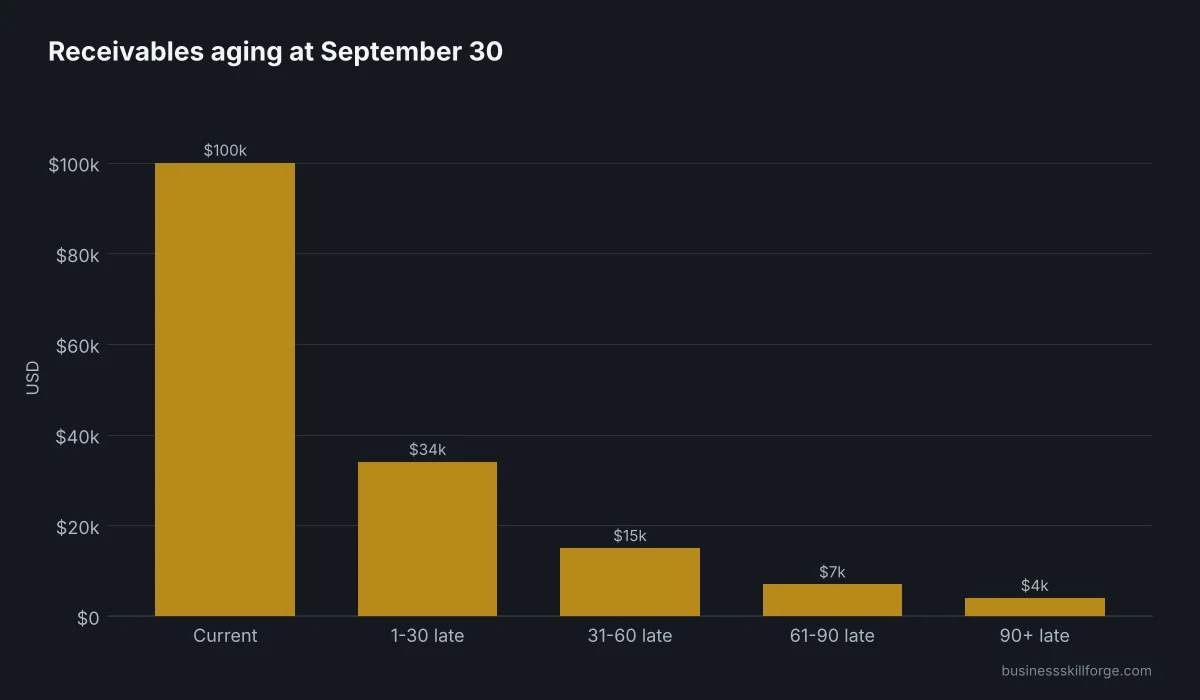
Best possible DSO = $100,000 ÷ $300,000 × 90 = 30 days. That’s exactly the agency’s terms. The other 18 days, sometimes called overdue DSO, is pure collection delay. The fix is in how the agency chases payment, not in the terms it offers.
What a high DSO costs you
Every day of DSO ties up one day’s worth of credit sales. For the agency, that’s $1,200,000 ÷ 365 = about $3,288 per day.
If the agency cut its DSO from 48 days to 35, it would release 13 × $3,288 = about $42,700 of cash, once, permanently, without winning a single new client. That’s money it could use to cover payroll in a slow month, pay down a credit line or stop using one altogether. Receivables are part of your working capital, and DSO is usually the fastest part of it to improve.
There’s also a risk cost. The older an invoice gets, the less likely it is to be paid in full. The $4,000 over 90 days in the aging table deserves a phone call this week, and a decision about whether to keep working for that client.
How to track DSO over time
Calculate DSO monthly and look at the trend. A single month can be distorted by one big invoice or one slow client. Six months tells a story.
| Month | DSO (days) | Payment terms (days) |
|---|---|---|
| April | 41 | 30 |
| May | 43 | 30 |
| June | 44 | 30 |
| July | 46 | 30 |
| August | 47 | 30 |
| September | 48 | 30 |
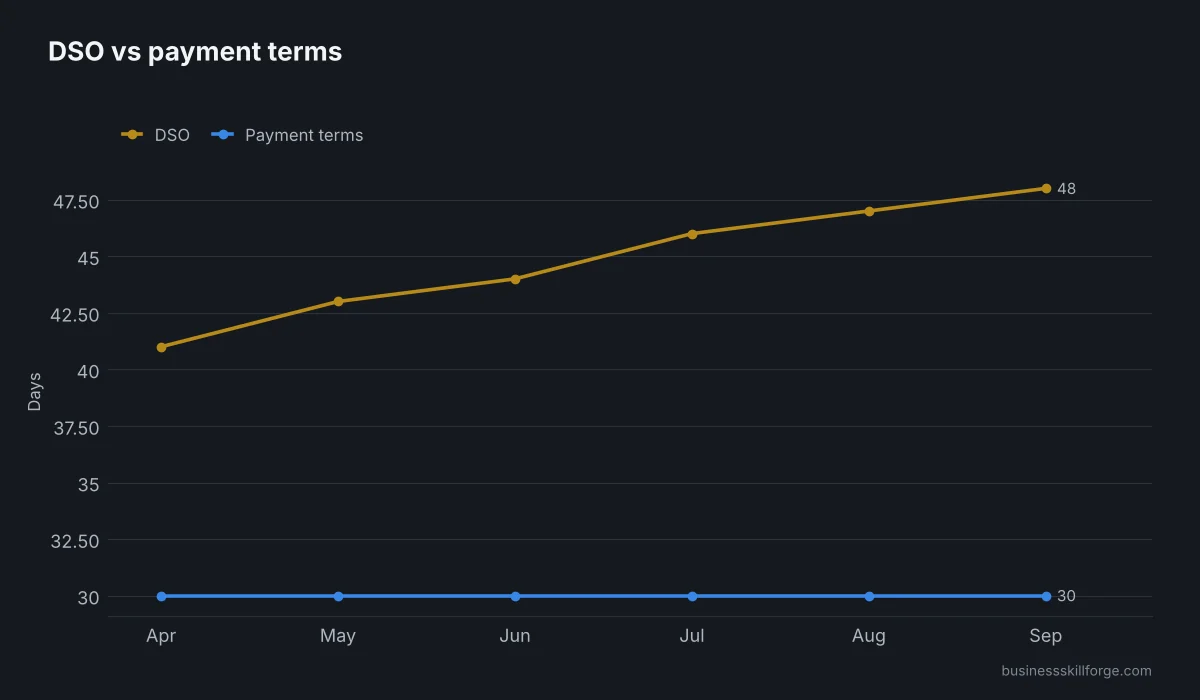
A slow drift like this is common and easy to miss. Nobody decided to let collections slide. A few clients started paying later, nobody followed up, and other clients noticed there was no consequence. Seven extra days over six months is about $23,000 of extra cash tied up for the agency.
How to get paid faster
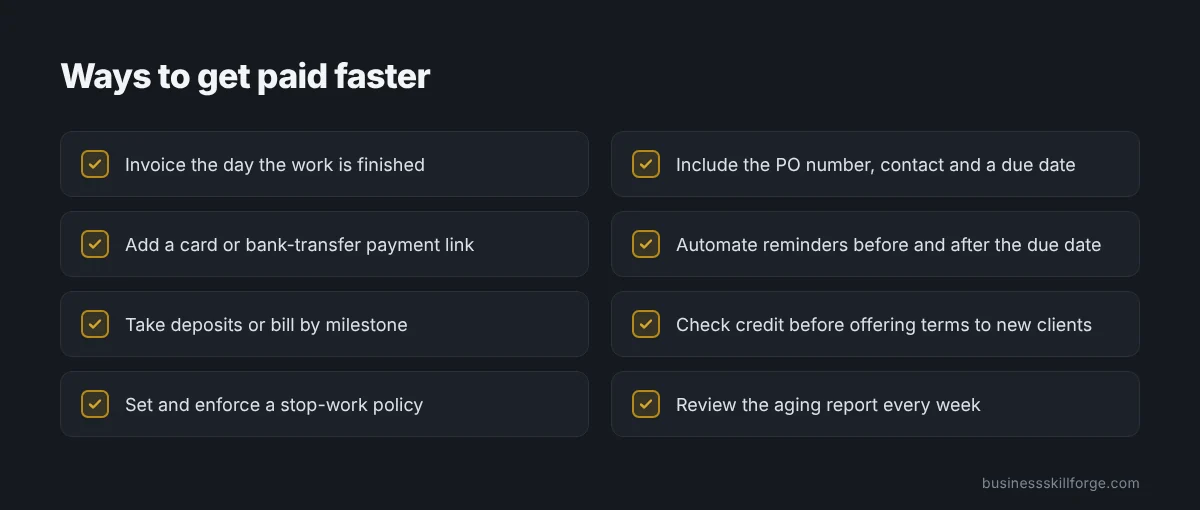
Most improvements come from making it easy to pay you and hard to forget. Start with the cheapest fixes.
- Invoice immediately. An invoice sent a week after the work finishes adds a week to your DSO. Bill on completion, or on a fixed day for retainers.
- Make invoices impossible to reject. Include the purchase order number, the right contact, a clear description and the due date as a date, not just “net 30”. Large clients often bounce invoices that are missing a PO.
- Add a payment link. Card and bank-transfer links on the invoice remove friction. Weigh the processing fee against the days you save.
- Send reminders on a schedule. A friendly note a few days before the due date, another on the due date, then firmer follow-ups at 7, 14 and 30 days overdue. Most accounting software can automate this.
- Take deposits or bill by milestone. On a $20,000 project, a 30% deposit means $6,000 is collected before work starts.
- Check credit before extending it. For new clients with large orders, ask for references or start with shorter terms.
- Have a stop-work policy. Decide in advance how overdue an account can be before you pause work, and put it in your terms.
Early-payment discounts: usually expensive
Terms like “2/10 net 30” offer 2% off if the customer pays within 10 days instead of 30. It sounds small. But you’re giving up 2% to get your money 20 days earlier. Annualized, that’s roughly 2 ÷ 98 × 365 ÷ 20 = 37%. Unless cash is very tight or a client is chronically late, a short-term credit line is usually cheaper.
Late payment charges
In the UK, the Late Payment of Commercial Debts (Interest) Act 1998 lets businesses charge statutory interest on late business-to-business payments at 8% plus the Bank of England base rate, plus a fixed compensation sum, according to the Office of the Small Business Commissioner. In the US, Canada and Australia, what you can charge generally depends on your contract terms and local law, so set any late fee out in writing before the work starts and check the rules where you operate.
Common DSO mistakes
- Including cash and card sales in the denominator, which makes DSO look shorter than it is.
- Comparing a monthly DSO with an annual one.
- Ignoring disputed invoices. If a client is withholding payment over a problem, fix the problem; reminders won’t help.
- Focusing on the DSO number while the aging report shows a few very old invoices that may never be paid.
- Leaving bad debts in receivables. Writing them off cleans up DSO and gives you an honest picture.
What to do next
Run an aging report from your accounting software and calculate DSO for each of the last six months. Compare it with your payment terms and work out best possible DSO to see how much of the gap is late payment. Then pick the three cheapest fixes from the list above and set them up this week: same-day invoicing, a payment link and automated reminders. Recheck in 60 days. To see how faster collections change your overall position, plug the new figures into our working capital calculator, and read our guide to accounts receivable vs accounts payable for the other side of the timing equation.
Key takeaways
- Days sales outstanding is accounts receivable divided by credit sales, multiplied by the days in the period, and it shows how long customers take to pay.
- Compare DSO with your payment terms: the agency in the example had a 48-day DSO on 30-day terms, so invoices were paid about 18 days late on average.
- Best possible DSO uses only current receivables and separates slow terms from slow payers.
- Each day of DSO ties up one day of credit sales, so cutting DSO from 48 to 35 days frees about $42,700 for a business billing $1.2 million a year.
- Same-day invoicing, payment links, scheduled reminders and deposits usually improve DSO more cheaply than early-payment discounts.
Frequently asked questions
How do you calculate days sales outstanding?
Divide accounts receivable at the end of the period by credit sales for the period, then multiply by the number of days in the period. If receivables are $160,000 and quarterly credit sales are $300,000, DSO is $160,000 ÷ $300,000 × 90 = 48 days. Use only sales made on credit, not cash or card sales paid upfront.
What is a good DSO for a small business?
A good DSO is close to your payment terms. On net-30 terms, a DSO in the low 30s means most customers pay on time. A DSO well above your terms means customers are paying late on average. Your own trend over several months is more useful than industry averages, which vary a lot by customer type.
Is a higher or lower DSO better?
Lower is generally better, because it means you collect cash sooner and have less money tied up in unpaid invoices. A very low DSO can sometimes mean your credit terms are so strict they cost you sales, but for most small businesses the bigger risk is a DSO that creeps upward without anyone noticing.
What is the difference between DSO and the accounts receivable turnover ratio?
They measure the same thing in different units. Receivables turnover is credit sales divided by average receivables, showing how many times a year you collect your receivables balance. DSO converts that into days: 365 divided by the turnover ratio. A turnover of 8 means a DSO of about 46 days.
Do early-payment discounts reduce DSO?
They can, but they’re often expensive. Offering 2% off for payment within 10 days instead of 30 works out to an annualized cost of roughly 37%. Same-day invoicing, payment links and automated reminders usually cut DSO at much lower cost. Discounts make sense mainly when cash is very tight or a customer is consistently late.
Sources
This article is general education, not tax, legal, accounting or investment advice. Rules and thresholds differ by country and change over time, so check the specifics for your situation. See our financial disclaimer.
Get practical finance & accounting tips in your inbox
Join US professionals getting our best guides, templates and tools. Free. Unsubscribe anytime.