Accounts Receivable vs Accounts Payable: The Difference
November 1, 2026 · Aditya Gupta

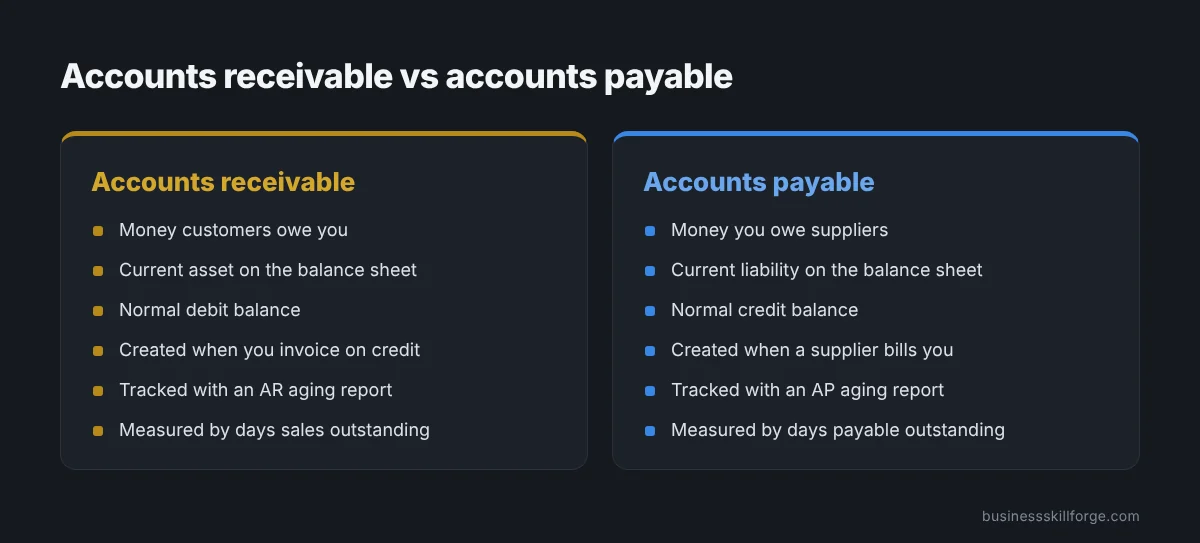
The difference between accounts receivable vs accounts payable comes down to direction. Accounts receivable (AR) is money customers owe you for work you’ve already delivered, so it’s an asset. Accounts payable (AP) is money you owe suppliers for things you’ve already received, so it’s a liability. Both exist because invoices get paid later, not on the spot.
That sounds simple, and it is. The trouble starts when owners treat these two balances as background noise. AR and AP decide when cash actually shows up in your bank account, and a business can be profitable on paper while running out of money because one of them is out of control. Below you’ll see how each one is recorded, how to read them, and what to do about them.
What is accounts receivable?
Accounts receivable is the total of unpaid customer invoices for goods or services you have already delivered. It sits in the current assets section of your balance sheet because you expect to turn it into cash within a year, usually within 30 to 60 days.
Say a freelance designer billing $6,000 a month finishes a brand package on March 31 and sends an invoice due in 30 days. On March 31 she has earned the money but doesn’t have it. That $6,000 is a receivable. When the client pays on April 28, the receivable disappears and cash goes up by the same amount.
AR only exists if you use accrual accounting or at least track invoices separately. Under pure cash accounting, nothing is recorded until money arrives, so unpaid invoices live in your invoicing tool rather than in your books.
What is accounts payable?
Accounts payable is the total of unpaid bills from suppliers for goods or services you have already received. It’s a current liability, because you’re expected to pay it in the short term, typically on terms like net 15, net 30 or net 60.
A restaurant that receives $2,400 of produce on Monday with an invoice due in 14 days has $2,400 of AP until it pays. The food is already in the walk-in fridge (and probably on plates by Friday), but the cash hasn’t left yet.
AP covers trade bills: inventory, materials, contractors, software invoiced on terms, utilities billed after the fact. It usually excludes loans, payroll and taxes, which get their own liability accounts.
Accounts receivable vs accounts payable: the differences side by side
Your customer’s AP is your AR. The same invoice is a receivable for the seller and a payable for the buyer. Everything else follows from that.
| Accounts receivable | Accounts payable | |
|---|---|---|
| What it is | Money owed to you | Money you owe |
| Balance sheet type | Current asset | Current liability |
| Created when | You invoice a customer on credit | A supplier bills you on credit |
| Normal balance | Debit | Credit |
| Cleared when | The customer pays (or you write it off) | You pay the supplier |
| Effect on cash when it grows | Cash you’ve earned is stuck with customers | Cash stays in your account longer |
| Key report | AR aging report | AP aging report |
| Key metric | Days sales outstanding (DSO) | Days payable outstanding (DPO) |
| UK term | Trade debtors | Trade creditors |
That last row matters if you work with UK clients or read UK accounts. “Debtors” and “creditors” on a UK balance sheet mean the same things as AR and AP.
Worked example: a month of AR and AP at a print shop
Ridgeline Print is a two-person print shop that invoices most customers on net 30. It starts March with $3,100 of AR (a February invoice to a real estate office) and $700 of AP (an unpaid ink bill). Here is March, with the journal entries behind each event.
| Date | Event | Debit | Credit | Amount |
|---|---|---|---|---|
| Mar 3 | Invoice restaurant for menus | Accounts receivable | Sales revenue | $4,800 |
| Mar 5 | Paper supplier bill arrives, net 30 | Printing supplies | Accounts payable | $1,900 |
| Mar 10 | Real estate office pays February invoice | Cash | Accounts receivable | $3,100 |
| Mar 12 | Invoice school for event programs | Accounts receivable | Sales revenue | $2,600 |
| Mar 20 | Pay February ink bill | Accounts payable | Cash | $700 |
| Mar 27 | School pays | Cash | Accounts receivable | $2,600 |
| Mar 28 | Press repair bill arrives | Repairs and maintenance | Accounts payable | $450 |
Now follow the balances. AR went from $3,100 to $4,800: plus $4,800 and $2,600 in new invoices, minus $3,100 and $2,600 collected. AP went from $700 to $2,350: plus $1,900 and $450 in new bills, minus the $700 paid.
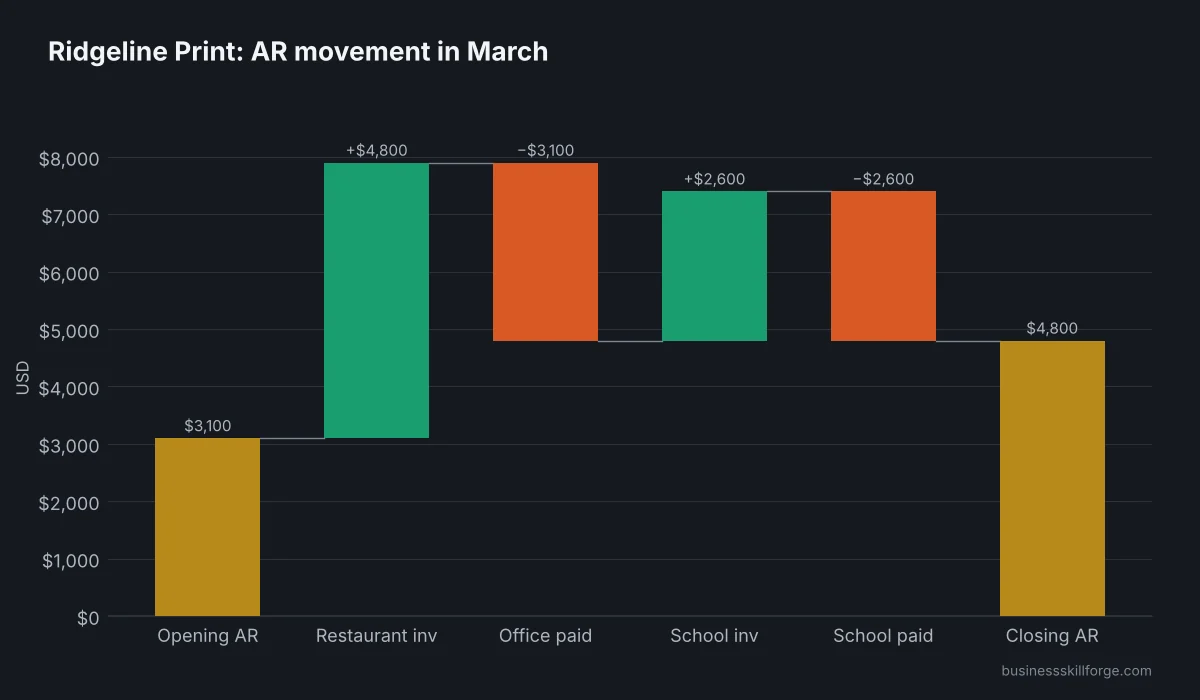
Notice what the income statement says versus the bank account. Ridgeline recorded $7,400 of March revenue, but only $5,700 of cash came in, and $3,100 of that was for February’s work. The restaurant’s $4,800 is real revenue that won’t be cash until April. On the other side, $2,350 of March costs haven’t been paid yet. This gap is exactly why cash flow and profit tell different stories.
How AR and AP affect your cash
Higher AR means more of your earned money is sitting with customers. Higher AP means you’re holding on to suppliers’ money for longer. Both show up in working capital, which is current assets minus current liabilities, and you can test your own numbers with our working capital calculator.
Two ratios turn the raw balances into something you can compare month to month.
Days sales outstanding (DSO)
DSO is the average number of days it takes to collect a sale. The formula is accounts receivable divided by credit sales for the period, multiplied by the number of days in the period.
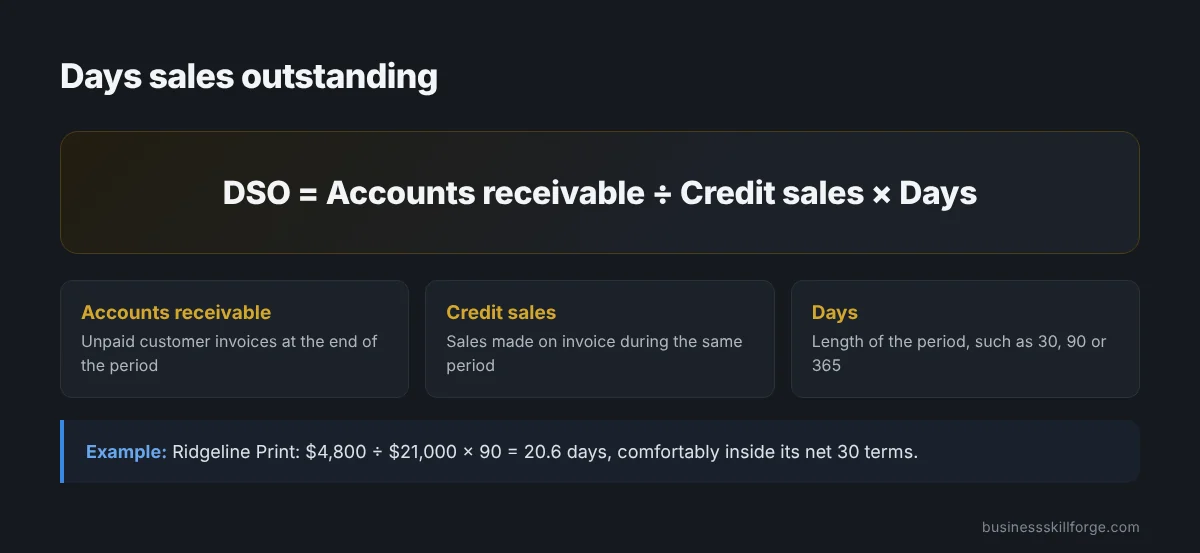
Ridgeline had $21,000 of sales over the last 90 days and $4,800 of AR at the end of March. DSO is $4,800 ÷ $21,000 × 90 = 20.6 days. With net 30 terms, that’s healthy. If DSO crept to 45 days, customers would be paying two weeks late on average, and you’d want to know which ones. Our guide to days sales outstanding covers the collection side in more detail.
Days payable outstanding (DPO)
DPO is the average number of days you take to pay suppliers: accounts payable divided by purchases for the period, multiplied by days. Ridgeline bought $6,300 of supplies and services on credit over 90 days and ended with $2,350 of AP, so DPO is $2,350 ÷ $6,300 × 90 = 33.6 days.
Collecting in about 21 days and paying in about 34 is a comfortable position. Cash comes in roughly two weeks before it has to go out. Flip those numbers and you’d be financing your customers out of your own pocket.
How to read an AR aging report
An aging report sorts every unpaid invoice by how long it has been outstanding. It’s the single most useful AR document, because a total balance hides the difference between a customer who paid yesterday’s invoice late and one who hasn’t paid since spring.
Here’s an aging summary for a commercial cleaning company with $38,500 of receivables. The reserve column applies sample collection-risk percentages, which is how many businesses estimate an allowance for doubtful accounts. The percentages are illustrative; yours should come from your own collection history.
| Age bucket | Balance | Share of AR | Sample reserve rate | Reserve |
|---|---|---|---|---|
| Current (not yet due) | $21,000 | 54.5% | 1% | $210 |
| 1–30 days past due | $9,800 | 25.5% | 3% | $294 |
| 31–60 days past due | $4,200 | 10.9% | 10% | $420 |
| 61–90 days past due | $2,100 | 5.5% | 25% | $525 |
| Over 90 days past due | $1,400 | 3.6% | 50% | $700 |
| Total | $38,500 | 100% | $2,149 |
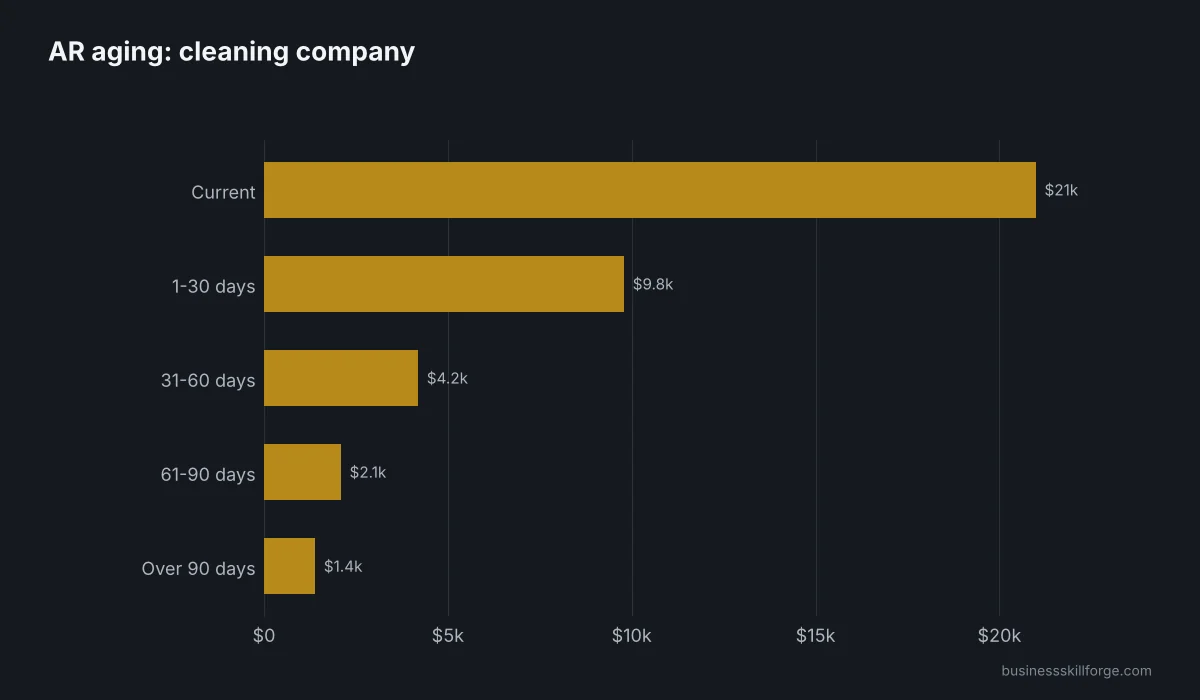
Read it from the bottom up. The $1,400 over 90 days is small, but each dollar there is much less likely to be collected than a dollar in the current bucket. Look at who is in the older buckets, not just how much. One customer making up most of the 61–90 day balance is a conversation to have this week.
An AP aging report works the same way in reverse. It tells you which bills are due soon and which are already late, so you can plan payments instead of reacting to reminder emails.
Managing AR and AP without starving your cash
Getting receivables paid
- Invoice the day the work is done. Every day of delay adds a day to DSO.
- Put the due date, not just the terms, on the invoice. “Due April 30” gets paid faster than “Net 30”.
- Offer card or ACH payment links. Friction slows payment.
- Follow up on a schedule: a reminder a few days before the due date, another on the day, then weekly.
- For new or slow-paying customers, ask for a deposit before work starts.
Paying bills on purpose
Paying every bill the moment it arrives feels responsible but gives away free financing. Paying late damages supplier relationships and can cost late fees. The middle path is to pay on the due date, unless there’s an early payment discount worth taking.
Terms of “2/10 net 30” mean you can take 2% off if you pay within 10 days, otherwise the full amount is due in 30. On a $10,000 bill, paying $9,800 on day 10 instead of $10,000 on day 30 saves $200 for giving up 20 days of cash. That works out to $200 ÷ $9,800 × 365 ÷ 20 = 37.2% a year. If your line of credit costs 12%, borrowing to grab that discount still comes out ahead.
When a receivable won’t be collected
Sometimes a customer simply doesn’t pay. Under accrual accounting you write the invoice off against your allowance (or directly to bad debt expense) so AR doesn’t overstate what you’ll really collect. For US tax purposes, the IRS says business bad debts are deductible only if the amount was included in gross income in the current or a prior year. That means a cash-basis business generally has nothing to deduct, because the unpaid invoice was never counted as income in the first place. Rules differ in the UK, Canada and Australia, so check the local guidance or an adviser before claiming.
Common mistakes with AR and AP
- Recording customer payments as new revenue. If you already booked the invoice to AR, the payment should credit AR, not sales. Otherwise revenue is counted twice and AR never clears.
- Entering bills only when you pay them. In an accrual system, this hides liabilities and makes the month look more profitable than it was.
- Never writing off dead invoices. A $900 invoice from a client who closed two years ago isn’t an asset. Leaving it in AR inflates the balance sheet and your DSO.
- Ignoring credits and overpayments. A customer who overpays creates a negative receivable. Left alone, these mess up the aging report.
- Not reconciling AR and AP to the ledger. The aging report total should equal the AR control account in your general ledger. If it doesn’t, something was posted directly to the account instead of through an invoice or bill.
What to do next
Pull your AR aging report today and sort it by oldest balance. Pick the three largest past-due amounts and contact those customers this week. Then run the AP aging and mark which bills are due in the next 14 days, so cash going out is planned rather than a surprise.
Once a month, calculate DSO and DPO with the formulas above and write them down. Two numbers tracked over a year will tell you more about your cash than any single balance sheet.
Key takeaways
- Accounts receivable is money customers owe you and is recorded as a current asset.
- Accounts payable is money you owe suppliers and is recorded as a current liability.
- The same invoice is AR for the seller and AP for the buyer.
- Revenue and expenses can be recorded long before cash moves, which is why AR and AP explain most of the gap between profit and cash.
- An aging report and two ratios, DSO and DPO, are enough to spot most collection and payment problems early.
- Pay bills on their due date unless an early payment discount beats your cost of borrowing.
Frequently asked questions
Is accounts receivable an asset or a liability?
Accounts receivable is an asset. It represents money customers are legally obliged to pay you for goods or services you have already delivered, and you expect to collect it within a year, so it is classified as a current asset on the balance sheet. Accounts payable is the liability: money you owe to suppliers for things you have already received.
Is accounts payable an expense?
No. Accounts payable is a liability, not an expense. The expense is recorded when you receive the goods or service, for example as supplies or repairs. Accounts payable is the matching credit that says you still owe the money. When you pay the bill, you reduce accounts payable and reduce cash, and the expense is not recorded a second time.
Can a business have accounts receivable under cash accounting?
Not in the books. Under cash-basis accounting, income is recorded only when payment arrives, so unpaid invoices are not entered as receivables. You still have customers who owe you money, though, and you should track them in your invoicing software. Many small businesses keep cash-basis books for tax but run an accrual-style AR report to manage collections.
What is a good accounts receivable turnover or DSO?
There’s no single good number, because it depends on your payment terms and industry. A useful test is to compare DSO with your terms. If you invoice on net 30 and DSO is around 30 to 35 days, customers are mostly paying on time. If DSO is well above your terms, check the aging report to see which customers are paying late.
Should I pay suppliers early?
Usually only when there’s a discount worth taking. Paying early with no discount simply reduces the cash you have on hand. A discount like 2/10 net 30 is worth about 37% a year in annualized terms, which beats most borrowing costs, so taking it generally makes sense if you have the cash or a cheaper credit line.
Sources
This article is general education, not tax, legal, accounting or investment advice. Rules and thresholds differ by country and change over time, so check the specifics for your situation. See our financial disclaimer.
Get practical finance & accounting tips in your inbox
Join US professionals getting our best guides, templates and tools. Free. Unsubscribe anytime.