How to Read a Cash Flow Statement, With a Worked Example
November 3, 2026 · Aditya Gupta
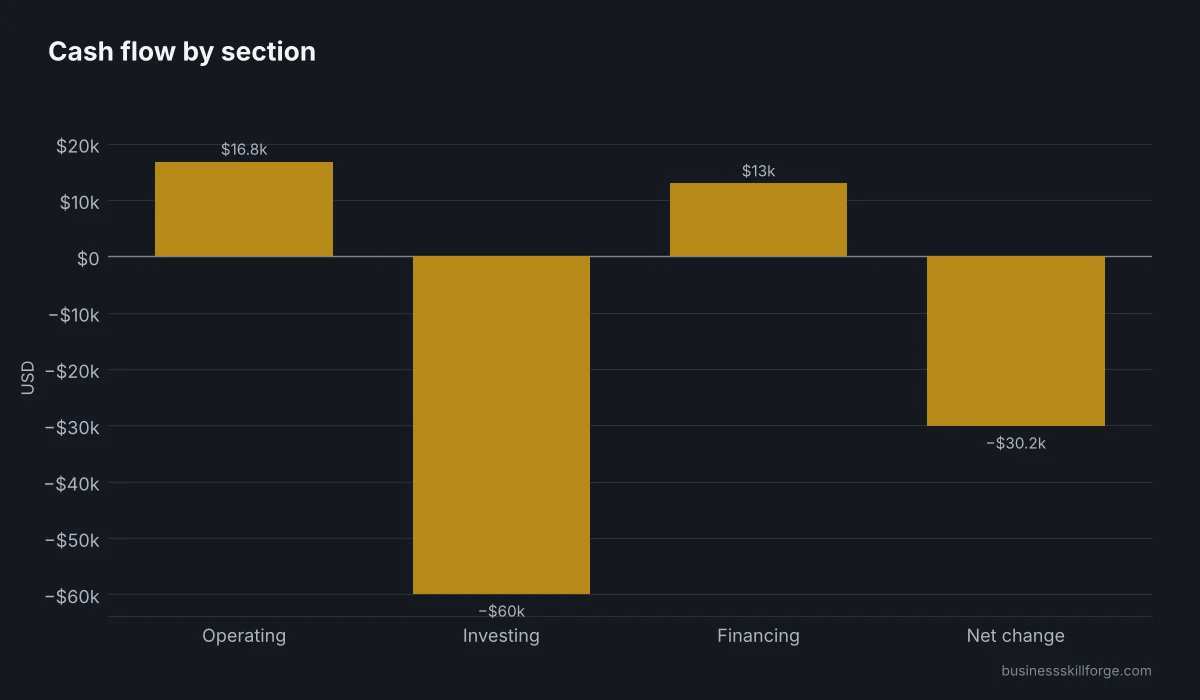
Learning how to read a cash flow statement starts with its three sections. Operating activities show cash generated by the day-to-day business, investing activities show cash spent on or received from long-term assets, and financing activities show cash from lenders and owners. Add the three together and you get the change in cash for the period, which should match the movement in your bank balance.
The cash flow statement answers the question the income statement can’t: where did the money actually go? A business can report a healthy profit and still end the year with less cash than it started with. This guide uses one small business’s year to show how that happens, line by line, and what to look for when you read a statement of your own.
What a cash flow statement shows
A cash flow statement is a report of the cash coming into and going out of a business over a period, grouped into operating, investing and financing activities. The SEC’s Beginners’ Guide to Financial Statements puts the difference neatly: the income statement tells you whether a company made a profit, while the cash flow statement tells you whether it generated cash. The two are related, but they’re not the same number.
The gap comes from accrual accounting. Revenue counts when it’s earned, even if the customer hasn’t paid. Equipment purchases don’t hit profit all at once; they’re spread out as depreciation. Loan repayments and owner distributions never appear on the income statement at all. The cash flow statement puts all of that back. We cover the general idea in cash flow vs profit; here we’ll read the statement itself.
The three sections of a cash flow statement
Cash flow from operating activities
Operating cash flow is the cash generated by the normal running of the business: collecting from customers, paying suppliers, staff, rent and taxes. This is the section that matters most. Over time, a healthy business funds itself from operations.
Cash flow from investing activities
Investing cash flow covers buying and selling long-term assets: equipment, vehicles, property, and investments in securities. Buying a new delivery van is a cash outflow here, not an expense on the income statement. In a growing business this section is usually negative, and that’s normal.
Cash flow from financing activities
Financing cash flow is cash moving between the business and the people who fund it: new loans, loan repayments, money the owners put in, and dividends or distributions they take out. It shows how the business is paying for any gap between what operations produce and what it invests.
Cash flow statement example: a small coffee roaster
Here’s a full year for a small specialty coffee roaster that earned net income of $36,340. (It’s the same business we use in our guide on how to read an income statement, so you can follow the numbers across both.)
| Line | Amount |
|---|---|
| Operating activities | |
| Net income | $36,340 |
| Add back: depreciation | $14,000 |
| Increase in accounts receivable | ($18,000) |
| Increase in inventory | ($22,000) |
| Increase in accounts payable | $6,500 |
| Net cash from operating activities | $16,840 |
| Investing activities | |
| Purchase of roasting equipment | ($60,000) |
| Net cash from investing activities | ($60,000) |
| Financing activities | |
| New equipment loan | $45,000 |
| Loan principal repaid | ($12,000) |
| Dividends paid to owners | ($20,000) |
| Net cash from financing activities | $13,000 |
| Net change in cash | ($30,160) |
| Cash at start of year | $58,000 |
| Cash at end of year | $27,840 |
The roaster made $36,340 of profit and ended the year with $30,160 less cash. Nothing went wrong in the bookkeeping. Let’s read it section by section.
How net income turns into operating cash flow
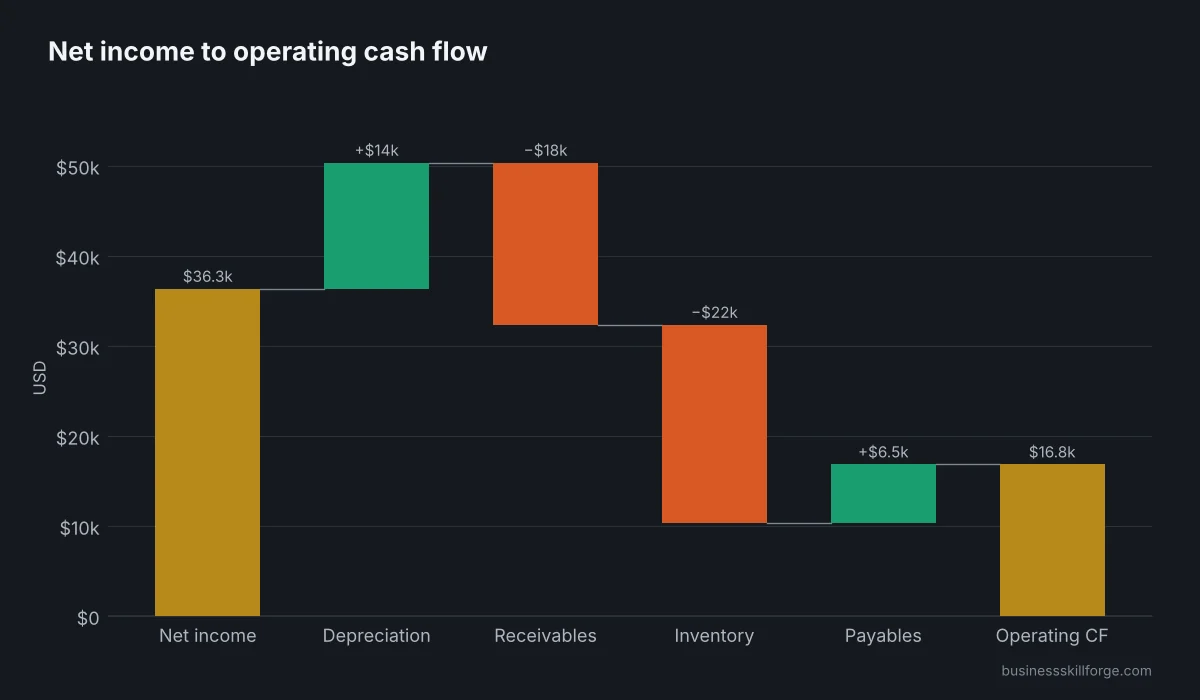
The statement above uses the indirect method for the operating section. It starts with net income and adjusts it for everything that affected profit without moving cash, or moved cash without affecting profit. Each adjustment follows a simple logic.
Add back non-cash expenses
Depreciation of $14,000 reduced profit, but no cash left the business this year for it. The cash went out when the equipment was bought. So it’s added back. Amortization and some write-downs work the same way.
Adjust for changes in working capital
Working capital is current assets minus current liabilities, and changes in it are the usual reason profit and cash drift apart:
- Accounts receivable up $18,000: The roaster recorded sales that customers haven’t paid for yet. That’s profit without cash, so it’s subtracted.
- Inventory up $22,000: It bought more beans and packaging than it used. Cash went out, but the cost hasn’t hit COGS yet, so it’s subtracted.
- Accounts payable up $6,500: It received $6,500 more in supplier bills than it paid. Those costs are in profit but the cash is still in the bank, so it’s added.
The rule of thumb: an increase in a current asset uses cash; an increase in a current liability provides cash. Decreases work in reverse.
The other version, the direct method, lists actual cash received from customers and paid to suppliers and staff. It’s easier to understand but more work to prepare from ordinary bookkeeping records. Both reach the same operating cash flow.
Reading the investing and financing sections
The roaster spent $60,000 on a second roasting machine. That’s why depreciation went up, and it’s the single biggest reason cash fell. To fund it, the roaster took a $45,000 equipment loan, repaid $12,000 of older loan principal, and paid its owners $20,000 in dividends.
Put the three together: operations produced $16,840, the investment cost $60,000, and the owners still took $20,000 out. The new loan covered most of the gap, and the cash balance covered the rest. That works for a year. It doesn’t work every year.
What would have changed the result
The useful thing about this statement is that it points straight at the levers. Two of them sit in working capital:
- Collect faster. If receivables had grown by $6,000 instead of $18,000, say by moving wholesale customers from 60-day to 30-day terms, operating cash flow would have been $12,000 higher at $28,840.
- Buy stock closer to need. If inventory had grown by $10,000 instead of $22,000, that is another $12,000, taking operating cash flow to $40,840.
With both changes, the year’s cash decline shrinks from $30,160 to $6,160, with the same profit, the same machine and the same dividend. That’s why owners who only watch the P&L are often surprised by their bank balance: the profit was real, but it was sitting in customers’ unpaid invoices and on the storeroom shelves.
The third lever is the payout. Dividends of $20,000 exceeded operating cash flow of $16,840, so part of the owners’ payout was effectively funded by the new loan. Setting payouts against free cash flow rather than profit avoids that.
What the pattern of pluses and minuses tells you
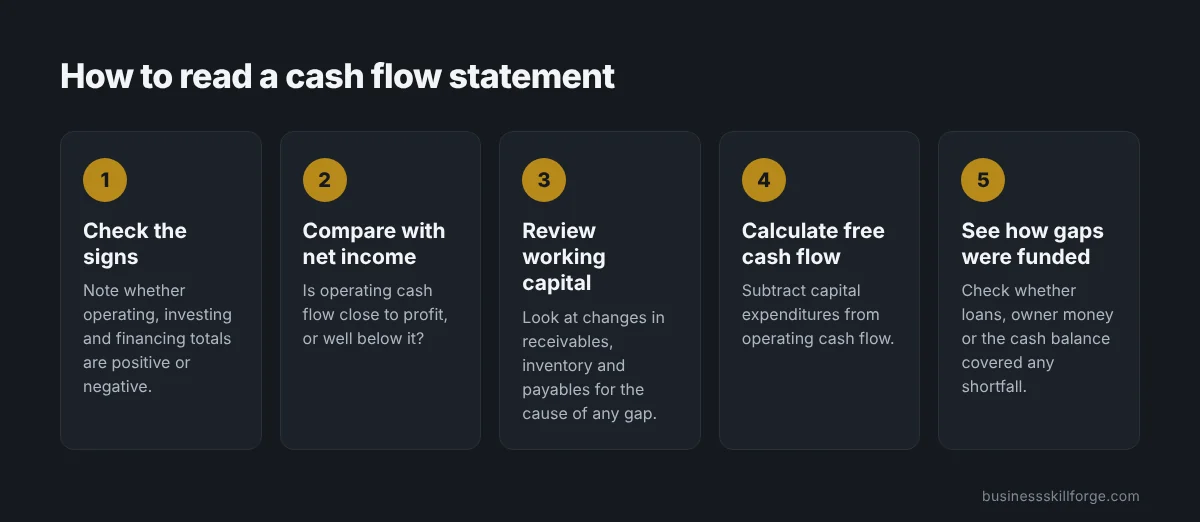
Before reading any detail, look at the sign of each section’s total. The combination tells you roughly what stage a business is in.
| Operating | Investing | Financing | What it often means |
|---|---|---|---|
| + | − | − | Mature and self-funding: operations pay for investment, debt repayment and owner payouts |
| + | − | + | Growing: operations positive, but borrowing or new equity helps fund investment (the roaster) |
| − | − | + | Early stage or struggling: relying on loans or investors to cover both operations and investment |
| − | + | + or − | Warning sign: selling assets to cover operating losses |
| + | + | − | Shrinking or restructuring: selling assets and paying down debt |
These are patterns, not verdicts. A startup with negative operating cash flow funded by investors may be exactly on plan. A mature business with that pattern has a problem.
Free cash flow: the number many people check first
Free cash flow is operating cash flow minus capital expenditures. It’s the cash left over after keeping the business running and investing in its assets, available to repay debt, pay owners or save.
For the roaster: $16,840 − $60,000 = −$43,160. Negative free cash flow in a year with a big equipment purchase isn’t automatically bad. The question is whether the new machine will lift operating cash flow enough in later years. If next year’s operating cash flow is still around $17,000 and the owners still want $20,000 a year, the business will be borrowing to pay dividends.
Common mistakes when reading a cash flow statement
- Reading net change in cash as performance. Cash can rise because of a new loan. Look at operating cash flow first.
- Panicking about negative investing cash flow. Spending on equipment is how businesses grow. Judge it against what operations produce.
- Getting the working capital signs backward. A rise in receivables reduces cash. Remember: more assets tied up means less cash.
- Ignoring operating cash flow vs net income over several years. If profit is consistently well above operating cash flow, receivables or inventory are growing faster than they should, or revenue is being recognized too early.
- Not tying ending cash to the bank. Ending cash should agree with the balance sheet and, after reconciling items, with your bank statements. If it doesn’t, something is misposted.
What to do next
Pull your own cash flow statement for the last year (most accounting software produces one from the balance sheet and P&L). Note the sign of each section, calculate free cash flow, and compare operating cash flow with net income. If operating cash flow is much lower, look at the receivables and inventory lines first.
A historical statement tells you what happened. To manage what happens next, project it forward: our cash flow calculator gives a quick view, and our guide to building a 13-week cash flow forecast shows how to plan week by week.
Key takeaways
- A cash flow statement splits cash movements into operating, investing and financing activities, and their total equals the change in cash.
- Operating cash flow under the indirect method starts with net income, adds back non-cash expenses like depreciation, then adjusts for working capital changes.
- An increase in receivables or inventory uses cash, while an increase in payables provides it.
- Free cash flow is operating cash flow minus capital expenditures.
- A profitable business can lose cash when it invests heavily, collects slowly or pays out more to owners than operations produce.
Frequently asked questions
Why is depreciation added back on the cash flow statement?
Depreciation is an expense that reduces net income, but no cash leaves the business when it’s recorded. The cash went out earlier, when the asset was bought, and that purchase already appears in investing activities. Because the indirect method starts from net income, it adds depreciation back so the operating section reflects only real cash movements and the same spending isn’t counted twice.
What is the difference between the direct and indirect method?
Both methods produce the same operating cash flow; they only present it differently. The direct method lists actual cash received from customers and paid to suppliers, staff and others. The indirect method starts with net income and adjusts for non-cash items and working capital changes. The indirect method is easier to prepare from standard accounting records, while the direct method is easier for a non-accountant to follow.
Can a profitable company have negative cash flow?
Yes, and it’s common in growing businesses. Profit counts sales when earned, so a company that sells a lot on credit, builds up inventory or buys equipment can show strong profit while cash falls. Paying down loans or paying owners also reduces cash without touching profit. The cash flow statement shows exactly which of these caused the gap.
Is negative cash flow from investing activities bad?
Not necessarily. Negative investing cash flow usually means the business is buying equipment, property or other long-term assets, which is how most businesses grow or replace worn-out kit. It becomes a concern only when operating cash flow can’t support the spending over time and the business keeps relying on new borrowing or its cash reserves to pay for it.
What is a good free cash flow?
Positive and stable free cash flow is the general goal, because it means the business can maintain and grow its assets from its own operations and still have cash left to repay debt or pay owners. One negative year after a large investment can be fine. Several negative years in a row, without a clear payoff in rising operating cash flow, deserves a close look.
Sources
This article is general education, not tax, legal, accounting or investment advice. Rules and thresholds differ by country and change over time, so check the specifics for your situation. See our financial disclaimer.
Get practical finance & accounting tips in your inbox
Join US professionals getting our best guides, templates and tools. Free. Unsubscribe anytime.