Depreciation Methods: Straight-Line, Declining Balance, Units
November 2, 2026 · Aditya Gupta

The three main depreciation methods spread an asset’s cost over its useful life in different patterns. Straight-line charges the same amount every year. Declining balance charges more in the early years and less later. Units of production charges according to how much the asset is actually used. All three expense the same total; they differ only in timing, which changes reported profit year by year.
Choosing a method for your books is a judgment about how the asset wears out. Tax is a separate question with its own rules in each country. This guide works one asset through every method with full numbers, shows the journal entry, and then covers how the tax side differs in the US, UK, Canada and Australia.
What depreciation is and why it exists
Depreciation is the process of spreading the cost of a long-lived asset over the years it helps earn revenue. When a business buys equipment that will last five years, expensing the full cost in year one would make that year look terrible and the next four look better than they were. Depreciation matches the cost to the periods that benefit, which is the core idea of accrual accounting.
Every calculation uses the same three inputs:
- Cost: the purchase price plus what it took to get the asset working, such as delivery, installation and setup.
- Salvage value (or residual value): what you expect to sell it for at the end of its useful life.
- Useful life: how long you expect to use it, in years or in units of output.
Cost minus salvage value is the depreciable base, the total amount you’ll expense over the asset’s life. Land is never depreciated: as the IRS puts it in Publication 946, land doesn’t wear out, become obsolete or get used up.
The worked example: a $50,000 printer
A small print shop buys a large-format printer. All the numbers below come from this one asset:
| Input | Value |
|---|---|
| Cost, including delivery and setup | $50,000 |
| Expected salvage value | $5,000 |
| Depreciable base | $45,000 |
| Useful life | 5 years |
| Expected lifetime output | 600,000 prints |
Straight-line depreciation
Straight-line depreciation is a method that expenses the same amount in every year of an asset’s useful life. It’s the simplest method and the most common choice for small-business books.
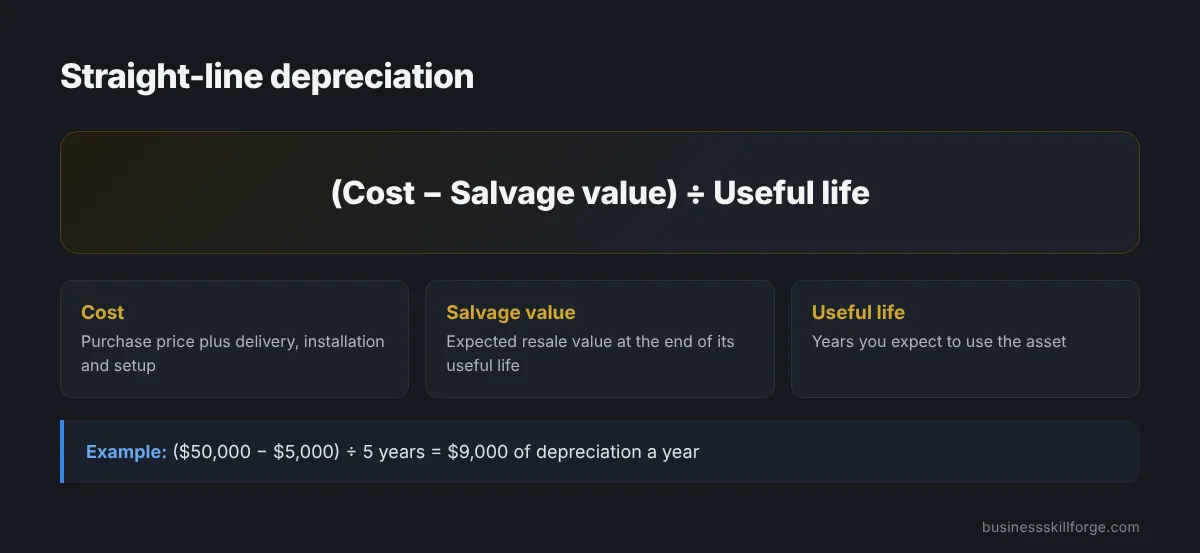
For the printer: ($50,000 − $5,000) ÷ 5 = $9,000 a year. The book value, which is cost minus accumulated depreciation, falls by $9,000 each year: $41,000, $32,000, $23,000, $14,000, and finally $5,000, the salvage value.
Use straight-line when an asset delivers roughly the same benefit every year: office furniture, fixtures, buildings, most software. It’s also the sensible default when you have no strong reason to choose something else.
Declining balance depreciation
Declining balance depreciation applies a fixed percentage to the asset’s remaining book value each year, so the charge is largest in year one and shrinks after that. The most common version is double-declining balance (DDB), which uses twice the straight-line rate.
For a five-year asset, the straight-line rate is 1 ÷ 5 = 20%, so the DDB rate is 40%. Unlike straight-line, you apply it to the full book value, not cost minus salvage, but you stop once book value reaches salvage value.
| Year | Opening book value | Calculation | Depreciation | Closing book value |
|---|---|---|---|---|
| 1 | $50,000 | $50,000 × 40% | $20,000 | $30,000 |
| 2 | $30,000 | $30,000 × 40% | $12,000 | $18,000 |
| 3 | $18,000 | $18,000 × 40% | $7,200 | $10,800 |
| 4 | $10,800 | $10,800 × 40% | $4,320 | $6,480 |
| 5 | $6,480 | Capped at salvage | $1,480 | $5,000 |
| Total | $45,000 |
In year 5 the formula would give $2,592, but that would take book value below $5,000, so the charge is limited to $1,480. In other cases, especially with low salvage values, declining balance never reaches salvage on its own. The usual fix is to switch to straight-line for the remaining years once straight-line gives the bigger charge. The US tax system builds that switch in, as we’ll see below.
Use declining balance for assets that lose value or usefulness fastest when new: vehicles, computers, phones, technology that becomes outdated quickly.
Units of production depreciation
Units of production depreciation charges a fixed amount per unit of output or use, so the expense rises and falls with activity. You need a sensible measure of use (prints, machine hours, miles) and a reasonable estimate of the lifetime total.
For the printer: $45,000 ÷ 600,000 prints = $0.075 per print.
| Year | Prints | Depreciation | Closing book value |
|---|---|---|---|
| 1 | 90,000 | $6,750 | $43,250 |
| 2 | 150,000 | $11,250 | $32,000 |
| 3 | 160,000 | $12,000 | $20,000 |
| 4 | 120,000 | $9,000 | $11,000 |
| 5 | 80,000 | $6,000 | $5,000 |
| Total | 600,000 | $45,000 |
Use units of production for assets whose wear depends on use rather than time: production machinery, delivery vehicles measured in miles, and equipment with a rated number of cycles. It’s the most accurate method for these assets, and also the most work, because someone has to record usage every period.
Comparing the methods side by side
| Year | Straight-line | Double-declining | Units of production | Sum-of-years’ digits |
|---|---|---|---|---|
| 1 | $9,000 | $20,000 | $6,750 | $15,000 |
| 2 | $9,000 | $12,000 | $11,250 | $12,000 |
| 3 | $9,000 | $7,200 | $12,000 | $9,000 |
| 4 | $9,000 | $4,320 | $9,000 | $6,000 |
| 5 | $9,000 | $1,480 | $6,000 | $3,000 |
| Total | $45,000 | $45,000 | $45,000 | $45,000 |
The last column is a fourth method you’ll occasionally see. Sum-of-years’ digits adds up the years (1 + 2 + 3 + 4 + 5 = 15) and expenses 5/15 of the base in year 1, 4/15 in year 2, and so on. It’s accelerated, like declining balance, but smoother.

What the choice does to profit
Say the print shop earns $80,000 a year before depreciation. In year 1, straight-line leaves operating profit of $71,000. Double-declining leaves $60,000. Units of production leaves $73,250. Same business, same cash, three different profit figures. By year 5 the order flips: straight-line gives $71,000, double-declining $78,520.
None of this changes cash. The $50,000 left the bank when the printer was bought, which is why depreciation is added back on the cash flow statement and excluded from EBITDA. What it does change is reported profit, and therefore anything tied to profit: bonuses, loan covenants, and how healthy the business looks to a lender.

How to record depreciation in your books
Depreciation is recorded with an adjusting entry at the end of each month or year. For straight-line on the printer, the annual entry is:
- Debit Depreciation expense $9,000 (an expense on the income statement)
- Credit Accumulated depreciation $9,000 (a contra-asset account that reduces equipment on the balance sheet)
The equipment account stays at its $50,000 cost. Accumulated depreciation grows each year, and the difference is book value. If you sell the asset, you remove both and record a gain or loss for any difference between the sale price and book value. If debits and credits are new to you, see our guide to debits and credits.
Keep a simple fixed asset register: one line per asset with purchase date, cost, salvage value, useful life, method and accumulated depreciation to date. It makes the monthly entry quick and avoids double-counting when assets are sold or scrapped.
Tax depreciation: the rules differ by country
The method in your books and the deduction on your tax return are often different. Most tax systems set their own rules, and small businesses commonly keep the two separately. This is a summary, not tax advice.
- United States. Most property placed in service after 1986 must be depreciated for tax using MACRS. Under the general depreciation system, the Form 4562 instructions say 3-, 5-, 7- and 10-year property uses the 200% declining balance method, switching to straight-line in the first year the straight-line rate is higher. Automobiles and copiers are 5-year property; office furniture is 7-year property. Equipment generally uses a half-year convention, which treats assets as placed in service in the middle of the tax year. Separately, the section 179 deduction and bonus depreciation can let you deduct much or all of an asset’s cost in the first year; the limits change, so check the current Publication 946.
- United Kingdom. HMRC’s capital allowances manual says depreciation charged in the accounts is not allowed as a tax deduction; capital allowances are given instead. The annual investment allowance gives full relief on most plant and machinery (excluding cars) in the year of purchase, and writing-down allowances work on a reducing-balance pool.
- Canada. The CRA uses capital cost allowance, mostly on a declining balance basis by asset class. A half-year rule has traditionally limited the first-year claim to half the net additions to a class (temporary incentives have relaxed this for many assets, so check current CRA guidance), and you don’t have to claim the maximum in any year.
- Australia. The ATO lets you work out decline in value using the prime cost (straight-line) or diminishing value method. Diminishing value uses base value × (days held ÷ 365) × (200% ÷ effective life) for assets held from 10 May 2006.

Common depreciation mistakes
- Expensing a long-lived asset. Recording a $50,000 printer as a repair or supply expense understates assets and distorts profit. Know your business’s capitalization threshold (the cost below which you expense small items) and apply it consistently.
- Depreciating land. When you buy property, split the price between land and building. Only the building is depreciated.
- Forgetting setup costs. Delivery, installation and initial calibration are part of cost, not separate expenses.
- Depreciating below salvage value. Stop once book value reaches salvage.
- Leaving sold assets on the books. When you sell or scrap an asset, remove its cost and accumulated depreciation, and record the gain or loss.
- Assuming book and tax depreciation must match. They often don’t, and that’s fine as long as you track both.
What to do next
List every asset your business owns that cost more than your capitalization threshold and will last more than a year. For each, record cost, date, useful life, salvage value and method. Straight-line is the right default for most of them; use declining balance for fast-ageing technology and vehicles, and units of production only where you can measure usage reliably.
Then ask your tax adviser how your country’s tax rules apply, particularly any first-year write-offs, before you make a large capital expenditure. The timing of the deduction can matter as much as the price.
Key takeaways
- Depreciation spreads an asset’s cost, less salvage value, over its useful life, and every method expenses the same total.
- Straight-line charges the same amount each year and suits assets that wear evenly.
- Double-declining balance front-loads the expense and suits vehicles and technology that lose value quickly.
- Units of production ties depreciation to actual use, such as prints, miles or machine hours.
- Tax depreciation follows separate rules in the US (MACRS), UK (capital allowances), Canada (CCA) and Australia (decline in value), so your books and your return may differ.
Frequently asked questions
Which depreciation method is best for a small business?
For most small-business books, straight-line is the best default because it’s simple, easy to explain and fits assets that wear evenly. Declining balance suits vehicles and technology that lose value fastest when new. Units of production suits machinery whose wear depends on use. For tax, the method is usually set by your country’s rules, so the best book method and the tax deduction are separate decisions.
Does depreciation affect cash flow?
Not directly. Depreciation is a non-cash expense: the cash left when you bought the asset, and depreciation just spreads that cost across later income statements. That’s why it is added back to net income in the operating section of the cash flow statement. Indirectly, tax depreciation can affect cash because a larger deduction lowers the tax you pay for that year.
What is salvage value in depreciation?
Salvage value, also called residual value, is the amount you expect to get for an asset when you stop using it, whether by selling it or scrapping it. You subtract it from cost to find the depreciable base. Many small businesses use a salvage value of zero for assets that will be worthless at the end, which is acceptable if that’s a realistic estimate.
Can I change my depreciation method later?
For your own books, a change is possible if a different method better reflects how the asset is used, but it should be rare and documented, and you shouldn’t switch just to improve one year’s profit. For US tax purposes, the IRS treats a change in depreciation method as a change in accounting method, which generally requires filing Form 3115. Other countries have their own rules.
What is double-declining balance depreciation?
Double-declining balance is an accelerated method that applies twice the straight-line rate to an asset’s remaining book value each year. For a five-year asset, the straight-line rate is 20%, so the double-declining rate is 40%. The expense is highest in year one and shrinks every year. You stop depreciating once book value reaches salvage value, or switch to straight-line when that gives a larger charge.
Sources
- IRS Publication 946, How To Depreciate Property
- IRS Instructions for Form 4562, Depreciation and Amortization
- HMRC Capital Allowances Manual CA20006: Plant and machinery allowances outline
- Canada Revenue Agency: Basic information about capital cost allowance
- Australian Taxation Office: Prime cost (straight line) and diminishing value methods
This article is general education, not tax, legal, accounting or investment advice. Rules and thresholds differ by country and change over time, so check the specifics for your situation. See our financial disclaimer.
Get practical finance & accounting tips in your inbox
Join US professionals getting our best guides, templates and tools. Free. Unsubscribe anytime.