Revenue Recognition Basics: When You Can Count a Sale
November 4, 2026 · Aditya Gupta

Revenue recognition is the set of rules that decides when a sale counts as revenue in your books. The short version: you record revenue when you’ve delivered what the customer paid for, not when the cash arrives and not when you sign the deal. Money received before you deliver is a liability called deferred revenue until you earn it.
If you run a small business on cash-basis books, this may sound academic. It stops being academic the first time a lender asks for accrual financials, an investor looks at your monthly revenue, or you sell an annual plan and wonder why one great January makes the rest of the year look terrible. The examples below show how the timing works in practice.
What revenue recognition means
Revenue recognition is the accounting principle that revenue is recorded in the period it is earned, meaning the period in which you transfer goods or services to the customer. It’s a core part of accrual accounting, where income and expenses follow the work rather than the bank account.
Three terms come up constantly:
- Earned revenue is revenue for goods or services you’ve already delivered. It goes on the income statement.
- Deferred revenue (also called unearned revenue or contract liability) is cash received for work you haven’t done yet. It’s a liability on the balance sheet.
- Accrued revenue (or unbilled revenue) is work you’ve completed but haven’t invoiced yet. It’s an asset.
Why the timing of a sale matters
Take a small software company that sells a $12,000 annual plan on January 1, paid upfront. On a cash basis, January shows $12,000 of revenue and the next eleven months show zero from that customer. On an accrual basis, the company has promised twelve months of service, so it records $1,000 of revenue each month.
The journal entry on January 1 is a debit to cash of $12,000 and a credit to deferred revenue of $12,000. At the end of each month, it debits deferred revenue $1,000 and credits subscription revenue $1,000. After January the deferred revenue balance is $11,000, after June it’s $6,000, and by December 31 it’s zero, with all $12,000 recognized.
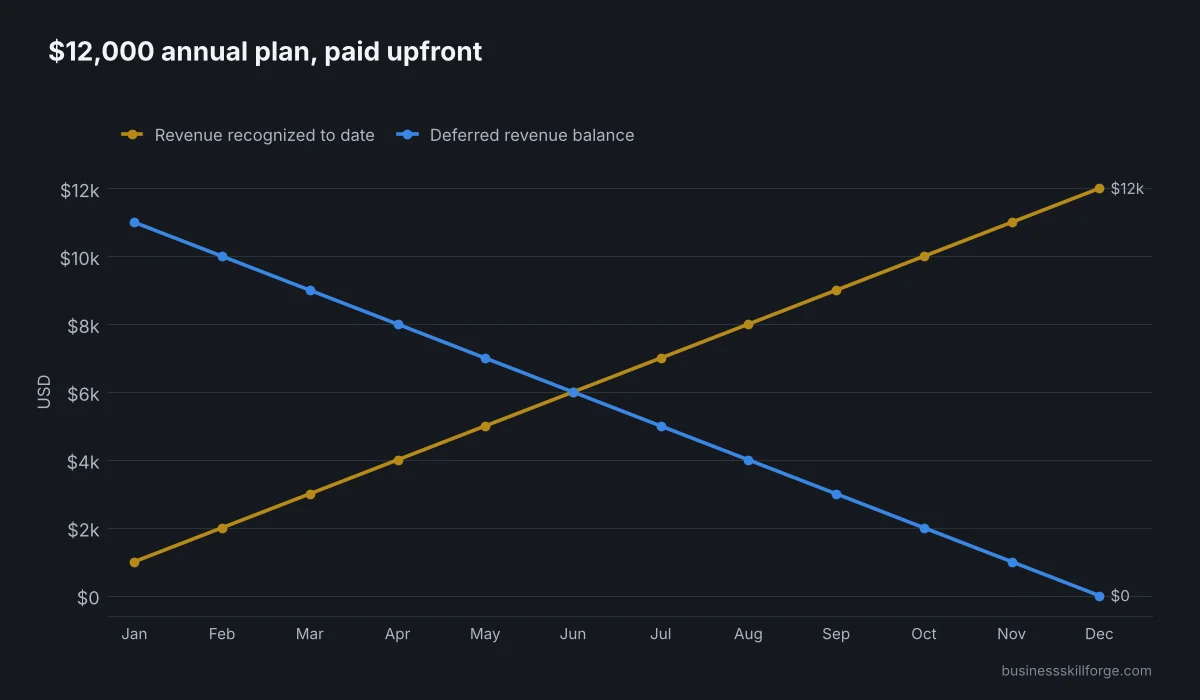
Why bother? Because the cash version tells a false story. A business that sells most annual plans in January would look wildly profitable in winter and loss-making all summer, even though the work is spread evenly. The accrual version also shows the obligation honestly: if the company closed in June, it would owe customers service (or refunds) worth $6,000.
The five-step model in plain English
In 2014 the FASB and the IASB issued a converged revenue standard: ASC Topic 606 under US GAAP and IFRS 15 internationally, which applies to companies reporting under IFRS in the UK, Canada, Australia and most other countries (many private companies there use a local framework instead). Both use the same five steps.

- Identify the contract. A contract can be a signed agreement, an accepted quote, or your standard terms when someone checks out online. It needs to create enforceable rights and payment terms.
- Identify the performance obligations. A performance obligation is a distinct promise to deliver a good or service. A website build plus a year of hosting is two promises, not one.
- Determine the transaction price. This is what you expect to receive, after discounts, rebates or likely refunds.
- Allocate the price to each obligation. If you bundle things, split the price in proportion to what each piece would sell for on its own.
- Recognize revenue when each obligation is satisfied. That happens either at a point in time (handing over a product) or over time (a subscription or a long build).
Most small-business sales clear steps one to four in a second. A coffee sold over the counter is one contract, one obligation, one price, satisfied on the spot. The steps start to matter with subscriptions, bundles, deposits and projects.
Point in time vs over time
The fifth step is where timing is decided. A performance obligation is satisfied at a point in time unless it meets one of the over-time tests.
| Point in time | Over time | |
|---|---|---|
| When revenue is recorded | When control passes to the customer | Gradually, as the work is performed |
| Typical signs | Customer has legal title, physical possession, and you have a right to payment | Customer benefits as you work, controls the asset as it’s built, or you’re building something custom with a right to be paid for work to date |
| Examples | Retail sale, shipped product, one-off logo file delivered | Monthly bookkeeping, software subscription, construction on the client’s site, retainer |
| How to measure | Full amount on the transfer date | Time elapsed, costs incurred, hours worked or milestones reached |
Worked examples you’ll actually run into
A product shipped across month-end
A bike shop takes an online order for a $1,500 bike on March 30, charges the card the same day, ships on April 2 and the bike is delivered April 4. The cash came in March, but the bike was still in the shop. If the shop’s terms say ownership passes when the bike leaves the warehouse, revenue belongs to April 2. If ownership passes on delivery, it’s April 4. Either way, March shows a $1,500 liability (a customer deposit), not a sale.
A deposit before the work
A caterer books a $5,000 wedding for next month and takes a 50% deposit. Today: debit cash $2,500, credit customer deposits (deferred revenue) $2,500. After the event: debit customer deposits $2,500, debit accounts receivable $2,500, credit catering revenue $5,000. The deposit never touches the income statement on its own.
A bundle with two promises
A web agency sells a site build plus 12 months of hosting for $9,000, paid upfront. On their own, it charges $8,000 for a build and $2,000 for a year of hosting, a combined $10,000. The $1,000 bundle discount gets shared out proportionally: each piece is recognized at 90% of its standalone price.
| Obligation | Standalone price | Share | Allocated price | When recognized |
|---|---|---|---|---|
| Website build | $8,000 | 80% | $7,200 | When the site launches |
| 12 months hosting | $2,000 | 20% | $1,800 | $150 a month for 12 months |
| Total | $10,000 | 100% | $9,000 |

The common shortcut, booking all $9,000 at launch, overstates launch-month revenue by $1,800 and understates the following year.
A long job measured by cost
A contractor signs a $60,000 kitchen remodel and estimates total costs of $40,000. Because the work happens in the client’s house, the client controls it as it’s built, so revenue is recognized over time. Using costs incurred as the measure of progress:
| Month | Cumulative costs | % complete | Cumulative revenue | Revenue this month |
|---|---|---|---|---|
| 1 | $10,000 | 25% | $15,000 | $15,000 |
| 2 | $26,000 | 65% | $39,000 | $24,000 |
| 3 | $40,000 | 100% | $60,000 | $21,000 |
If the cost estimate changes partway through, you recalculate the percentage complete from that point. Billing doesn’t have to match: the client might pay a third upfront, a third at cabinets and a third at sign-off. The gap between what’s billed and what’s earned sits on the balance sheet as deferred or accrued revenue.
Deferred revenue vs accrued revenue
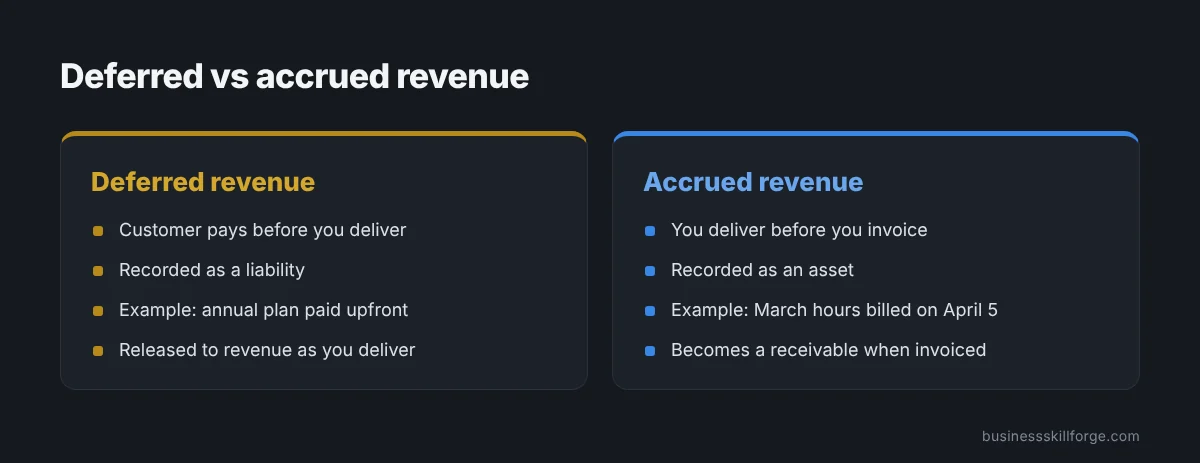
These two are mirror images, and mixing them up is how balance sheets go wrong.
| Deferred revenue | Accrued revenue | |
|---|---|---|
| Cash vs work | Paid before you deliver | Delivered before you bill |
| Balance sheet | Liability | Asset |
| Example | Annual plan paid upfront | Consulting hours worked in March, invoiced April 5 |
| Clears when | You deliver the service | You send the invoice (it becomes a receivable) |
Does this apply to your business?
Formal ASC 606 or IFRS 15 compliance matters when you produce financial statements under GAAP or IFRS: audited or reviewed accounts, bank covenants, investor reporting, or a sale of the company. Many sole proprietors and small firms keep cash-basis books for tax and never need the full standard. Tax rules on when income is taxable are separate from accounting rules and differ between the US, UK, Canada and Australia, so don’t assume your tax return follows your accrual books.
Still, the idea is useful even if you stay on cash. If you sell prepaid packages, retainers or annual plans, tracking how much you’ve been paid for work not yet done tells you what you actually owe customers. That number is easy to forget and painful to discover.
Common revenue recognition mistakes
- Booking upfront payments as revenue. Annual plans, retainers and deposits are liabilities until delivered.
- Treating bundles as one sale. If parts are delivered at different times, split the price.
- Recognizing revenue on signature. A signed contract with nothing delivered is not revenue.
- Forgetting refunds and discounts. If you know a share of sales usually comes back, the transaction price should reflect it.
- Never releasing deferred revenue. Some businesses post the upfront payment correctly but forget the monthly entry, so the liability just grows. A recurring journal entry fixes this.
- Comparing accrual revenue to cash in the bank. They will differ. Reconcile the gap through deferred revenue and receivables, as covered in how to read an income statement.
What to do next
List every way customers pay you before you deliver: deposits, prepaid packages, annual plans, retainers. For each one, decide how you’ll release it to revenue (monthly, on delivery, by milestone) and set up a recurring journal entry or a deferred revenue schedule in a spreadsheet. Then check your deferred revenue balance against that schedule at each month-end. If the two don’t match, you’ve found either a missed entry or a customer who prepaid for something you haven’t delivered.
Key takeaways
- Revenue recognition records a sale when you deliver what was promised, not when cash arrives or a contract is signed.
- Cash received before delivery is deferred revenue, a liability, and moves to revenue as you earn it.
- ASC 606 and IFRS 15 use the same five steps: contract, obligations, price, allocation, and recognition as each obligation is satisfied.
- Bundled deals should be split by standalone selling price, so each piece is recognized when that piece is delivered.
- Long jobs and subscriptions are usually recognized over time; product sales are usually recognized at the point control passes.
Frequently asked questions
When should revenue be recognized?
Revenue should be recognized when you transfer the promised goods or services to the customer, meaning when the customer gains control of them. For a product, that’s usually when it’s shipped or delivered, depending on your terms. For a service delivered over a period, such as a subscription or monthly retainer, revenue is recognized gradually across that period rather than all at once.
Is deferred revenue a liability?
Yes. Deferred revenue is a liability because you’ve been paid for goods or services you still owe the customer. If you couldn’t deliver, you’d normally have to refund the money. As you deliver the service, you reduce the deferred revenue balance and record the same amount as revenue on the income statement.
What is the difference between ASC 606 and IFRS 15?
ASC 606 is the US GAAP revenue standard and IFRS 15 is the international equivalent, used by companies that report under IFRS in the UK, Canada, Australia and many other countries. They were developed together and share the same core principle and five-step model. Many private companies outside the US use a local framework instead, such as FRS 102 in the UK or ASPE in Canada, whose revenue rules differ in detail.
Do small businesses have to follow ASC 606?
Only if they prepare financial statements under US GAAP, for example for an audit, a lender that requires GAAP statements, or investors. Many small businesses keep cash-basis books for tax and internal use, which don’t follow ASC 606. Even so, tracking prepayments and deposits separately helps you see what you still owe customers.
Can I recognize revenue when I send the invoice?
Only if the invoice is sent when the work is delivered. Revenue is tied to delivery, not to paperwork. If you invoice upfront for future work, the amount is deferred revenue until you deliver. If you finish work in March but invoice in April, the revenue still belongs to March under accrual accounting, recorded as accrued revenue until invoiced.
Sources
- ACCA: Revenue revisited (IFRS 15 five-step model)
- NYSSCPA: FASB, IASB release final form of revenue recognition standard
This article is general education, not tax, legal, accounting or investment advice. Rules and thresholds differ by country and change over time, so check the specifics for your situation. See our financial disclaimer.
Get practical finance & accounting tips in your inbox
Join US professionals getting our best guides, templates and tools. Free. Unsubscribe anytime.