Debits and Credits Explained With Simple Examples
October 25, 2026 · Aditya Gupta

Debits and credits are the two sides of every bookkeeping entry. A debit is an entry on the left side of an account and a credit is an entry on the right. Debits increase assets, expenses and owner draws; credits increase liabilities, equity and revenue. Every transaction has at least one of each, and the totals always match.
That’s the whole rule. The trouble is that most people learn it as a list to memorize, then freeze the first time they have to book a customer deposit or a credit card payment. This guide fixes that by walking one small business through nine real transactions, entry by entry, until the books balance. By the end you should be able to work out any entry from first principles instead of guessing.
What debits and credits actually mean
Forget the everyday meaning of “credit” as something good and “debit” as money leaving. In bookkeeping, the words only mean left and right. A debit is an amount recorded on the left side of an account. A credit is an amount recorded on the right side. Whether that entry makes the balance go up or down depends entirely on what kind of account it is.
The IRS describes the double-entry system in exactly these terms in Publication 583: each account has a left side for debits and a right side for credits, and the system is self-balancing because every transaction is recorded as a debit in one account and a credit in another. After you post your entries, total debits must equal total credits. If they don’t, there’s an error somewhere.
Double-entry bookkeeping is a method where every transaction changes at least two accounts by equal and opposite amounts. That’s why it catches mistakes a simple checkbook register never will.
The debit and credit rules for each account type
There are five main account types, and each has a normal balance, which is the side that increases it. The normal balance of an account is the side (debit or credit) where its increases are recorded and where its balance usually sits.
| Account type | Examples | A debit will | A credit will | Normal balance |
|---|---|---|---|---|
| Assets | Cash, accounts receivable, equipment | Increase | Decrease | Debit |
| Expenses | Rent, software, wages | Increase | Decrease | Debit |
| Owner draws / dividends | Owner’s draw, dividends paid | Increase | Decrease | Debit |
| Liabilities | Accounts payable, credit card, loans | Decrease | Increase | Credit |
| Equity | Owner’s capital, retained earnings | Decrease | Increase | Credit |
| Revenue | Sales, service income | Decrease | Increase | Credit |
A common memory aid is DEA-LER: Draws, Expenses and Assets go up with debits; Liabilities, Equity and Revenue go up with credits. If you remember only one line from this article, make it that one.

Why debits always equal credits
The rules above aren’t arbitrary. They fall straight out of the accounting equation:
Assets = Liabilities + Equity
Assets sit on the left of the equals sign, so they increase on the left (debit). Liabilities and equity sit on the right, so they increase on the right (credit). Revenue and expenses are really just sub-accounts of equity: revenue adds to what the owner has in the business, so it behaves like equity and increases with a credit. Expenses and owner draws reduce equity, so they work in reverse and increase with a debit.
Because every entry has equal debits and credits, the equation stays in balance after every single transaction. That’s the safety net. If you want to see the equation hold up through a run of transactions, our walkthrough of the accounting equation worked through 10 transactions shows it line by line.
How to work out any journal entry in four steps
A journal entry is the record of one transaction, listing each account affected and whether it is debited or credited. When you’re not sure how to book something, run through these steps in order:
- Name the accounts. What changed? Cash, a bill you owe, a sale, an expense?
- Classify each one. Is it an asset, liability, equity, revenue or expense account?
- Decide the direction. Did each account go up or down?
- Apply the rule. Use the table above to turn “up” or “down” into debit or credit, then check that both sides total the same amount.

Debits and credits examples: nine transactions for a new business
Meet Maya, who has just opened a one-person brand design studio. Here’s her first month, booked entry by entry. Watch how each one follows the four steps.
1. Maya puts $10,000 of her own money into the business
Cash (asset) goes up, and her capital (equity) goes up. Debit Cash $10,000, credit Owner’s capital $10,000.
2. She buys a computer for $2,400 in cash
Equipment (asset) goes up, cash (asset) goes down. One asset is swapped for another. Debit Equipment $2,400, credit Cash $2,400.
3. She pays $300 for design software on the business credit card
Software expense goes up. No cash has left yet; instead she owes the card company, so a liability goes up. Debit Software expense $300, credit Credit card payable $300.
4. She invoices a client $6,000 for a branding project
She has earned the money but not collected it. Accounts receivable (asset) goes up and revenue goes up. Debit Accounts receivable $6,000, credit Revenue $6,000.
5. The client pays the $6,000 invoice
Cash goes up and the receivable goes away. Notice that revenue isn’t touched again; it was recorded when the work was billed. Debit Cash $6,000, credit Accounts receivable $6,000.
6. She pays $1,200 rent for a shared studio
Debit Rent expense $1,200, credit Cash $1,200.
7. She pays off the $300 credit card balance
Cash goes down and the liability goes down. This is the one people get wrong most often: paying the card is not a second software expense. The expense was already recorded in step 3. Debit Credit card payable $300, credit Cash $300.
8. She takes $2,000 out for personal living costs
An owner’s draw isn’t a business expense. It reduces equity, and the draw account increases with a debit. Debit Owner’s draw $2,000, credit Cash $2,000.
9. A new client pays a $1,500 deposit for work starting next month
Cash goes up, but Maya hasn’t earned this yet. She owes either the work or a refund, so it’s a liability called unearned (or deferred) revenue. Debit Cash $1,500, credit Unearned revenue $1,500. When she does the work next month, she’ll debit Unearned revenue and credit Revenue.
How to check your work: T-accounts and the trial balance
T-accounts show the running balance
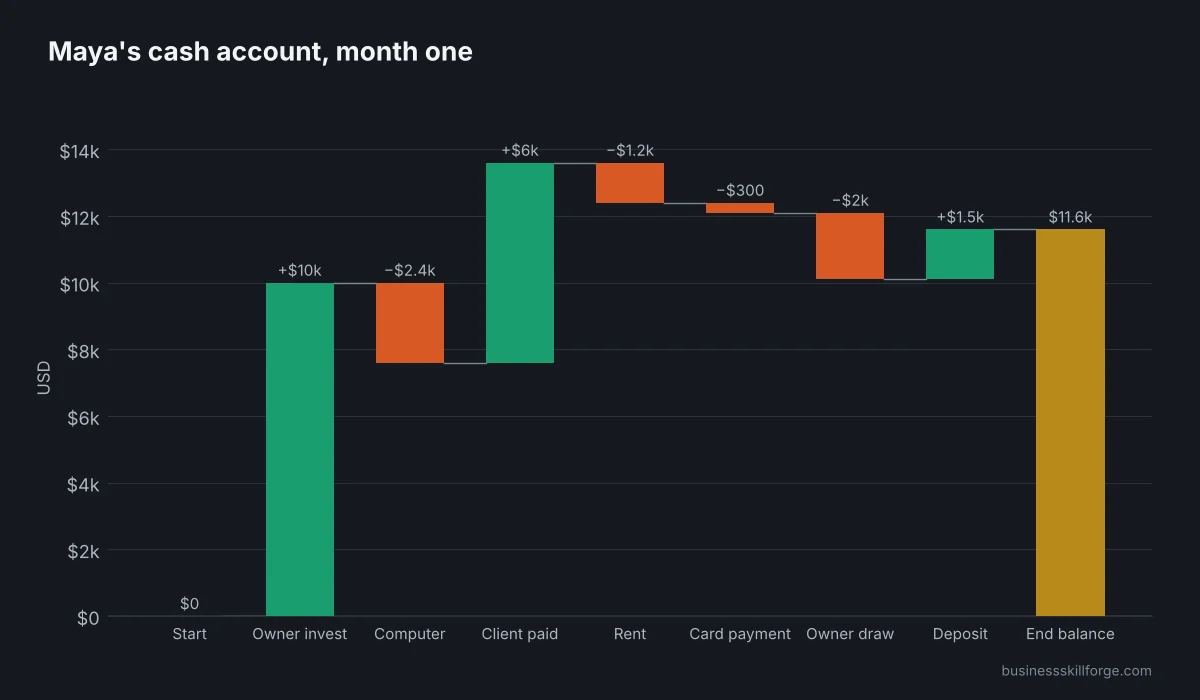
A T-account is a quick sketch of a single ledger account: debits on the left of the T, credits on the right. Here’s Maya’s cash account after all nine transactions.
| Cash: debits (in) | Amount | Cash: credits (out) | Amount |
|---|---|---|---|
| 1. Owner investment | $10,000 | 2. Computer | $2,400 |
| 5. Client payment | $6,000 | 6. Rent | $1,200 |
| 9. Client deposit | $1,500 | 7. Card payment | $300 |
| 8. Owner’s draw | $2,000 | ||
| Total debits | $17,500 | Total credits | $5,900 |
Debits of $17,500 minus credits of $5,900 leaves a debit balance of $11,600, which is exactly what should be sitting in her business bank account. If her bank statement says something different, that’s what a bank reconciliation is for.
The trial balance checks every account at once
A trial balance is a list of every account’s balance at a point in time, with debit balances in one column and credit balances in the other. If the columns match, every entry was at least recorded with equal sides. Here’s Maya’s at month end.
| Account | Debit | Credit |
|---|---|---|
| Cash | $11,600 | |
| Equipment | $2,400 | |
| Accounts receivable | $0 | |
| Credit card payable | $0 | |
| Unearned revenue | $1,500 | |
| Owner’s capital | $10,000 | |
| Owner’s draw | $2,000 | |
| Revenue | $6,000 | |
| Software expense | $300 | |
| Rent expense | $1,200 | |
| Totals | $17,500 | $17,500 |
Both columns total $17,500. Her profit for the month is revenue of $6,000 less expenses of $1,500, so $4,500. Notice the $2,000 draw doesn’t reduce profit; it reduces the equity she has left in the business. Those balances then roll into her financial statements, and if you want to see where each one lands, our guide on how to read a balance sheet picks up from here.
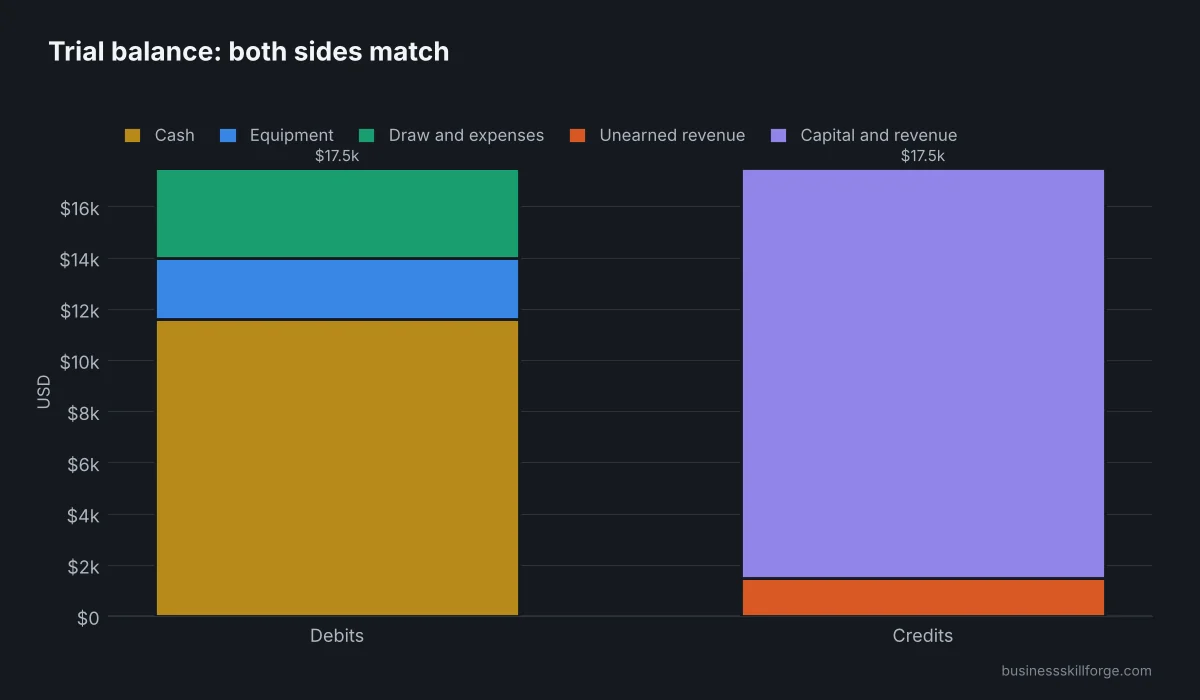
One warning: a balanced trial balance doesn’t prove the books are right. If Maya had booked the rent to the wrong expense account, or missed a transaction entirely, the columns would still match. The trial balance catches one-sided errors, not wrong-account or missing ones.
Why your bank says “credit” when your books say “debit”
This trips up almost everyone. When a customer pays you, your bank statement says your account was credited. In your books, you debit cash. Both are correct.
Your bank is keeping its own books, from its point of view. The money in your account is money the bank owes you, so to the bank it’s a liability. A liability increases with a credit, so the bank credits your account. In your books the same money is an asset, which increases with a debit. Same event, opposite sides of the relationship.
The same logic explains why a “debit card” is called that: each purchase reduces what the bank owes you, which on the bank’s books is a debit to your account.
Common mistakes with debits and credits
- Booking a loan or credit card payment as an expense. Paying down a balance reduces a liability. Only the interest portion of a loan payment is an expense.
- Treating owner draws as wages. For a sole proprietor or single-member LLC, money you take out is a draw against equity, not a business expense. Rules differ for corporations that pay the owner a salary through payroll, and for companies outside the US, so check how your entity is set up.
- Recording customer deposits as revenue. Money for work you haven’t done yet is a liability until you deliver.
- Counting revenue twice. If you record a sale when you invoice, the later payment only moves the amount from receivables to cash.
- Forgetting contra accounts. A few accounts run opposite to their type. Accumulated depreciation is an asset account with a credit balance, because it reduces the value of equipment on the balance sheet.
- Trusting a balanced trial balance as proof. It only proves the sides match, not that the right accounts were used.
What to do next
If you use software like QuickBooks or Xero, it writes most of these entries for you when you categorize a bank transaction. You still need the rules, because the software can only post a transaction to whichever account you pick. When something on the balance sheet looks wrong, you’ll trace it back through the debits and credits.
Three practical next steps:
- Pull your own trial balance and check that every account sits on its normal side. A cash account with a credit balance, or an expense with a credit balance, usually points to a miscategorized transaction.
- Set up accounts that make the rules easy to follow. Our guide to setting up a chart of accounts for a small business covers the numbering and structure.
- If you want guided practice with more entries, the accounting and bookkeeping masterclass for beginners works through them in order.
Key takeaways
- A debit is an entry on the left side of an account and a credit is an entry on the right; neither word means good or bad.
- Debits increase assets, expenses and owner draws, while credits increase liabilities, equity and revenue (DEA-LER).
- Every journal entry has equal debits and credits, which keeps Assets = Liabilities + Equity in balance.
- Paying a bill you already recorded reduces a liability; it isn’t a second expense.
- A balanced trial balance catches one-sided errors but won’t catch entries posted to the wrong account.
Frequently asked questions
Is a debit an increase or a decrease?
It depends on the account. A debit increases assets, expenses and owner draws, and decreases liabilities, equity and revenue. So debiting cash means more cash, while debiting accounts payable means you owe less. The word debit only tells you the entry goes on the left side of the account. The account type tells you whether that raises or lowers the balance.
Why do debits and credits have to be equal?
Because every transaction affects the accounting equation, Assets = Liabilities + Equity, on both sides at once or swaps value within one side. Recording equal debits and credits keeps that equation balanced after every entry. It also gives you a built-in error check: if total debits and total credits in your ledger don’t match, something was posted to only one side or with the wrong amount.
Is revenue a debit or a credit?
Revenue is a credit. Revenue increases the owner’s equity in the business, and equity accounts increase with credits, so a sale is recorded as a credit to revenue. The matching debit usually goes to cash for an immediate payment or to accounts receivable if you invoiced and will be paid later. A refund to a customer reverses this with a debit to revenue or to a sales returns account.
Why does my bank statement call a deposit a credit?
Your bank statement shows your account from the bank’s point of view. The money you hold there is a debt the bank owes you, which is a liability on its books, and liabilities increase with credits. In your own books the same money is an asset, cash, which increases with a debit. Both records are correct; they describe the same deposit from opposite sides.
Do I need to understand debits and credits if I use accounting software?
Yes, at least the basics. Software posts the debits and credits automatically, but only to the accounts you choose when you categorize transactions. If you pick the wrong account, the software will happily record the wrong entry. Knowing the rules lets you spot a balance on the wrong side, fix miscategorized transactions and understand what your accountant means when they ask about an adjusting entry.
Sources
This article is general education, not tax, legal, accounting or investment advice. Rules and thresholds differ by country and change over time, so check the specifics for your situation. See our financial disclaimer.
Get practical finance & accounting tips in your inbox
Join US professionals getting our best guides, templates and tools. Free. Unsubscribe anytime.