Single-Entry vs Double-Entry Bookkeeping: Which to Use
November 4, 2026 · Aditya Gupta

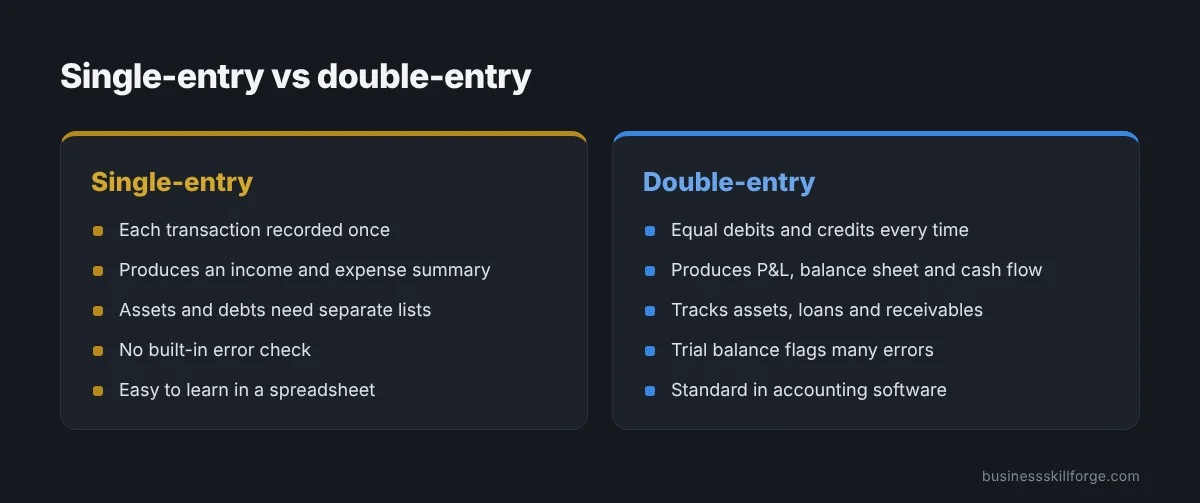
The difference in single-entry vs double-entry bookkeeping is how much each transaction tells you. Single-entry records each transaction once, as money in or money out, like a checkbook register. Double-entry records every transaction in at least two accounts, a debit and an equal credit, so you get a full balance sheet and a built-in check that the books add up.
Single-entry is quicker to learn and perfectly adequate for some very small businesses. Double-entry takes more understanding but shows you what you own, what you owe and whether your numbers are internally consistent. The rest of this article records the same month both ways, so you can see exactly what each system shows and what it misses.
What is single-entry bookkeeping?
Single-entry bookkeeping is a system where each transaction is recorded once, in a running list of income and expenses. The IRS describes it in Publication 583 as the simplest system to maintain, built around the income statement, with daily and monthly summaries of cash receipts and disbursements. It also notes that it may not suit everyone.
A single-entry cash book usually looks like this:
| Date | Description | Category | Money in | Money out | Balance |
|---|---|---|---|---|---|
| Mar 10 | Parent payments, March sessions | Tutoring income | $4,200 | $13,600 | |
| Mar 15 | Tutor contractor | Contract labor | $1,500 | $12,100 | |
| Mar 20 | Room rent | Rent | $900 | $11,200 |
It answers “how much came in, how much went out, and what’s left” very well. It doesn’t record what you own beyond cash, what you owe, or what customers owe you, unless you keep separate lists for those.
What is double-entry bookkeeping?
Double-entry bookkeeping is a system where every transaction affects at least two accounts, with total debits always equal to total credits. It rests on the accounting equation: assets equal liabilities plus equity. When you pay rent, cash goes down (a credit to cash) and rent expense goes up (a debit to rent). When you take out a loan, cash goes up and a loan liability goes up by the same amount.
Publication 583 describes double-entry as having built-in checks and balances to assure accuracy and control. Each account has a left side for debits and a right side for credits, transactions go through a journal into ledger accounts, and total debits must equal total credits. If debits and credits are new to you, start with our guide to debits and credits.
Single-entry vs double-entry: side by side
| Single-entry | Double-entry | |
|---|---|---|
| Entries per transaction | One | Two or more (debits = credits) |
| Main output | Income and expense summary | Income statement, balance sheet, cash flow |
| Tracks assets and liabilities | Only in separate lists, if at all | Yes, in the ledger |
| Built-in error check | No | Yes, the trial balance |
| Works with accrual accounting | Poorly | Yes |
| Learning curve | Low | Moderate |
| Typical tool | Spreadsheet or cash book | Accounting software |
| Good fit | Very small, cash-only, no debt or inventory | Anything with loans, assets, inventory, staff or outside readers |
Most modern accounting software is double-entry under the hood even if you never type a debit. When you categorize a bank transaction as “rent,” the software credits the bank account and debits rent expense for you.
The same month recorded both ways
Brightpath Tutoring is a small tutoring business that starts March with $5,000 in the bank, all of it put in by the owner. Here’s what happens during the month:
- Mar 1: borrows $8,000 from the bank to fit out a room.
- Mar 3: buys tablets and a laptop for $3,600, expected to last three years.
- Mar 10: receives $4,200 from parents for March sessions.
- Mar 15: pays a contract tutor $1,500.
- Mar 20: pays $900 room rent.
- Mar 31: invoices a local school $2,400 for a March workshop, to be paid in April.
Single-entry version
The cash book shows $12,200 in and $6,000 out, ending with $11,200 in the bank. A careless reader might say the business made $6,200 in March. That’s wrong: $8,000 of the money in was a loan and $3,600 of the money out was equipment.
A careful single-entry bookkeeper tags those correctly and reports income of $4,200 and expenses of $2,400 (tutor and rent), so profit is $1,800. That’s a fair cash-basis figure. But the books say nothing about the $8,000 loan balance, the $3,600 of equipment or the $2,400 the school owes, unless the owner keeps three extra lists and remembers to update them.
Double-entry version
Here are the same events as journal entries, using accrual accounting and adding a month of depreciation on the equipment ($3,600 ÷ 36 months = $100).
| Event | Debit | Credit | Amount |
|---|---|---|---|
| Bank loan | Cash | Loan payable | $8,000 |
| Buy equipment | Equipment | Cash | $3,600 |
| Parent payments | Cash | Tutoring revenue | $4,200 |
| Pay tutor | Contract labor | Cash | $1,500 |
| Pay rent | Rent expense | Cash | $900 |
| Invoice school | Accounts receivable | Tutoring revenue | $2,400 |
| Depreciation | Depreciation expense | Accumulated depreciation | $100 |
Revenue is $6,600 ($4,200 + $2,400) and expenses are $2,500 ($1,500 + $900 + $100), so accrual profit is $4,100. The $2,300 gap from the single-entry figure is the school invoice ($2,400) less the depreciation ($100).

The double-entry books also produce a balance sheet without extra work. Assets: cash $11,200, receivable $2,400 and equipment $3,500 after depreciation, a total of $17,100. Liabilities: the $8,000 loan. Equity: the owner’s $5,000 plus $4,100 profit, $9,100. And $8,000 + $9,100 = $17,100, so the equation balances. Our guide on how to read a balance sheet explains each of those lines.
Why double-entry catches errors
Because every entry has equal debits and credits, the totals of all debit balances and all credit balances must match. A trial balance is a list of every account balance that checks exactly that. Here’s Brightpath’s at March 31:
| Account | Debit | Credit |
|---|---|---|
| Cash | $11,200 | |
| Accounts receivable | $2,400 | |
| Equipment | $3,600 | |
| Accumulated depreciation | $100 | |
| Loan payable | $8,000 | |
| Owner’s equity | $5,000 | |
| Tutoring revenue | $6,600 | |
| Contract labor | $1,500 | |
| Rent expense | $900 | |
| Depreciation expense | $100 | |
| Total | $19,700 | $19,700 |
Suppose the rent had been entered as a $900 debit to rent expense, but the credit side was keyed as $90. Cash would show $12,010 instead of $11,200, so debits would total $20,510 against credits of $19,700, and the $810 difference would flag the mistake immediately. In a single-entry cash book, the same typo just produces a wrong balance that nobody notices until the bank statement disagrees.
Double-entry has limits. It won’t catch a transaction left out completely, or one posted to the wrong account on the correct side (rent recorded as advertising still balances). That’s why you still reconcile to bank statements.
Which one should you use?
Single-entry is reasonable if all of these are true: you’re a sole proprietor or freelancer, you have no inventory, no employees and no business loans, you don’t buy significant equipment, and nobody outside the business (a lender, investor or buyer) needs your financial statements.
Switch to double-entry when any of these appear:
- You take on a loan or credit line.
- You buy equipment or vehicles you’ll depreciate.
- You carry inventory.
- You invoice customers on terms and want to track receivables properly.
- You hire staff and run payroll.
- A bank, investor or buyer asks for a balance sheet.
- You want accrual-basis reports to see true monthly profit.
In practice, many small businesses get double-entry for free by using accounting software. If you’re using a spreadsheet only because software looked complicated, the switch is often simpler than it seems.
How to switch from single-entry to double-entry
The cleanest moment to switch is the start of a month, quarter or year, so the opening balances are easy to establish.
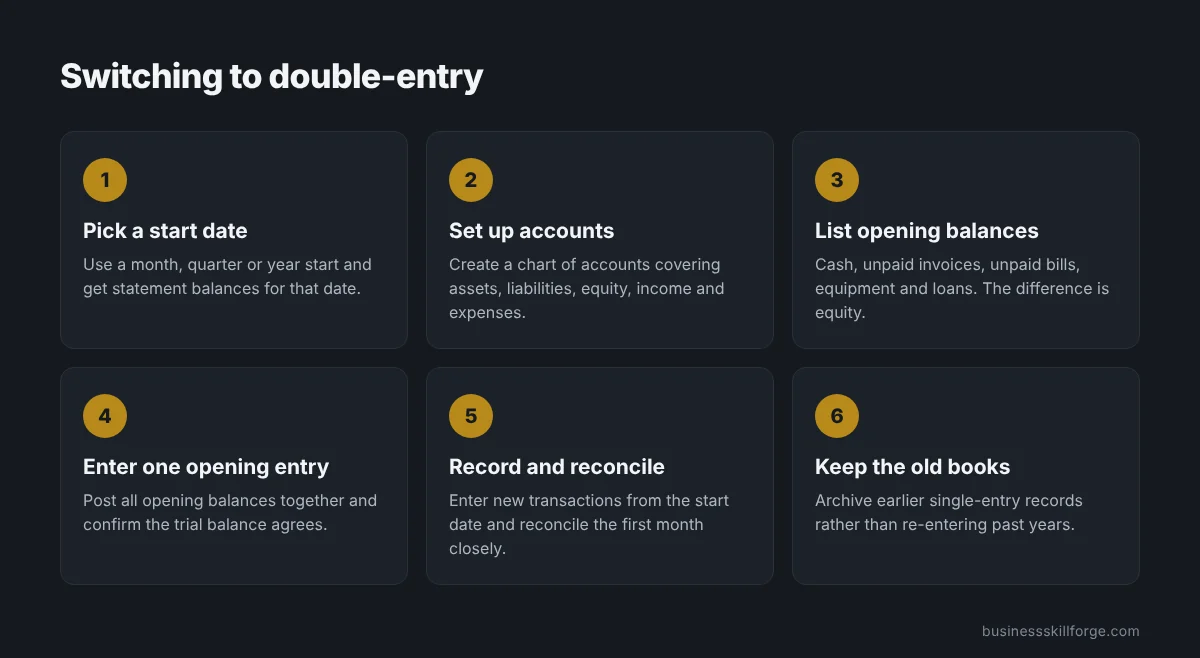
- Pick a start date and get the bank and card statement balances for that date.
- Set up a chart of accounts that covers assets, liabilities, equity, income and expenses. Our glossary entry on the chart of accounts shows the standard structure.
- List opening balances: cash in each account, unpaid customer invoices, unpaid bills, equipment at cost, loan balances. The difference between total assets and total liabilities is your opening equity.
- Enter the opening balances as one journal entry, and check that the trial balance matches.
- Record transactions from the start date in the new system and reconcile the first month carefully against the bank.
- Keep the old records for the earlier periods. Don’t re-enter years of history unless someone needs it.
Common mistakes with either system
- Treating loans as income and repayments as expenses. Common in single-entry books, and it distorts profit badly.
- Expensing equipment purchases. A $3,600 purchase that lasts three years isn’t a one-month expense in accrual books.
- Assuming a balanced trial balance means correct books. It only proves debits equal credits.
- Using a “suspense” account as a permanent home. In double-entry software, unexplained items parked in suspense need clearing every month.
- Keeping single-entry books but promising a lender a balance sheet. Building one after the fact takes much longer than recording it as you go.
What to do next
Write down which of the switch triggers above apply to you. If none do, a well-kept single-entry cash book with a separate invoice list is fine for now. If one or more do, set up double-entry software from the start of next month using the six steps above. If you’d like a structured walkthrough of journals, ledgers and trial balances, our accounting and bookkeeping masterclass for beginners covers them module by module.
Key takeaways
- Single-entry bookkeeping records each transaction once as money in or out; double-entry records equal debits and credits in at least two accounts.
- Single-entry is simple and fine for very small cash businesses with no loans, inventory or significant equipment.
- Double-entry produces a balance sheet and a trial balance, which reveals many recording errors immediately.
- In the worked example, the same month showed $1,800 of cash-basis profit and $4,100 of accrual profit, and only double-entry tracked the $8,000 loan.
- Switch to double-entry when you take on debt, assets, inventory, staff or outside readers of your financial statements.
Frequently asked questions
Is single-entry bookkeeping acceptable for taxes?
In the US, the IRS describes single-entry as the simplest bookkeeping system and practical for many small businesses, though it notes it may not suit everyone. What matters for tax is that your records are complete, accurate and supported by documents such as receipts, invoices and bank statements. Other countries have their own record-keeping rules, so check local guidance.
What is the main advantage of double-entry bookkeeping?
It gives you a complete picture and a built-in accuracy check. Because every transaction has equal debits and credits, you can produce a balance sheet showing assets, liabilities and equity, and a trial balance that flags many recording errors. Single-entry systems show income and expenses but don’t track what you own and owe in the same structured way.
Does accounting software use double-entry?
Most mainstream small-business accounting software is double-entry underneath. When you categorize a bank transaction or record an invoice, the software creates the matching debit and credit automatically. That’s why it can produce a balance sheet and trial balance even if you never enter a journal entry by hand.
Can I use double-entry bookkeeping with cash-basis accounting?
Yes. Double-entry is about how transactions are recorded, while cash or accrual basis is about when income and expenses are recognized. You can run double-entry books on a cash basis, recording revenue when paid and expenses when paid, and still get a trial balance and a balance sheet for cash, loans and equipment.
When should a small business switch to double-entry?
Switch when you take on a business loan, buy equipment you’ll depreciate, hold inventory, invoice customers on credit terms, hire employees, or need a balance sheet for a bank, investor or buyer. Any one of those makes single-entry records hard to keep accurate. The cleanest time to switch is the start of a month, quarter or year.
Sources
This article is general education, not tax, legal, accounting or investment advice. Rules and thresholds differ by country and change over time, so check the specifics for your situation. See our financial disclaimer.
Get practical finance & accounting tips in your inbox
Join US professionals getting our best guides, templates and tools. Free. Unsubscribe anytime.