Bookkeeping for Freelancers and Sole Proprietors
October 31, 2026 · Aditya Gupta

Bookkeeping for freelancers means keeping a complete, organized record of every dollar your business earns and spends, so you know your real profit, can pay the right tax on time and can prove your numbers if asked. For most sole proprietors that takes a separate bank account, a simple list of categories, a weekly 15-minute routine and a habit of setting money aside for tax.
You don’t need double-entry software and a monthly accountant on day one. You do need a system you’ll actually keep up with, because bad books cost a freelancer far more than a messy spreadsheet: a tax bill you didn’t plan for, deductions you can’t support, and no idea whether your rates are high enough. Here’s a setup that works, followed by a full quarter of numbers for a freelance designer.
What bookkeeping means when you work for yourself
Bookkeeping is the day-to-day recording and organizing of a business’s financial transactions. For a freelancer, that boils down to four questions you should be able to answer at any time:
- How much did I invoice, and how much of it has been paid?
- How much did I spend on the business, and on what?
- What’s my profit so far this year?
- How much do I owe in tax, and have I set it aside?
If your system answers those four quickly, it’s good enough. Everything else is refinement.
Setting up your books
Open a separate business account
This is the single most useful thing you can do. The IRS small-business guide, Publication 583, tells business owners to keep the business account separate from personal checking and to use it for business purposes only. Every client payment goes in. Every business expense comes out. Paying yourself is a transfer to your personal account, not an expense.
With a separate account, your bank statement becomes your first draft of the books. Without one, you’ll spend tax season deciding whether each coffee shop charge was a client meeting.
Pick cash basis, most likely
Most freelancers keep books on a cash basis: income counts when the client pays, and expenses count when you pay. It’s simpler and matches how you experience money. If you carry big unpaid invoices at year-end or need accrual statements for a lender, you’ll probably want a fuller system; our guide to single-entry vs double-entry bookkeeping explains when it’s worth the extra work.
Set up a short list of categories
Ten to fifteen expense categories is plenty: software, equipment, office costs, phone and internet, professional fees, advertising, travel, meals, education, and a few specific to your work. Match them to the tax form you file. Our guide on how to categorize business expenses lists the US Schedule C lines and how to handle mixed-use costs.
Choose a tool you’ll keep using
A spreadsheet is fine if you have a few dozen transactions a month and enjoy that sort of thing. Accounting software with a bank feed is better once you have more transactions, multiple payment platforms or employees. The best tool is the one you open every week.
Keep an invoice list next to the bank
Cash-basis books only show money that has arrived, so they can’t tell you who still owes you. Keep a simple invoice list with the client, invoice number, amount, date sent, due date and date paid. Most invoicing tools do this for you. Sort it by due date every week. A freelancer with $9,000 of unpaid invoices and $2,000 in the bank is in a very different position from one with $2,000 in the bank and nothing owed, and only the invoice list shows the difference.
A weekly and monthly routine
Bookkeeping goes wrong when it’s left for months. A short, regular routine keeps it small.
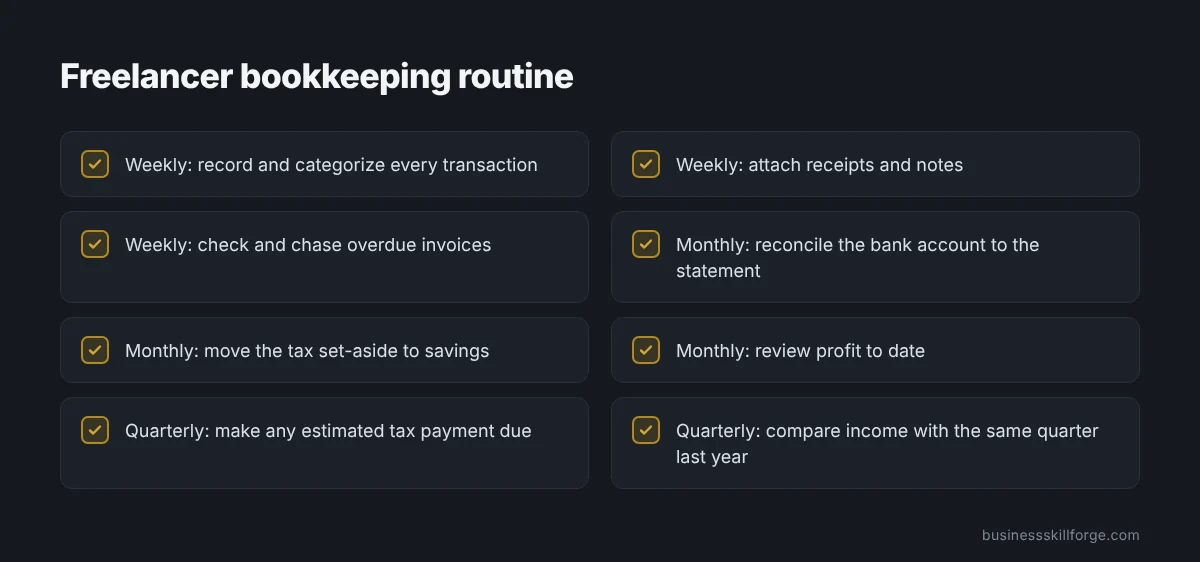
Once a week, record or categorize every transaction, attach receipts, and check which invoices are overdue. Once a month, reconcile the bank account to the statement, move the month’s tax set-aside into a separate savings account, and glance at profit to date. Once a quarter, make your estimated tax payment if you’re required to and compare your income with the same quarter last year.
Worked example: a freelance designer’s first quarter
Maya is a freelance brand designer billing around $6,000 a month. She keeps cash-basis books and sets aside 30% of each month’s profit for tax. (That percentage is her own planning choice based on last year’s return, not a rule. Yours depends on your income, deductions and where you live.)
| Month | Client payments received | Business expenses | Profit | Set aside (30%) |
|---|---|---|---|---|
| January | $6,000 | $640 | $5,360 | $1,608 |
| February | $4,800 | $520 | $4,280 | $1,284 |
| March | $7,200 | $890 | $6,310 | $1,893 |
| Quarter | $18,000 | $2,050 | $15,950 | $4,785 |
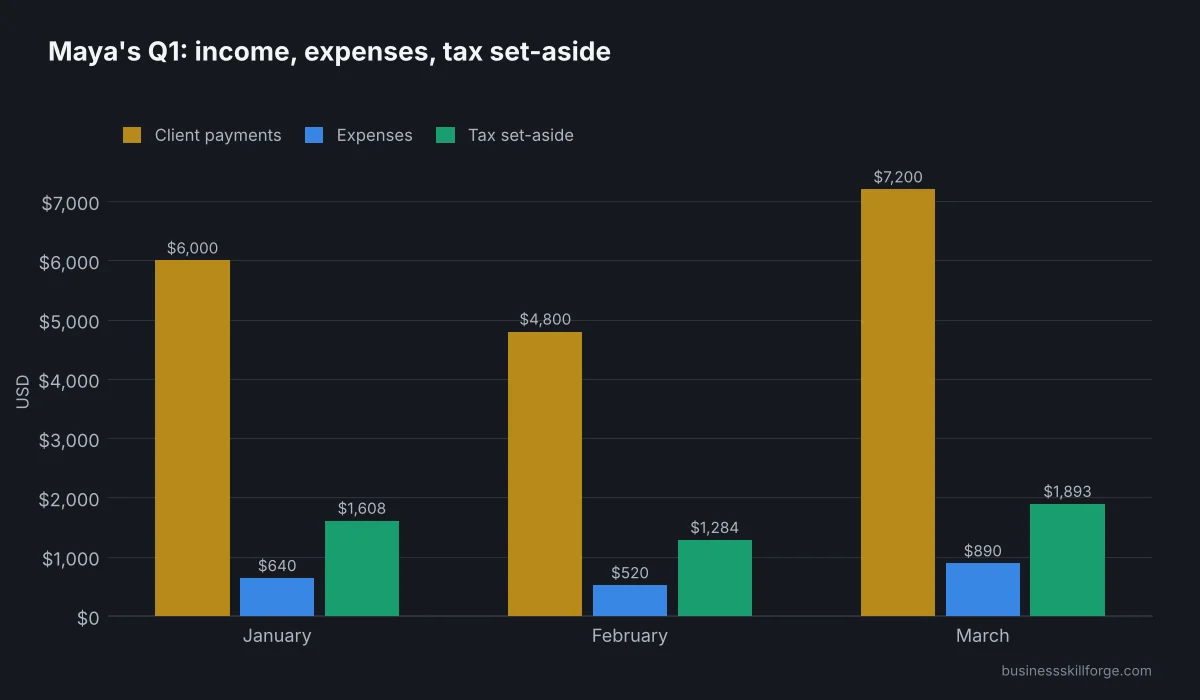
Her $2,050 of expenses for the quarter break down like this:
| Category | Q1 total | Notes |
|---|---|---|
| Software subscriptions | $360 | Design suite and project tool, $120 a month |
| Co-working day passes | $450 | Client workshops and focused days |
| Accountant | $400 | Prior-year tax return |
| Stock photos and fonts | $290 | Licensed for client projects |
| Advertising | $280 | Portfolio site promotion |
| Phone and internet | $270 | Business share only, based on a typical month |
| Total | $2,050 |
February’s dip wasn’t a slow month. Maya invoiced $6,500, but a $1,700 invoice was paid on March 3, which is part of why March looks strong. On cash-basis books that’s normal, and it’s exactly why she checks unpaid invoices weekly instead of relying on the bank balance.
By the end of March she has $4,785 sitting in a tax savings account. When her quarterly estimated payment is due, the money is already there.
How much to set aside for taxes
In the US, freelancers pay income tax plus self-employment tax. According to the IRS, the self-employment tax rate is 15.3%, made up of 12.4% for Social Security and 2.9% for Medicare, and you generally owe it if your net earnings from self-employment are $400 or more. The 12.4% Social Security part only applies up to an annual earnings cap; the 2.9% Medicare part has no cap. You can deduct the employer-equivalent portion when working out your adjusted gross income. Income tax comes on top, at your own bracket, plus state tax where it applies.
Nobody withholds any of this for you, so you have to pay during the year. The IRS says individuals generally need to make estimated tax payments if they expect to owe $1,000 or more when they file, after withholding, and that this commonly applies to sole proprietors and other self-employed people. See our quarterly estimated taxes glossary entry for how the schedule works.
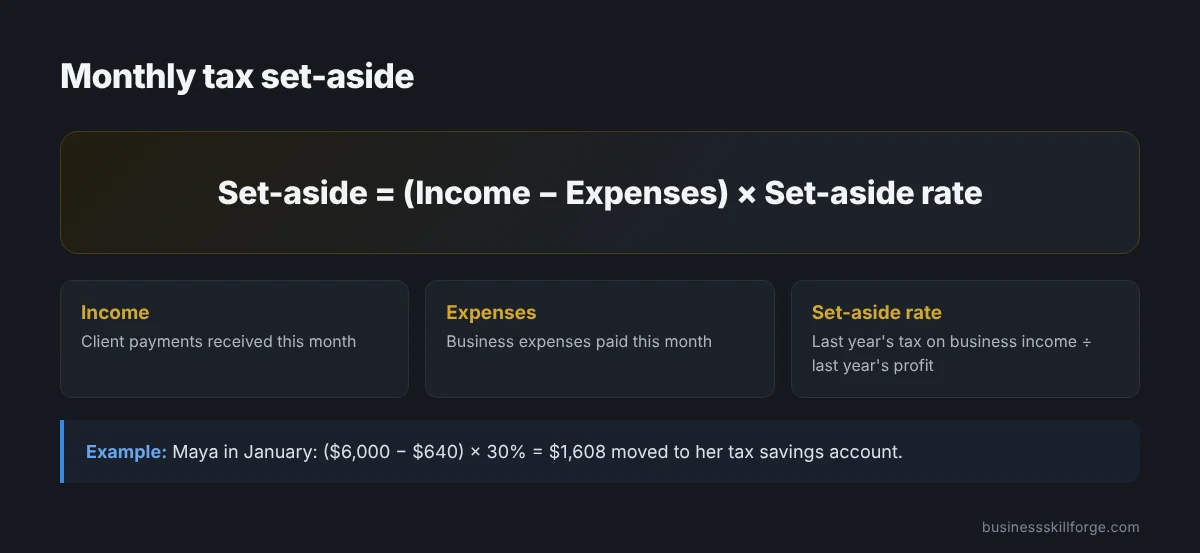
A simple method: take last year’s total tax bill for your business income, divide by last year’s business profit, and use that percentage (rounded up a little) as your set-aside rate this year. Move the money monthly, not when the bill arrives.
Records to keep, and for how long
Your books are only as good as the documents behind them. Publication 583 lists supporting documents such as sales slips, paid bills, invoices, receipts, deposit slips and canceled checks.
| Record | Why you keep it |
|---|---|
| Invoices you send | Proves income and payment terms |
| Bank and card statements | Proves money in and out; basis for reconciliation |
| Receipts and bills | Supports each deduction |
| Payment platform reports | Shows gross income and fees before payouts |
| Forms 1099 from clients (US) | Cross-check against your own income records |
| Mileage log, if you claim vehicle use | Supports the business share of vehicle costs |
| Purchase records for equipment | Supports depreciation and any later sale |
In the US, Publication 583 says to keep records until the period of limitations for the return runs out, which is generally three years after filing for most situations, and longer in some cases. Other countries set their own periods, so check HMRC, CRA or ATO guidance if you file there.
If you freelance in the UK, Canada or Australia
The routine above works anywhere, but the reporting rules don’t. In the UK, sole traders and landlords with qualifying income over £50,000 have had to use Making Tax Digital for Income Tax from 6 April 2026, keeping digital records in compatible software and sending quarterly updates. The threshold drops to £30,000 from April 2027 and £20,000 from April 2028. HMRC also offers a £1,000 trading allowance, but you can’t claim expenses if you use it. In Canada, self-employed income and expenses go on Form T2125. Australia has its own rules for sole traders. In each case, set up your categories to match the form you’ll file.
Common freelancer bookkeeping mistakes
- Mixing personal and business spending. It makes every transaction a judgment call and weakens your deductions.
- Counting invoices as income on cash-basis books. Income is what was paid, not what was billed.
- Spending the tax money. If it sits in your main account, it will get spent. Move it.
- Recording payouts instead of gross income. If a platform pays you $950 after a $50 fee, your income is $1,000 and the fee is an expense.
- Forgetting small recurring costs. Twelve months of a $15 subscription is $180 of deductions you’ll miss if it’s not recorded.
- Not tracking profit against your rate. If your books show a lower profit than you expected, your rate may be too low. Our freelance rate example shows how to work backward from a target income.
What to do next
This week, open a separate business account if you don’t have one and move all client payments to it. Set up a tax savings account and transfer a percentage of last month’s profit into it. Then block 15 minutes on the same day each week for bookkeeping. If you’re in the US and your income is growing fast, our quarterly tax example for a high-earning 1099 worker shows how the payments scale.
Key takeaways
- Freelance bookkeeping needs a separate business account, a short list of categories and a weekly routine more than it needs expensive software.
- Most freelancers can keep cash-basis books, recording income when paid and expenses when paid.
- US self-employment tax is 15.3% (the Social Security part stops at an annual earnings cap), it comes on top of income tax, and nobody withholds it for you.
- Set aside a fixed percentage of profit every month in a separate account so quarterly payments are never a surprise.
- Keep invoices, statements, receipts and platform reports for at least as long as your tax authority can review the return.
Frequently asked questions
Do freelancers need a separate bank account?
It isn’t legally required for a US sole proprietor, but the IRS recommends keeping your business account separate from your personal checking account, and it makes bookkeeping far easier. Every business transaction appears in one place, personal spending stays out of your deductions, and reconciliation becomes a quick monthly check instead of a forensic exercise.
Can I do my freelance bookkeeping in a spreadsheet?
Yes, if you have a modest number of transactions and keep it up weekly. Use one row per transaction with date, description, amount, category and a receipt link, plus a separate list of invoices. Once you’re handling many transactions, several payment platforms or employees, accounting software with a bank feed usually saves more time than it costs.
How much should a freelancer set aside for taxes?
It depends on your income, deductions, state and country, so there’s no single right percentage. A practical approach is to divide last year’s tax on your business income by last year’s business profit and use that rate, rounded up slightly. In the US, remember that self-employment tax of 15.3% comes on top of income tax.
Should freelancers use cash or accrual accounting?
Most freelancers use cash-basis accounting, recording income when clients pay and expenses when you pay them. It’s simpler and matches your bank account. Accrual accounting can make sense if you carry large unpaid invoices, hold inventory, or need financial statements for a lender. Tax rules on which method you may use vary, so check before switching.
What records should a freelancer keep?
Keep copies of invoices you send, bank and credit card statements, receipts and bills for expenses, payment platform reports, any 1099 forms from US clients, mileage logs if you claim vehicle use, and purchase records for equipment. Store them digitally, organized by year and month, and keep them for at least as long as your tax authority can review the return.
Sources
- IRS Publication 583, Starting a Business and Keeping Records
- IRS: Self-employment tax (Social Security and Medicare taxes)
- IRS: What taxpayers need to know about making estimated tax payments
- GOV.UK: Use Making Tax Digital for Income Tax
- GOV.UK: Expenses if you're self-employed
- CRA: T2125 Statement of Business or Professional Activities
This article is general education, not tax, legal, accounting or investment advice. Rules and thresholds differ by country and change over time, so check the specifics for your situation. See our financial disclaimer.
Get practical finance & accounting tips in your inbox
Join US professionals getting our best guides, templates and tools. Free. Unsubscribe anytime.