Common Bookkeeping Mistakes and How to Fix Them
October 30, 2026 · Aditya Gupta

The most common bookkeeping mistakes are mixing personal and business money, recording processor deposits instead of gross sales, booking loan payments and owner draws as expenses, skipping bank reconciliations and leaving duplicates in the books. Each one quietly changes your profit or balance sheet. Most can be fixed with a correcting entry once you know what to look for.
This guide walks through each mistake with real numbers, shows how several small errors can add up to a profit figure that’s off by tens of thousands of dollars, and explains how to correct past periods without making a bigger mess.
Quick reference: the bookkeeping mistakes that cause the most damage
Not every error matters equally. A $12 coffee coded to office supplies instead of meals is untidy, but it won’t change a lending decision. The mistakes below are the ones that move profit, misstate what you owe, or make your tax return disagree with third-party forms.
| Mistake | What it distorts | Typical symptom | Fix |
|---|---|---|---|
| Personal and business money mixed | Expenses, owner’s equity | Groceries or streaming services in the expense list | Reclassify to owner’s draw; open a separate account |
| Net deposits booked as sales | Revenue, fees | Revenue lower than the processor’s gross sales report | Record gross sales and fees separately |
| Loan payments expensed in full | Expenses, loan balance | Loan balance on the books never goes down | Split payments into principal and interest |
| Owner draws expensed | Expenses, equity | Profit far below what the bank balance suggests | Move draws to an equity account |
| No bank reconciliation | Cash, everything else | Book cash balance doesn’t match the statement | Reconcile every account monthly |
| Duplicate transactions | Revenue or expenses | Same amount appears twice, days apart | Match bank deposits to invoices, delete the duplicate |
If you only have time to check three things this month, check the loan balance, the owner’s draw account and whether your book cash matches the bank. Those three catch most of the large errors.
Mixing personal and business transactions
This is the mistake that causes most of the others. When the business card also pays for dinner with friends and the family phone plan, every transaction needs a judgment call, and judgment calls made at speed in a bank feed are where errors come from.
The fix has two parts. Going forward, open a separate business checking account and card, even if you’re a sole proprietor and the law doesn’t require it. For the past, don’t delete personal transactions that went through a business account, because the bank balance has to reconcile. Instead, code them to an owner’s draw or owner’s contribution account in your chart of accounts. A personal purchase paid by the business is a draw. A business expense paid from your personal card is a contribution (or a reimbursement the business owes you).
Picture a freelance designer billing $6,000 a month who runs everything through one account. Over a year, $2,600 of personal spending (a phone plan, gym membership, a few dinners) lands in expense categories. Her books show $2,600 more in expenses than she really had. Reclassifying those to owner’s draw raises her profit by exactly $2,600.
Recording net deposits instead of gross sales
Card processors and marketplaces pay you the sale minus their fees and minus any refunds. If you code the deposit straight to revenue, your sales and your fees are both understated. Gross sales are the full amount customers paid before fees, refunds or chargebacks are taken out.
Take a small online shop with $12,000 of card sales in a month. The processor keeps $378 in fees and $250 goes back to customers as refunds, so $11,372 lands in the bank.
| Line | Booked as a single deposit | Booked correctly |
|---|---|---|
| Sales | $11,372 | $12,000 |
| Refunds (contra-revenue) | $0 | ($250) |
| Processing fees (expense) | $0 | ($378) |
| Net effect on profit | $11,372 | $11,372 |
Profit is identical, which is why people assume the shortcut is harmless. It isn’t. Your sales figure is wrong by $628 a month, your gross margin looks different from reality, and you can’t see what the processor costs you (about $4,536 a year at this volume). In the US, the IRS notes that Form 1099-K reports only gross payments, so revenue booked net won’t tie to the form and you’ll have to explain the gap.

The fix is to record each payout as a small journal entry: gross sales, less refunds, less fees, equals the deposit. Our sibling guide on reconciling Stripe payouts shows that entry in detail, and it works the same way for most processors.
Booking loan payments and owner draws as expenses
Loan payments
A loan payment is usually two things: interest, which is an expense, and principal, which reduces a liability. Coding the whole payment to an expense account overstates expenses and leaves the loan balance on your balance sheet stuck at the original amount forever.
Say a landscaping company pays $1,500 a month on an equipment loan, and in an average month $1,200 is principal and $300 is interest. Over a year, $14,400 of principal has been wrongly expensed. Profit is understated by $14,400 and the loan liability is overstated by the same amount. The lender’s statement shows the real balance, so the quickest check is to compare your book loan balance with that statement.
Owner draws
In a sole proprietorship or partnership, money you take out for yourself is an owner’s draw, not wages and not an expense. It reduces equity. Booking $1,000 a month of draws as “salary” or “contract labor” understates profit by $12,000 a year. (Corporations are different: an owner who is on payroll is paid wages, which are an expense, so check your entity type before reclassifying anything.)
Skipping reconciliations and leaving duplicates
A bank reconciliation compares your book balance with the bank statement and explains every difference. It’s the single control that catches the rest of the mistakes in this article, because almost every error eventually shows up as cash that doesn’t match.
Duplicates are the classic example. You create an invoice for $4,200, the client pays, and you mark the invoice paid. Then the bank feed brings in the same $4,200 deposit and you accept it as new income. Revenue is now overstated by $4,200 and your book cash is $4,200 higher than the bank. A reconciliation flags the extra $4,200 immediately; without one, it can sit there until year-end.
Reconcile every bank, credit card and loan account monthly, within a couple of weeks of the statement date. If you’ve never done one, our step-by-step guide to doing a bank reconciliation walks through the process with a worked example.
Miscategorized expenses and missing receipts
Category errors usually don’t change total profit, but some do. The ones worth watching:
- Equipment expensed when it should be capitalized. A $9,000 truck repair that extends the truck’s life may need to be treated as an asset and depreciated, depending on your capitalization policy and local tax rules. Ask your accountant where your threshold sits.
- Cost of goods sold mixed into overhead. If materials and inventory purchases sit in general expenses, your gross margin is meaningless.
- Sales tax collected booked as revenue. Sales tax (or VAT/GST outside the US) you collect belongs to the government. It’s a liability until you pay it over.
- An “uncategorized” or “ask my accountant” account that keeps growing. Clear it every month. A balance that sits there for a year becomes a guessing game.
Missing receipts are a records problem, not a coding problem, but they bite at the same time: when someone asks you to prove an expense. In the US, the IRS says to keep records for 3 years in most cases, longer in specific situations (7 years for a bad debt deduction, at least 4 years for employment tax records). The UK, Canada and Australia set their own retention periods, so check your tax authority’s guidance. Snap a photo of the receipt when you pay and attach it to the transaction in your software.
How small bookkeeping mistakes add up: a worked example
Here’s a two-person service business whose books show a profit of $31,400 for the year. Nobody has reviewed them since January. A cleanup finds five of the mistakes above:
| Finding | Effect on profit |
|---|---|
| Profit as recorded | $31,400 |
| Loan principal expensed ($1,200 × 12) | +$14,400 |
| Owner draws coded as contract labor ($1,000 × 12) | +$12,000 |
| Personal costs coded as business expenses | +$2,600 |
| Client payment recorded twice | −$4,200 |
| Supplier bills received but never entered | −$1,800 |
| Corrected profit | $54,400 |
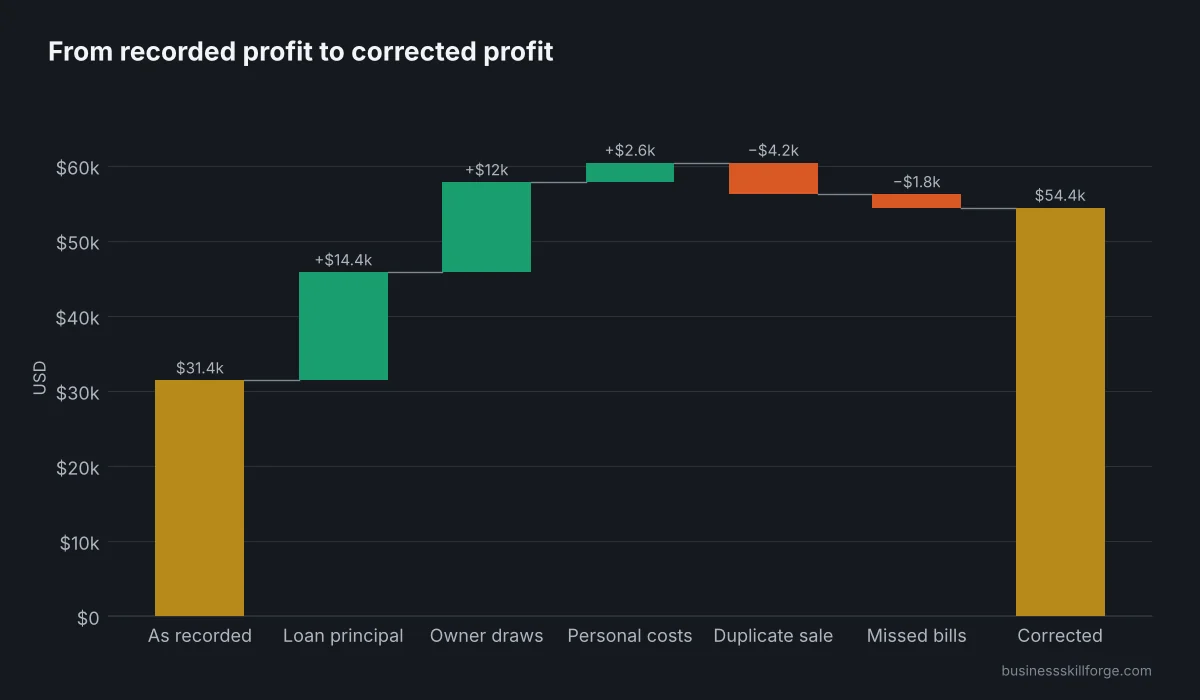
Corrected profit is $23,000 higher than the books said. That cuts both ways. If the owner filed a tax return on $31,400, the return understated income. If she showed $31,400 to a bank when applying for a loan, she undersold the business. Errors in opposite directions also hide each other: the $4,200 duplicate partly masked the expensed draws, which is why a profit figure that “looks about right” is no guarantee the books are clean.
How to fix bookkeeping mistakes without breaking closed periods
Once you’ve found an error, the way you fix it matters. Editing an old transaction directly can change a period you’ve already reported, reconciled or filed taxes on, and then last year’s numbers stop matching last year’s return.

A correcting journal entry dated in the current period is usually the cleanest approach for material errors from a closed year. The side of the entry that would have hit last year’s income or expenses normally goes to retained earnings (owner’s equity for a sole proprietor) instead, so this year’s profit isn’t distorted by last year’s mistake. Write a short memo on every correction (“Reclassify 2 equipment loan payments from repairs to loan principal, see lender statement”). Six months from now you won’t remember why that entry exists.
When an error affects a tax return that’s already filed, talk to your accountant before you post anything. Whether you amend the return or adjust in the current year depends on the size of the error and your country’s rules, and that’s not a decision to make from a bank feed.
What to do next
Set aside two hours and work through the checks in order of payoff: compare every loan balance with the lender’s statement, review the owner’s draw and any wages or contract labor paid to yourself, reconcile your main bank account for the most recent month, then scan the expense list for personal items. That sequence finds the big-dollar errors first.
After the cleanup, prevention is mostly routine. A short monthly checklist does more than an annual scramble.

If you want a structured place to learn the underlying double-entry logic, our free accounting and bookkeeping masterclass covers journal entries, ledgers and reconciliations from the start.
Key takeaways
- Loan principal, owner draws and personal spending are the three errors most likely to move profit by thousands of dollars.
- Record processor payouts as gross sales less refunds and fees, so revenue ties to the processor’s reports and to any Form 1099-K.
- A monthly bank reconciliation is the one control that catches duplicates, missing entries and most other mistakes.
- Errors in opposite directions can cancel out, so a profit figure that looks reasonable isn’t proof the books are right.
- Fix errors in closed periods with a dated, documented correcting entry, and check with an accountant if a filed return is affected.
Frequently asked questions
What is the most common bookkeeping mistake?
Mixing personal and business transactions is the most common, and it causes many of the others. When one account pays for both, personal costs end up in expense categories and business costs paid personally go missing. Open a separate business account and card, and code any personal item that went through the business to owner’s draw rather than deleting it.
Is a loan payment a business expense?
Only the interest part is an expense. The principal part reduces the loan liability on the balance sheet. If you book the whole payment as an expense, profit is understated and the loan balance never goes down in your books. Compare your book loan balance with the lender’s statement to catch this, then reclassify the principal.
How do I fix a bookkeeping mistake from last year?
If last year is closed or a tax return has been filed, don’t edit the original transaction. Post a correcting journal entry dated in the current period with a memo explaining the error and the evidence, putting last year’s profit effect through retained earnings or owner’s equity rather than this year’s income and expenses. If the error changes a filed return, speak to your accountant about whether an amended return is needed under your country’s rules.
Should I record Stripe or PayPal deposits as revenue?
Record the gross sale as revenue, refunds as a reduction of revenue and processing fees as an expense, so that gross less refunds less fees equals the deposit. Booking the deposit alone gives the same profit but understates sales and hides fees, and in the US it won’t match the gross figure on Form 1099-K.
How often should a small business reconcile its accounts?
Monthly is the practical standard for bank, credit card and loan accounts, ideally within two weeks of the statement date. Busy businesses with many transactions sometimes reconcile weekly. Waiting until year-end means errors have twelve months to pile up, and tracing a difference back through a full year of transactions takes far longer than fixing it in the month it happened.
Sources
This article is general education, not tax, legal, accounting or investment advice. Rules and thresholds differ by country and change over time, so check the specifics for your situation. See our financial disclaimer.
Get practical finance & accounting tips in your inbox
Join US professionals getting our best guides, templates and tools. Free. Unsubscribe anytime.