The Accounting Equation, Worked Through 10 Transactions
October 31, 2026 · Aditya Gupta

The accounting equation says that a business’s assets always equal its liabilities plus its equity: Assets = Liabilities + Equity. Everything the business owns was paid for either with borrowed money or with the owner’s money, including profits kept in the business. Every transaction changes at least two numbers, and the equation stays balanced after each one.
Reading the rule is easy. Seeing why it never breaks is what makes bookkeeping click. Below, we take a new one-person business through ten ordinary transactions and track the equation after every one, so you can see exactly which side moves and why.
The accounting equation in plain terms
An asset is something the business owns or controls that has value: cash, equipment, inventory, money customers owe it. A liability is an amount the business owes to someone else: a bank loan, unpaid supplier bills, taxes due. Equity is the owner’s claim on the business, which is whatever is left of the assets after every liability has been paid.
The SEC’s Beginners’ Guide to Financial Statements describes equity in exactly that way: the money that would be left if a company sold all of its assets and paid off all of its liabilities. Since equity is defined as the leftover, the equation can’t fail to balance. It’s the structure of the balance sheet, with assets on one side and the claims on those assets on the other.
You can rearrange it to answer different questions:
- Equity = Assets − Liabilities tells you what the owner’s stake is worth on paper. (It’s the same idea as personal net worth, which you can work out with our net worth calculator.)
- Liabilities = Assets − Equity tells you how much of the business is funded by other people’s money.
The expanded accounting equation
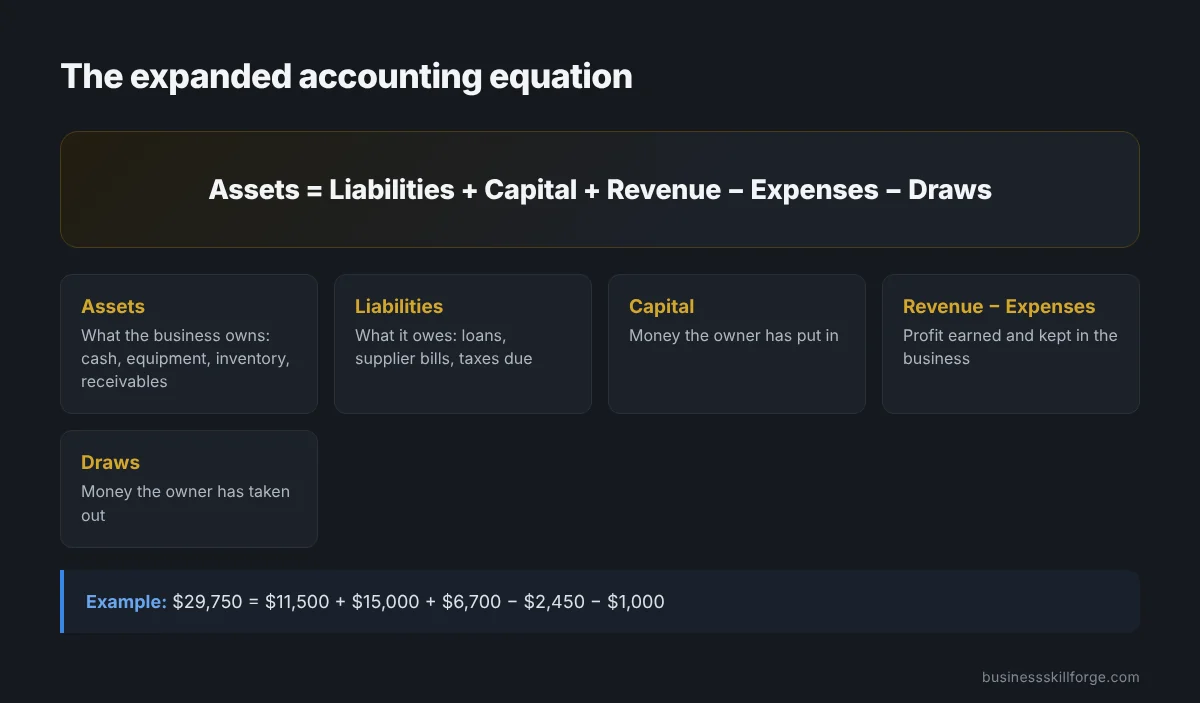
Equity doesn’t just change when the owner puts money in. It also rises with revenue and falls with expenses and owner draws. Writing those out gives the expanded equation:
Assets = Liabilities + Owner’s capital + Revenue − Expenses − Draws
This version is the bridge between the balance sheet and the income statement. Revenue minus expenses is profit, and profit kept in the business increases equity.
The same equation for a corporation
In a company, the owner’s capital line is replaced by share capital (what shareholders paid for their shares) and retained earnings (profits kept in the business over the years). Draws become dividends. So the corporate version reads: Assets = Liabilities + Share capital + Retained earnings. The logic is identical.
Accounting equation examples: 10 transactions for a new business
Jordan starts a mobile bike repair business, working from a van. Here’s the first month. After each transaction, check that the totals still match.
1. Jordan invests $15,000 of savings
Cash (asset) +$15,000. Owner’s capital (equity) +$15,000. Assets $15,000 = Liabilities $0 + Equity $15,000.
2. The business borrows $10,000 from a bank
Cash +$10,000. Bank loan (liability) +$10,000. Borrowing gives you assets but doesn’t make you richer, because you owe it all back. $25,000 = $10,000 + $15,000.
3. Jordan buys a used cargo van for $18,000 cash
Van +$18,000. Cash −$18,000. One asset turns into another, so the totals don’t move. $25,000 = $10,000 + $15,000.
4. Buys $3,000 of parts on credit from a supplier
Parts inventory +$3,000. Accounts payable (liability) +$3,000. $28,000 = $13,000 + $15,000.
5. Completes repairs for walk-up customers, paid $4,200 cash, using $1,200 of parts
Cash +$4,200 and inventory −$1,200, so assets rise $3,000. Revenue of $4,200 less parts cost of $1,200 adds $3,000 to equity. $31,000 = $13,000 + $18,000.
6. Services a corporate bike fleet for $2,500 on account, using $600 of parts
Accounts receivable +$2,500 and inventory −$600, so assets rise $1,900. Revenue of $2,500 less $600 of parts cost adds $1,900 to equity. No cash yet, but the profit is real. $32,900 = $13,000 + $19,900.
7. The fleet customer pays the $2,500 invoice
Cash +$2,500. Accounts receivable −$2,500. Another swap inside assets; equity doesn’t change because the profit was already counted in step 6. $32,900 = $13,000 + $19,900.
8. Pays the supplier $1,500 of what it owes
Cash −$1,500. Accounts payable −$1,500. Both sides fall together. $31,400 = $11,500 + $19,900.
9. Pays $650 for fuel and a phone plan
Cash −$650. These are expenses, which reduce equity by $650. $30,750 = $11,500 + $19,250.
10. Jordan takes $1,000 out for personal bills
Cash −$1,000. An owner’s draw reduces equity directly, but it isn’t a business expense and doesn’t touch profit. $29,750 = $11,500 + $18,250.
The full month in one table
| # | Transaction | Assets change | Liabilities change | Equity change | Total assets | Liabilities + equity |
|---|---|---|---|---|---|---|
| 1 | Owner invests | +$15,000 | $0 | +$15,000 | $15,000 | $15,000 |
| 2 | Bank loan | +$10,000 | +$10,000 | $0 | $25,000 | $25,000 |
| 3 | Buy van for cash | $0 | $0 | $0 | $25,000 | $25,000 |
| 4 | Parts on credit | +$3,000 | +$3,000 | $0 | $28,000 | $28,000 |
| 5 | Cash repairs | +$3,000 | $0 | +$3,000 | $31,000 | $31,000 |
| 6 | Fleet job on account | +$1,900 | $0 | +$1,900 | $32,900 | $32,900 |
| 7 | Customer pays | $0 | $0 | $0 | $32,900 | $32,900 |
| 8 | Pay supplier | −$1,500 | −$1,500 | $0 | $31,400 | $31,400 |
| 9 | Fuel and phone | −$650 | $0 | −$650 | $30,750 | $30,750 |
| 10 | Owner’s draw | −$1,000 | $0 | −$1,000 | $29,750 | $29,750 |

Where Jordan ends up
At month end the business holds cash of $10,550, a van at $18,000 and parts of $1,200: total assets of $29,750. It owes the bank $10,000 and the supplier $1,500, so liabilities are $11,500. Equity is $18,250.
Check that against the expanded equation. Revenue was $6,700 ($4,200 + $2,500). Expenses were $2,450 (parts of $1,200 and $600, plus $650 of fuel and phone). Profit was $4,250. So equity is $15,000 capital + $6,700 revenue − $2,450 expenses − $1,000 draws = $18,250. And $11,500 + $18,250 = $29,750. It ties out.
The four ways a transaction can move the equation
Every one of the ten transactions above fits one of four patterns. Once you can spot which pattern you’re in, booking anything new gets much easier.
| Pattern | What happens | Examples above |
|---|---|---|
| Both sides increase | An asset goes up along with a liability or equity | 1, 2, 4, 5, 6 |
| Both sides decrease | An asset goes down along with a liability or equity | 8, 9, 10 |
| Swap within assets | One asset goes up, another goes down by the same amount | 3, 7 |
| Swap within claims | One liability or equity item goes up, another goes down | None here; for example, a lender converting a loan into an ownership stake |
Transactions 5 and 6 combine two effects at once (a sale raising assets and equity, and parts used lowering both), but the net result still lands in the “both sides” pattern.

How the equation connects to debits and credits
Double-entry bookkeeping is the accounting equation put into practice. Assets sit on the left side of the equation and increase with debits. Liabilities and equity sit on the right and increase with credits. Revenue increases equity, so it’s a credit; expenses and draws reduce equity, so they’re debits.
That’s why every journal entry needs equal debits and credits: it’s how the equation stays balanced entry by entry. Our guide to debits and credits with simple examples books a similar first month as journal entries, if you want to see the same logic from the other direction.
How to use the equation to find a missing number
Because the equation always holds, you can solve for any piece you don’t have. Say a small catering business has total assets of $84,000 and liabilities of $31,500 at year end. Equity must be $84,000 − $31,500 = $52,500.
Now say equity was $40,000 at the start of the year, the owner put no new money in, and took $12,000 in draws. Profit for the year must have been $52,500 − $40,000 + $12,000 = $24,500. If the income statement shows a different figure, either the balance sheet or the P&L has an error, and you know to go looking before you file anything.
This is the same check accountants run when they roll equity forward from one year to the next: opening equity, plus capital added, plus profit, minus draws or dividends, should equal closing equity.
Common mistakes the equation helps you catch
- Treating a loan as income. Borrowing $10,000 raises assets and liabilities equally. Equity, and therefore profit, doesn’t change.
- Booking the whole loan payment as an expense. If Jordan’s first loan payment is $600, of which $520 is principal and $80 is interest, only the $80 is an expense. The $520 reduces the liability.
- Counting an invoice twice. Profit is recorded when the fleet job is done (step 6). The payment in step 7 only swaps receivables for cash.
- Expensing an asset purchase. The $18,000 van is an asset. Recording it as an expense would wipe $18,000 off equity and understate the business’s value. It’s expensed gradually through depreciation instead.
- Recording draws as wages. For a sole proprietor, money taken out is a draw against equity, not an operating expense. Corporations paying the owner through payroll are different.
What to do next
Take your own balance sheet and check the equation: total assets should equal total liabilities plus total equity to the cent. If they don’t, something has been posted to one side only, which usually means a manual entry or a spreadsheet error.
Then pick three transactions from last month and write out the equation effect for each, the way we did above. If you can’t say which pattern a transaction fits, that’s a sign it may be in the wrong account. To see how these totals are presented and what the ratios built on them tell you, read our guide on how to read a balance sheet.
Key takeaways
- The accounting equation is Assets = Liabilities + Equity, and it balances after every transaction.
- Equity is what’s left after subtracting liabilities from assets, so it is the owner’s claim on the business.
- The expanded version, Assets = Liabilities + Capital + Revenue − Expenses − Draws, links the balance sheet to profit.
- Every transaction either moves both sides together or swaps amounts within one side.
- Loans, asset purchases and customer payments don’t change profit, which makes the equation a quick test for miscategorized entries.
Frequently asked questions
Why must the accounting equation always balance?
Because equity is defined as whatever remains after liabilities are subtracted from assets. Every asset a business holds was funded either by creditors or by the owners, so the two sides describe the same resources from different angles. Double-entry bookkeeping records each transaction with equal effects, which keeps the totals matched. If your balance sheet doesn’t balance, an entry was posted incorrectly.
Does a loan increase equity?
No. Borrowing increases cash and increases liabilities by the same amount, so equity stays exactly where it was. You have more money in the bank, but you owe all of it back. Equity only rises when the owner invests more or the business earns a profit and keeps it. Repaying the loan principal later reduces cash and liabilities together, again without touching equity.
How do revenue and expenses fit into the accounting equation?
Revenue and expenses are temporary parts of equity. Revenue increases equity, and expenses decrease it, so profit for the period adds to the owner’s stake. During the year they are tracked in separate accounts so you can produce an income statement. At year end they are closed into retained earnings or owner’s capital, which is how profit reaches the balance sheet.
Is the accounting equation the same as net worth?
It’s the same idea. For a person, net worth is assets minus liabilities. For a business, equity is assets minus liabilities. The accounting equation simply rearranges that to Assets = Liabilities + Equity. The main difference is that business assets are usually recorded at historical cost less depreciation, so book equity can differ from what the business would actually sell for.
What happens to the accounting equation when an owner takes a draw?
An owner’s draw reduces assets, usually cash, and reduces equity by the same amount. Liabilities don’t change. A draw is not a business expense, so it doesn’t lower profit on the income statement, but it does lower the owner’s remaining stake in the business. In the example, a $1,000 draw moved the equation from $30,750 = $11,500 + $19,250 to $29,750 = $11,500 + $18,250.
Sources
This article is general education, not tax, legal, accounting or investment advice. Rules and thresholds differ by country and change over time, so check the specifics for your situation. See our financial disclaimer.
Get practical finance & accounting tips in your inbox
Join US professionals getting our best guides, templates and tools. Free. Unsubscribe anytime.