How to Categorize Business Expenses the Right Way
October 27, 2026 · Aditya Gupta

To categorize business expenses, you assign every business cost to an account in your chart of accounts that describes what it was for, such as advertising, supplies, insurance or rent. Good categories match your tax return lines, separate direct costs from overhead, and keep things that aren’t expenses at all, like equipment purchases, loan principal and owner withdrawals, out of the expense list entirely.
Categorizing sounds like admin, and it is. But it decides what your P&L tells you, how long tax prep takes, and whether you can defend a deduction if anyone asks. This guide gives you a short list of categories that works for most small businesses, a five-question method for any transaction, and a worked month for a one-van business where every dollar is accounted for.
Why expense categories matter
Categories do three jobs at once.
- Tax. In the US, sole proprietors and single-member LLCs report expenses on Schedule C, which has fixed lines such as advertising, car and truck expenses, and legal and professional services. If your categories map to those lines, the tax return almost fills itself.
- Decisions. “Expenses: $8,400” tells you nothing. “Advertising: $2,100, up 40%” tells you where to look.
- Margins. Separating direct costs from overhead is what lets you calculate gross margin and see whether each job actually makes money.
Before anything goes in a category, it has to qualify as a business expense. The IRS says a business expense must be both ordinary and necessary: ordinary means common and accepted in your industry, and necessary means helpful and appropriate for your business. It doesn’t have to be indispensable. Our glossary entry on deductible business expenses covers the definition in more depth.
The categories most small businesses need
You don’t need eighty accounts. Most small service businesses do well with 15 to 25 expense categories. Here’s a core set, with the matching line on the IRS Schedule C form for US sole proprietors.
| Category | What goes in it | Examples | Schedule C line |
|---|---|---|---|
| Advertising | Promoting the business | Online ads, flyers, sponsorships | Line 8 |
| Car and truck | Business vehicle running costs | Fuel, tolls, parking (or the standard mileage rate) | Line 9 |
| Contract labor | Non-employee workers | Freelance designer, subcontractor | Line 11 |
| Insurance | Business cover, other than health | Liability, vehicle, equipment | Line 15 |
| Interest | Interest on business debt | Interest portion of a van loan, card interest | Line 16b |
| Legal and professional | Outside professional help | Accountant, lawyer, bookkeeper | Line 17 |
| Office expense | Running the office | Postage, small software, stationery | Line 18 |
| Rent | Renting property or equipment | Office lease, equipment hire | Lines 20a / 20b |
| Repairs and maintenance | Keeping things working | Equipment servicing, small fixes | Line 21 |
| Supplies | Items used up in the work | Cleaning products, packaging, materials | Line 22 |
| Taxes and licenses | Business taxes and permits | Business license, local permits | Line 23 |
| Travel | Overnight business travel | Flights, hotels | Line 24a |
| Meals | Business meals | Lunch with a client or referral partner | Line 24b |
| Utilities | Power, water, phone, internet | Business share of a phone bill | Line 25 |
| Wages | Employee pay | Gross wages to staff | Line 26 |
Add categories your business actually uses, such as software subscriptions or merchant fees, and roll them up to the nearest tax line at year end. If you’re setting up accounts from scratch, our guide to building a chart of accounts for a small business walks through the structure.
Direct costs, overhead and capital purchases
Three kinds of spending get confused all the time.
- Direct costs (cost of goods sold for product businesses) are costs that rise and fall with each sale: inventory, materials, the subcontractor on a specific job. They sit above gross profit on the P&L.
- Operating expenses are the costs of running the business regardless of how many sales you make this month: rent, insurance, software, your accountant. They sit below gross profit.
- Capital purchases are assets that last more than a year, like a van, a laptop or a commercial dryer. They go on the balance sheet and are expensed over time through depreciation (in the US, some can be deducted in the first year under section 179 or bonus depreciation rules, which change, so check current guidance).
How to categorize business expenses, step by step
Run every transaction through the same five questions, in order. The order matters: most miscategorizations happen when someone jumps straight to question four.
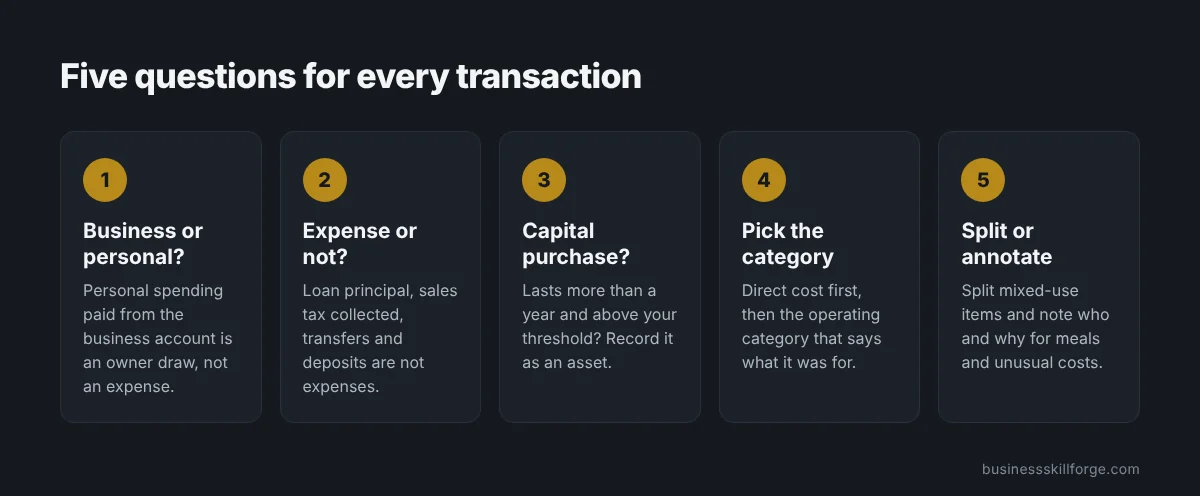
- Is it a business cost at all? Personal spending paid from the business account is an owner draw, not an expense.
- Is it an expense, or something else? Loan principal, sales tax you collected and passed on, transfers between your own accounts and security deposits are not expenses.
- Is it a capital purchase? If it will last more than a year and costs more than your capitalization threshold, it’s an asset.
- Which category fits? Direct cost first, then the operating category that best describes what it was for.
- Does it need splitting or a note? Split mixed-use items, and add a note for anything a stranger couldn’t understand from the receipt alone, such as who a meal was with and why.
Worked example: a month at a mobile grooming business
Pawsitive Mobile Grooming is run by one owner with one van. In June, $4,653 left the business account and card. Here is how each item is treated.
| Transaction | Paid | Treatment | June expense |
|---|---|---|---|
| Shampoo and grooming supplies | $640 | Supplies | $640 |
| Fuel for the van | $410 | Car and truck | $410 |
| Van insurance | $185 | Insurance | $185 |
| Booking software | $49 | Software (office expense) | $49 |
| Phone bill, 70% business use | $90 | $63 utilities, $27 owner draw | $63 |
| Social media ads | $300 | Advertising | $300 |
| New commercial dryer | $1,800 | Fixed asset, not a June expense | $0 |
| Clipper blade sharpening | $75 | Repairs and maintenance | $75 |
| Accountant’s quarterly fee | $250 | Legal and professional | $250 |
| Groceries on the business card by mistake | $120 | Owner draw | $0 |
| Van loan payment | $520 | $60 interest expense, $460 reduces the loan | $60 |
| Business license renewal | $150 | Taxes and licenses | $150 |
| Lunch with a vet clinic owner about referrals | $64 | Meals (with a note) | $64 |
| Total | $4,653 | $2,246 |
Only $2,246 of the $4,653 is a June operating expense. The other $2,407 is the dryer ($1,800, an asset), loan principal ($460, a reduction in a liability), and $147 of personal spending ($120 of groceries plus the $27 personal share of the phone). Had everything been dumped into expenses, June’s profit would have been understated by $2,407 and the tax return would have claimed personal costs.
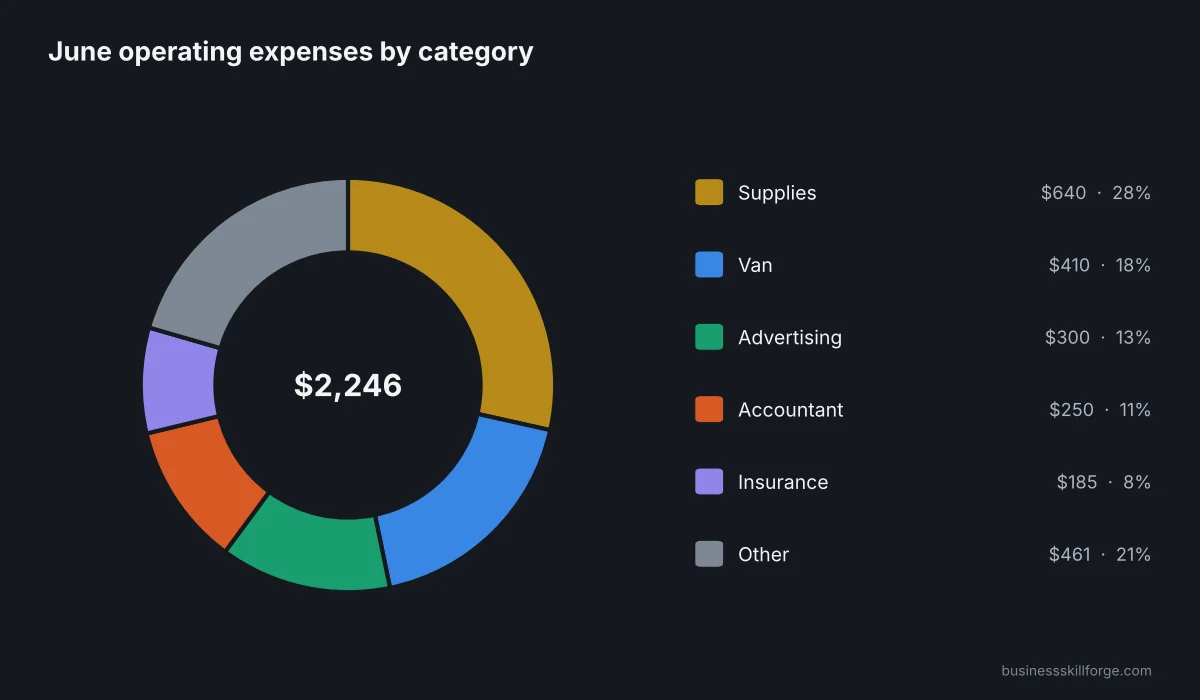
Grouped for the P&L, supplies are the largest cost at $640, followed by the van at $410, advertising at $300, the accountant at $250 and insurance at $185. The remaining six categories total $461.
The tricky ones
Meals and entertainment
Keep meals and entertainment in separate categories, because US tax treats them differently. Under the current rules, most entertainment isn’t deductible, and business food and beverage costs are generally limited to 50%. Book the full amount in your accounts and let the tax adjustment happen on the return. Write who you met and why on every meal receipt.
Mixed-use items
Phones, internet, vehicles and home offices are often used for both business and personal purposes. Only the business share is a business expense. Pick a reasonable, documented basis (a mileage log for a vehicle, a typical month’s itemized bill for a phone) and apply it consistently. For a home office, our home office deduction calculator shows how the US calculation works.
Software and subscriptions
Monthly software is an operating expense. An annual plan paid upfront is, strictly, a prepaid expense spread over twelve months on accrual books. On cash books it’s expensed when paid.
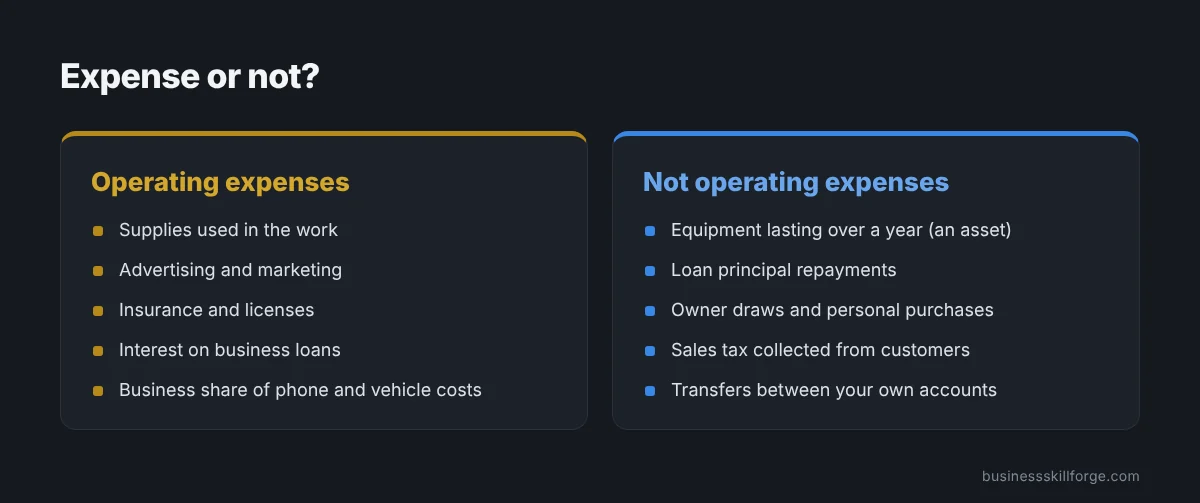
Things that look like expenses but aren’t
- Owner draws. Money you take out for yourself.
- Loan principal. Only the interest is an expense.
- Sales tax collected. It belongs to the tax authority; it’s a liability until paid over.
- Transfers. Moving money from checking to savings changes nothing.
- Income tax on your own profit. For a sole proprietor this is generally a personal tax, so keep it out of business expenses.
Expense categories in the UK, Canada and Australia
The principle is the same everywhere, but the lists differ. In the UK, HMRC’s guide to allowable expenses for the self-employed groups costs into areas such as office and phone costs, travel, staff, stock and materials, financial costs, premises, and advertising, and allows only the business portion of mixed-use costs. In Canada, sole proprietors report on Form T2125, which has its own expense lines. Set up your categories to match the form you’ll file, and check local rules for meals, vehicles and home offices, which vary by country.
Common categorization mistakes
- A bloated “miscellaneous” account. If more than a small fraction of spending lands in miscellaneous or uncategorized, your P&L can’t tell you much.
- Too many categories. Separate accounts for “printer ink” and “printer paper” add work without insight.
- Changing categories mid-year. If software was in office expense for six months, then a new software account, month-to-month comparisons break. Reclassify the earlier months when you change.
- Expensing equipment. A $1,800 machine is an asset, even if the tax rules let you deduct it quickly.
- Trusting auto-categorization rules blindly. A bank-feed rule that sends every Amazon purchase to office supplies will eventually file a personal purchase or a piece of inventory there too.
What to do next
Export last month’s transactions and run them through the five questions. Count how many were in the wrong place, and fix the bank-feed rules that put them there. Then compare your expense accounts with the lines on the tax form you file and rename or merge accounts so each one maps cleanly to a line. If you’re a freelancer setting this up for the first time, our guide to bookkeeping for freelancers covers the rest of the system.
Key takeaways
- A business expense needs to be ordinary and necessary before it goes in any category.
- Match your expense categories to the lines on your tax form, then add a few that help you manage the business.
- Equipment that lasts more than a year, loan principal, owner draws and sales tax collected are not operating expenses.
- Split mixed-use costs like phones and vehicles on a documented, consistent basis.
- Run every transaction through the same questions in the same order to avoid most categorization errors.
Frequently asked questions
How many expense categories should a small business have?
Most small businesses work well with roughly 15 to 25 expense categories. That’s enough to map to your tax form and see where money goes without creating busywork. Start with the lines on the tax return you file, add a few that matter for management, such as software or merchant fees, and avoid splitting categories so finely that you can’t tell them apart.
Is buying equipment a business expense?
Not immediately in your books. Equipment that will last more than a year, like a computer, vehicle or machine, is recorded as a fixed asset and expensed over time through depreciation. For US tax purposes, rules such as section 179 or bonus depreciation may allow a faster deduction, but those rules change, so check current IRS guidance or ask a tax professional.
Where do I categorize software subscriptions?
Many small businesses create a dedicated software or subscriptions account under operating expenses, then report it as office expense or other expenses on the tax return. If you pay an annual plan upfront and keep accrual books, record it as a prepaid expense and move one-twelfth to the expense account each month.
Are loan payments a business expense?
Only the interest part. A loan payment usually combines interest and principal. The interest is an expense. The principal reduces the amount you owe, so it’s recorded against the loan liability on the balance sheet. Your lender’s statement or amortization schedule shows the split for each payment.
What if I paid for a personal item with the business card?
Record it as an owner draw (or a shareholder loan, for a corporation), not as an expense. Don’t delete it, because the money really did leave the business account. If it happens often, consider reimbursing the business and keeping a separate personal card, which makes bookkeeping and any tax review much simpler.
Sources
- IRS: Ordinary and necessary expenses
- IRS Schedule C (Form 1040), Profit or Loss From Business
- Journal of Accountancy: IRS issues final rules on business meals and entertainment
- GOV.UK: Expenses if you're self-employed
- CRA: T2125 Statement of Business or Professional Activities
This article is general education, not tax, legal, accounting or investment advice. Rules and thresholds differ by country and change over time, so check the specifics for your situation. See our financial disclaimer.
Get practical finance & accounting tips in your inbox
Join US professionals getting our best guides, templates and tools. Free. Unsubscribe anytime.