EBITDA Explained: What It Shows and What It Hides
October 29, 2026 · Aditya Gupta
EBITDA stands for earnings before interest, taxes, depreciation and amortization. It takes net income and adds back interest, taxes and the non-cash charges for wearing out assets, to show what the core business earns before financing, tax and accounting choices. It’s useful for comparing operating performance, but it ignores real cash costs like equipment replacement.
That last sentence is the whole story of EBITDA. It’s a good lens for some questions and a misleading one for others. This guide shows how to calculate it, what it’s good for, and the specific costs it leaves out, using a moving company that owns a fleet of trucks.
What EBITDA measures
EBITDA is operating profit before depreciation and amortization. Each of the four items it strips out is removed for a reason:
- Interest depends on how the business is financed. Two identical shops, one funded by a bank loan and one by the owner’s savings, will report different net income. EBITDA puts them on the same footing.
- Taxes depend on location, legal structure and tax planning, not on how well the business runs.
- Depreciation spreads the cost of physical assets over their useful lives. It’s an accounting allocation, not a cash payment in the year it’s recorded. Our guide to depreciation methods shows how the method you pick changes the annual charge.
- Amortization does the same thing for intangible assets such as purchased software, customer lists or acquired brand names.
What’s left is a rough picture of the earnings the operations produce before anyone decides how to fund them, tax them or account for the assets they use. The EBITDA glossary entry has the one-line version.
EBITDA is not defined by GAAP or IFRS. Public companies in the US can report it, but SEC rules treat it as a non-GAAP measure: it must be reconciled to the most directly comparable GAAP figure, and SEC staff guidance says that for EBITDA used as a performance measure, that figure is net income, as summarized in Deloitte’s roadmap on non-GAAP measures.
How to calculate EBITDA
There are two routes, and they should land on the same number.
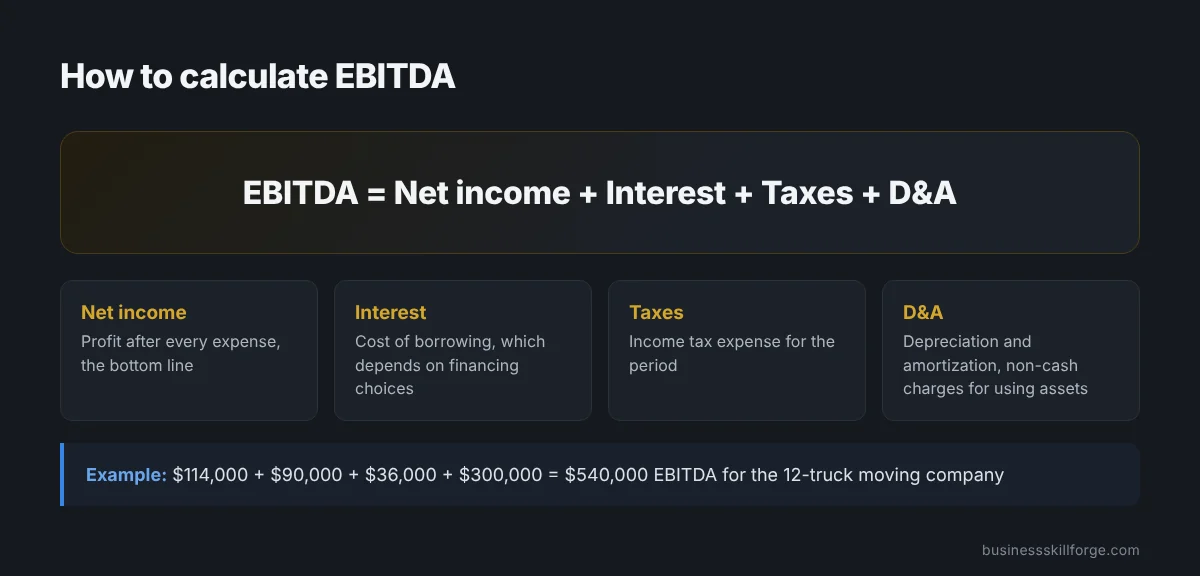
- Bottom-up: Net income + interest + taxes + depreciation + amortization.
- Top-down: Operating income (EBIT) + depreciation + amortization.
Worked example: a 12-truck moving company
A regional moving company with 12 trucks and a rented warehouse reports this year:
| Line | Amount |
|---|---|
| Revenue | $3,000,000 |
| Operating costs (crews, fuel, insurance, rent, admin) | $2,460,000 |
| Depreciation on trucks and equipment | $300,000 |
| Operating income (EBIT) | $240,000 |
| Interest on truck loans | $90,000 |
| Income before tax | $150,000 |
| Income tax | $36,000 |
| Net income | $114,000 |
Bottom-up: $114,000 + $90,000 + $36,000 + $300,000 = $540,000.
Top-down: $240,000 + $300,000 = $540,000.
EBITDA margin is EBITDA divided by revenue: $540,000 ÷ $3,000,000 = 18%. Compare that with an operating margin of 8% and a net margin of 3.8%. Same business, three very different-looking numbers.
If the two routes don’t match in your own books, something is misclassified. The usual culprits are depreciation buried inside cost of goods sold, interest income netted against interest expense, or a one-off gain sitting above the operating income line.
What EBITDA is good for
Comparing businesses with different financing
If you’re looking at two moving companies, one debt-free and one carrying truck loans, net income will favor the debt-free one even if the indebted one runs its crews better. EBITDA lets you compare the operations first and the financing second.
Lending and debt capacity
Lenders often express limits as a multiple of EBITDA. If the moving company has $1,200,000 of debt, debt to EBITDA is $1,200,000 ÷ $540,000 = 2.2x. Many loan agreements set a maximum for this ratio as a covenant, with EBITDA defined precisely in the agreement. Read that definition carefully; it rarely matches the textbook one exactly. Our financial ratios cheat sheet covers debt to EBITDA alongside the other leverage measures.
Valuing a business
Small and mid-sized businesses are frequently priced as a multiple of EBITDA (or of a close cousin called seller’s discretionary earnings for very small firms). That’s why owners preparing to sell pay so much attention to it, and why buyers scrutinize every adjustment, as you’ll see below.
What EBITDA hides
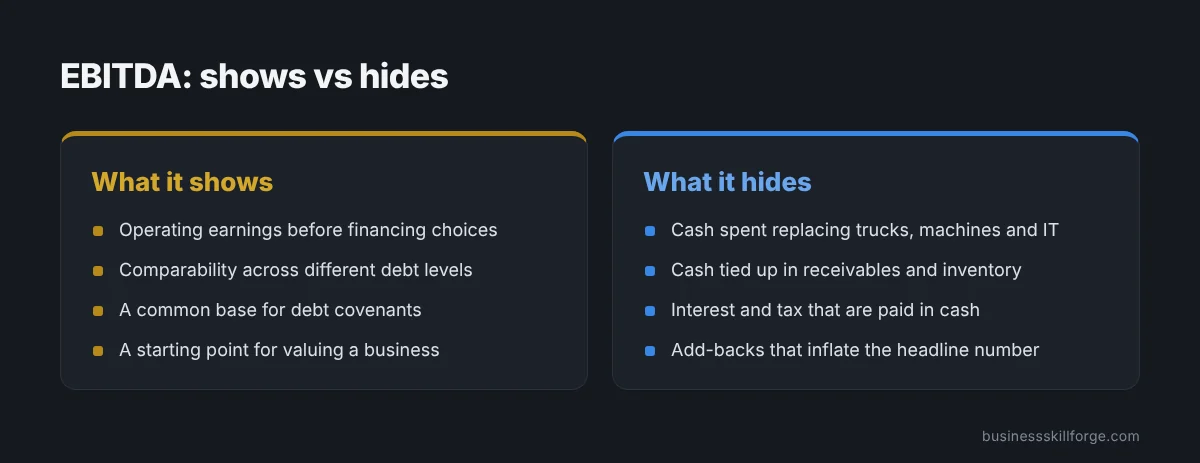
The critique of EBITDA is simple: depreciation isn’t cash this year, but the trucks it represents were paid for with cash, and they’ll need replacing with more cash. Interest and taxes are also paid in cash. EBITDA treats all of these as if they didn’t matter.
Capital expenditure
The moving company’s trucks last about eight years. To keep a fleet of 12 on the road it buys one or two trucks most years, and this year it spent $350,000 on capital expenditure: replacement trucks, a lift gate and warehouse racking. None of that appears in EBITDA.
Working capital
The company also signed a large commercial client on 45-day payment terms, so receivables grew by $40,000 this year. That’s cash earned on paper but not yet collected. EBITDA doesn’t see it.
Interest and tax
The $90,000 of interest and $36,000 of tax went out of the bank account. Adding them back is fine for comparing operations; it isn’t fine for asking how much cash the owner can take out.
Put it together and the gap is large:
| From EBITDA to free cash flow | Amount |
|---|---|
| EBITDA | $540,000 |
| − Interest paid | $90,000 |
| − Tax paid | $36,000 |
| − Capital expenditure | $350,000 |
| − Increase in receivables | $40,000 |
| Free cash flow (simplified) | $24,000 |
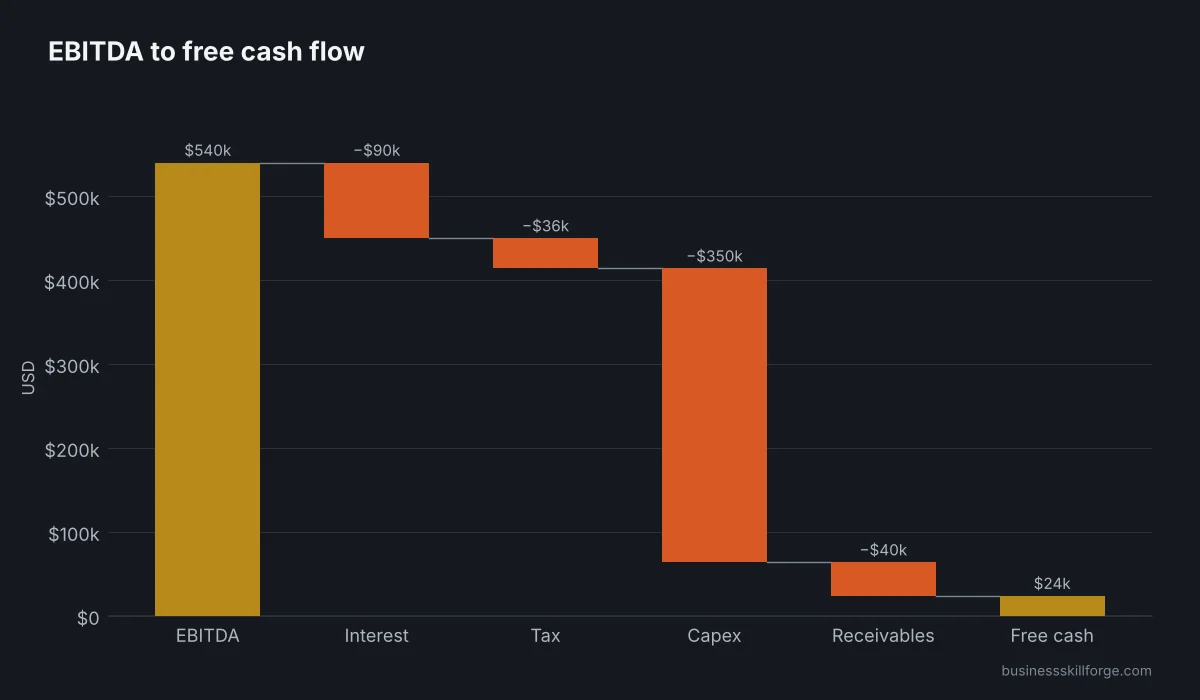
An owner who looked at $540,000 of EBITDA and decided to take $200,000 out of the business would have to borrow to do it. Free cash flow is the number that answers “how much cash can this business spare,” and in a capital-heavy business it can be a small fraction of EBITDA. The difference between accounting profit and cash is covered in more depth in cash flow vs profit.
Same EBITDA, very different businesses
Compare the moving company with a 15-person IT consultancy that also earns $540,000 of EBITDA. The consultancy’s capital spending is laptops and software, about $20,000 a year. After capex, the consultancy has $520,000 left; the moving company has $190,000. A buyer paying the same EBITDA multiple for both would be overpaying for the trucks.
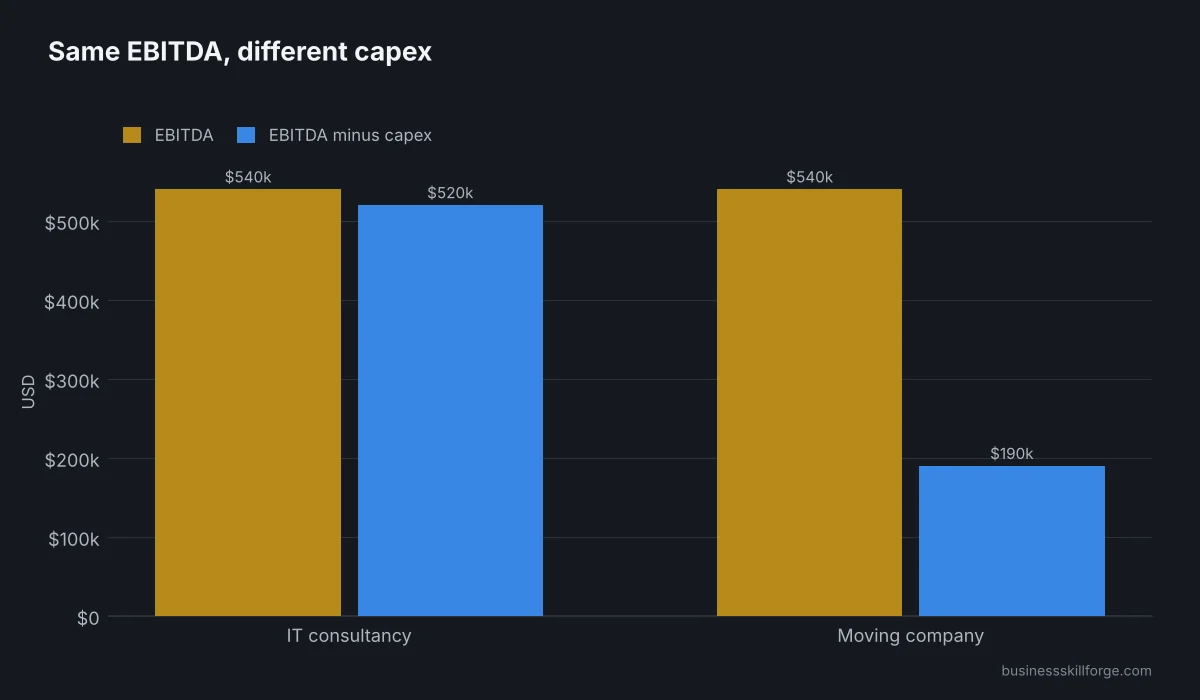
A simple fix is to look at EBITDA minus capex alongside EBITDA whenever the business owns significant physical assets. It’s a crude measure, but it closes the biggest gap.
Adjusted EBITDA and add-backs
Adjusted EBITDA is EBITDA with further items added back that management argues are one-off or not part of normal operations. Some adjustments are reasonable. Others are a sales pitch.
Say the moving company’s owner pays himself $160,000 a year, while a hired general manager would cost $100,000. He also paid $25,000 to settle a one-time legal dispute. Adjusted EBITDA becomes $540,000 + $60,000 + $25,000 = $625,000.
Now suppose, purely as an illustration, that a buyer values the business at 4 times EBITDA. That’s $2,160,000 on reported EBITDA and $2,500,000 on adjusted EBITDA. The two add-backs are worth $340,000 to the seller, which is why buyers test every one.
| Add-back | Usually accepted? | What a buyer will ask |
|---|---|---|
| Owner pay above market rate | Often | What would a replacement actually cost? |
| One-time legal settlement | Often | Has anything similar happened in prior years? |
| Owner’s personal expenses run through the business | Often, with evidence | Can you show the receipts and the pattern? |
| “Restructuring” that happens every year | Rarely | If it recurs, why is it one-off? |
| Projected cost savings not yet made | Rarely | Why should I pay for savings I’ll have to deliver? |
How lease accounting changes EBITDA
The moving company rents its warehouse. Where it reports matters for EBITDA.
Under US GAAP, an operating lease’s cost is typically recorded as a single straight-line expense within operating costs, so the warehouse rent stays inside EBITDA. Under IFRS 16, which applies to companies reporting under IFRS Accounting Standards (used by many listed companies outside the US), most leases are put on the balance sheet, and the expense is split into depreciation of the right-of-use asset and interest on the lease liability. Both of those sit below EBITDA. The IFRS Foundation’s effects analysis for IFRS 16 says it expected the standard to result in higher EBITDA for companies with material leases that were previously off balance sheet.
The practical point: two identical businesses can report different EBITDA purely because of the accounting framework. When comparing across countries, check how leases are treated before you compare EBITDA margins or debt-to-EBITDA ratios. Many small private companies in the UK, Canada and Australia report under their own local frameworks instead, with their own lease rules, so ask rather than assume.
Common mistakes with EBITDA
- Treating EBITDA as cash flow. It ignores capex, working capital, interest and tax, all of which are paid in cash.
- Comparing EBITDA margins across industries. An asset-light consultancy and a trucking firm can share an EBITDA margin and have nothing else in common.
- Accepting adjusted EBITDA without the reconciliation. Always ask for the bridge from net income, line by line.
- Forgetting stock-based pay and other non-cash costs that are real costs. Some companies add back share-based compensation. It may be non-cash, but it dilutes owners, and someone would have to be paid in cash otherwise.
- Using a covenant’s EBITDA definition interchangeably with your management reports. Loan agreements often allow or forbid specific add-backs. Calculate the covenant figure exactly as written.
What to do next
- Calculate EBITDA both ways from your latest income statement and make sure they match.
- Put capex next to it. Pull capital spending from the cash flow statement or your fixed asset register and calculate EBITDA minus capex.
- Build the bridge to free cash flow using the table above, so you know how much of EBITDA actually turns into spare cash.
- If you have loans, find the covenant definition of EBITDA in the agreement and calculate it separately each quarter.
- If you’re thinking about selling, list your proposed add-backs now with evidence for each, and assume a buyer will reject anything you can’t document.
Key takeaways
- EBITDA is net income plus interest, taxes, depreciation and amortization, or operating income plus depreciation and amortization.
- It’s useful for comparing operations across businesses with different financing and tax positions, and lenders and buyers use it widely.
- It hides capital expenditure, changes in working capital, interest and tax, so it can be far higher than the cash a business generates.
- In asset-heavy businesses, look at EBITDA minus capex and free cash flow, not EBITDA alone.
- Adjusted EBITDA is only as credible as its add-backs; ask for the line-by-line reconciliation from net income.
- Lease accounting differs between US GAAP and IFRS 16, which can change EBITDA for the same underlying business.
Frequently asked questions
Is EBITDA the same as cash flow?
No. EBITDA adds back depreciation, which isn’t a cash payment, but it also ignores several real cash outflows: capital expenditure on new equipment, cash tied up in growing receivables or inventory, interest and income tax. In the moving company example, EBITDA of $540,000 turned into only $24,000 of free cash flow. Use the cash flow statement or a free cash flow calculation to see actual cash generation.
What is a good EBITDA margin?
It depends heavily on the industry. Businesses with low material costs, like software or professional services, often have higher EBITDA margins than distributors or retailers, which sell physical goods on thin markups. A margin that’s good in one industry can be weak in another. Compare against your own history and against similar businesses, and look at EBITDA minus capex if your business owns significant equipment.
What is the difference between EBIT and EBITDA?
EBIT is earnings before interest and taxes, which is essentially operating income. EBITDA goes one step further and also adds back depreciation and amortization. For the moving company, EBIT is $240,000 and EBITDA is $540,000, the difference being $300,000 of depreciation. EBIT is the more conservative measure because it accounts for the cost of wearing out assets.
Why do investors and lenders use EBITDA?
It allows comparison of operating performance across companies with different debt levels, tax situations and depreciation policies. Lenders use multiples like debt to EBITDA to size loans and set covenants, and buyers often price small and mid-sized businesses as a multiple of EBITDA. Careful analysts still check capital spending, working capital and free cash flow before relying on it.
What are EBITDA add-backs?
Add-backs are adjustments that increase EBITDA to remove items management considers one-off or unrelated to normal operations, producing adjusted EBITDA. Common examples are owner pay above a market salary, one-time legal costs and personal expenses run through the business. Buyers accept documented, genuinely non-recurring items and push back on recurring costs labeled as one-off or on savings that haven’t happened yet.
Sources
- 3.2 Reconciliation Requirement, Roadmap: Non-GAAP Financial Measures (Deloitte DART)
- IFRS 16 Leases: Effects Analysis (IFRS Foundation, January 2016)
This article is general education, not tax, legal, accounting or investment advice. Rules and thresholds differ by country and change over time, so check the specifics for your situation. See our financial disclaimer.
Get practical finance & accounting tips in your inbox
Join US professionals getting our best guides, templates and tools. Free. Unsubscribe anytime.