Cost-Plus vs Value-Based Pricing: Which Should You Use?
October 26, 2026 · Aditya Gupta

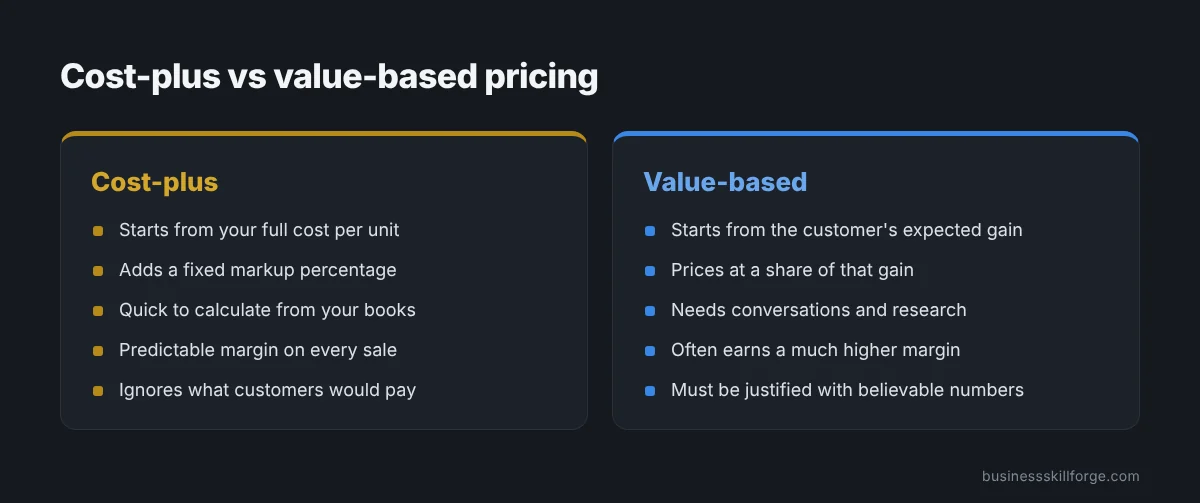
The difference in cost-plus vs value-based pricing is where the price starts. Cost-plus pricing adds a fixed markup to what the product costs you to make or deliver. Value-based pricing starts from what the result is worth to the customer and prices against that. Cost-plus is simpler and protects your margin; value-based usually earns more when your work produces a measurable gain for the buyer.
Most small businesses use cost-plus by default, because cost is the number they know. This guide works through both methods with real arithmetic, shows the trap hidden inside cost-plus, walks through setting a value-based price step by step, and explains how to use your costs as a floor and customer value as a ceiling.
Cost-plus vs value-based pricing at a glance
Cost-plus pricing is a method where the price equals your cost per unit plus a set percentage markup. Value-based pricing is a method where the price is set from the economic benefit the customer expects to get, with your cost acting only as a lower limit.
| Cost-plus pricing | Value-based pricing | |
|---|---|---|
| Starting point | Your cost per unit | The customer’s expected gain |
| Main input | Cost data from your books | Customer research and conversations |
| Effort to set | Low | Moderate to high |
| Margin | Fixed percentage, predictable | Varies, often higher |
| Best for | Commodity products, resale, cost-reimbursed contracts | Services and products with a clear, measurable outcome |
| Main risk | Leaving money on the table; prices drift with volume | Overestimating value; harder to justify |
How cost-plus pricing works
Take a small leather goods workshop that makes wallets. To use cost-plus, it first needs a full cost per wallet:
| Cost per wallet | Amount |
|---|---|
| Leather, thread, hardware | $14.00 |
| Direct labor (40 minutes at $15/hour) | $10.00 |
| Overhead ($6,000 a month ÷ 1,000 wallets) | $6.00 |
| Full cost | $30.00 |
The owner applies a 60% markup: $30.00 × 1.60 = $48.00.
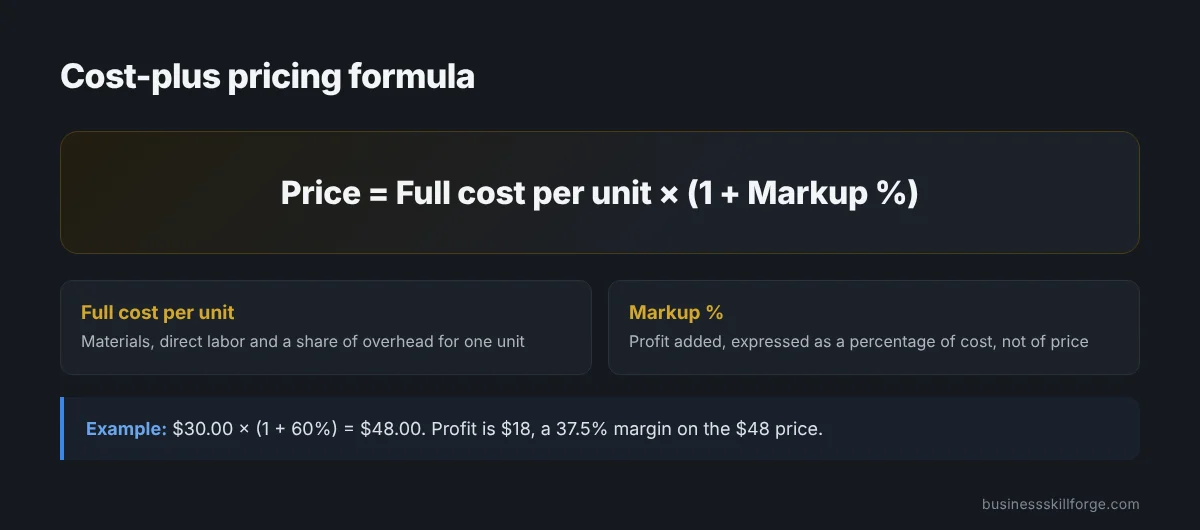
One thing to get straight: a 60% markup is not a 60% margin. The profit per wallet is $18, which is 60% of cost but only $18 ÷ $48 = 37.5% of the price. If the owner thinks they’re earning a 60% gross margin, every plan built on that number is wrong. Our guide to markup vs margin covers the conversion, and the markup to margin converter does it instantly.
Cost-plus has real strengths. It’s quick, it guarantees each sale covers its costs (if the costs are right), and it’s easy to explain to customers who expect a cost-based price, such as clients on cost-reimbursement contracts. For resellers whose customers can compare identical products elsewhere, a consistent markup over supplier cost is often the sensible approach.
The hidden problem with cost-plus pricing
The weak point is overhead. Fixed overhead gets spread across however many units you sell, so cost per unit depends on volume. When sales fall, the overhead per unit rises, and cost-plus tells you to raise your price exactly when demand is weakening.
| Wallets sold per month | Overhead per wallet | Full cost | Cost-plus price (60%) |
|---|---|---|---|
| 1,000 | $6.00 | $30.00 | $48.00 |
| 750 | $8.00 | $32.00 | $51.20 |
| 500 | $12.00 | $36.00 | $57.60 |
If sales slip from 1,000 to 750 a month and the workshop follows the formula, the price rises to $51.20. A higher price usually sells fewer wallets, which pushes overhead per unit up again, and the loop repeats. The reverse also happens: in a strong month, cost-plus tells you to cut prices just as customers are happy to pay.
The usual fix is to spread overhead over your normal expected volume, not last month’s actual volume. If the workshop normally sells about 1,000 wallets a month, it keeps the $6.00 overhead rate even in a slow month and treats the unrecovered overhead as the cost of a quiet period, not a reason to reprice. Then it reviews the normal-volume figure once or twice a year. This keeps prices stable and stops a temporary dip from turning into a permanent price rise. It also forces a more useful question: if 750 wallets is the new normal, is the answer a higher price, or lower overhead?
The other problem is simpler. Cost-plus ignores the customer completely. If buyers would happily pay $65 for that wallet because of the design or the brand, a $48 cost-plus price gives away $17 on every sale.
How value-based pricing works
Value-based pricing works best where your product or service changes something measurable for the customer: more revenue, lower costs, less risk, time saved.
Take a freelance developer asked to build an online booking and reminder system for a dental clinic. The clinic says it loses about 30 appointments a month to no-shows and phone-tag. After a conversation about its numbers, the developer and clinic agree a reasonable estimate: automated reminders and self-service rebooking could recover about 15 of those appointments a month, at an average of $180 per visit.
- Value to the clinic: 15 × $180 × 12 = $32,400 a year in recovered revenue.
- Cost-plus price: the developer estimates 40 hours at an $85 internal hourly cost, so $3,400, plus a 20% markup = $4,080.
- Value-based price: the developer proposes $7,500, a little under a quarter of the first year’s estimated value.
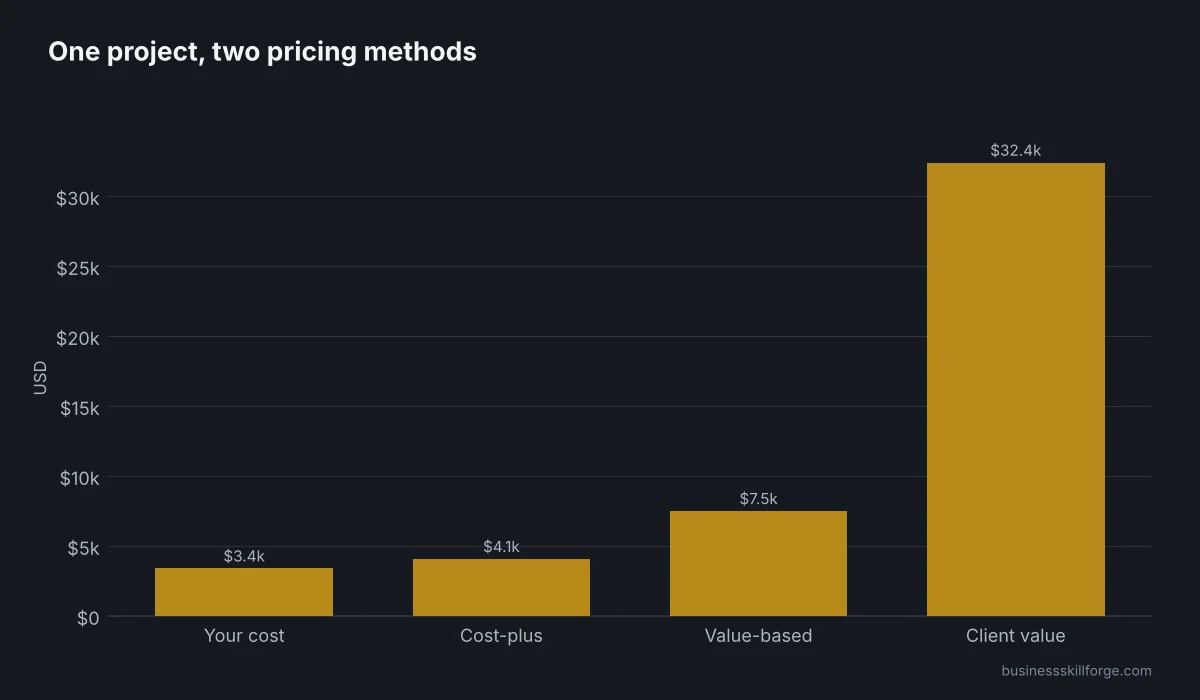
The clinic is still far better off at $7,500: it pays back in roughly three months at the estimated recovery rate. And the developer earns $4,100 over cost instead of $680 on the same 40 hours. Nothing about the work changed. Only the reference point did.
Notice the estimate is in revenue, not profit. A more careful developer would point out that recovered appointments don’t add many extra costs for the clinic, so most of that revenue becomes profit. The more conservative and specific the value estimate, the easier it is for the buyer to believe.
How to set a value-based price, step by step
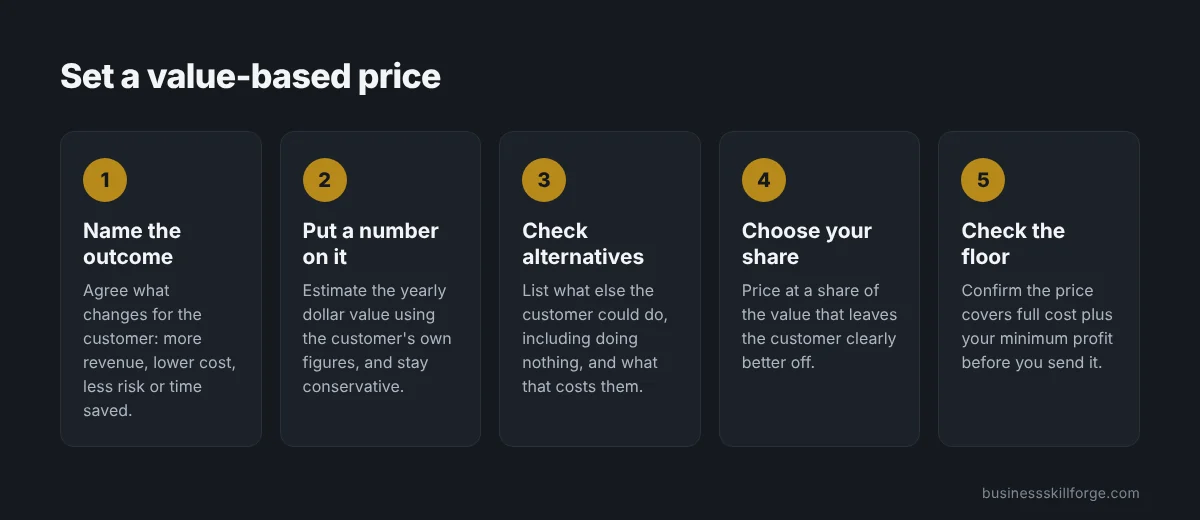
The hardest step for most owners is the conversation. You can’t price on value without asking the customer what the problem costs them now, and many owners feel awkward asking. Questions like “What happens if this doesn’t get fixed this year?” or “How do you measure whether this worked?” usually get you the numbers.
The next hardest step is choosing the share. There’s no fixed rule for how much of the value to capture. It depends on how confident the customer is in the estimate, how many alternatives they have, and how much of the risk you’re taking on. The developer above could offer a lower fixed fee plus a bonus if no-shows fall by an agreed amount, which shares the risk and makes a higher total easier to accept.
Which pricing strategy should you use?
| Situation | Better fit | Why |
|---|---|---|
| Reselling products customers can compare | Cost-plus | Buyers compare like for like; value is set by the market |
| Cost-reimbursement contracts | Cost-plus | The contract defines price as cost plus a fee |
| Custom projects with measurable outcomes | Value-based | The customer’s gain can be estimated and discussed |
| Consulting, software, specialized services | Value-based | Cost to deliver is small relative to the result |
| Handmade or branded products | Mixed | Use cost as the floor and test what buyers will pay |
A practical sign you’re underpricing on cost-plus: customers say yes immediately and nobody ever pushes back. A sign you’re overreaching on value: you lose most deals at the proposal stage, and lost prospects mention price, not fit.
Combining the two: cost floor, value ceiling
In practice the best answer for most small businesses uses both. Your full cost plus a minimum acceptable profit is the floor: never price below it. The customer’s estimated value is the ceiling: they won’t pay more than the benefit they expect. Competitors and alternatives sit somewhere between and tell you where in that range you can realistically land.
For the wallet workshop, the floor is $30 of full cost plus a minimum markup, so about $40. Testing prices with customers may show the design-led wallets sell well at $65 while the basic line can’t go far above $45. Pricing each line inside its own range earns more than one blanket 60% markup.
Tiered pricing is another way to combine them. The developer could offer a basic booking page at $3,900 (close to cost-plus), the full reminder and rebooking system at $7,500, and the same system with a year of monitoring and monthly no-show reports at $9,800. Customers choose the value level they want, and your floor is protected at every tier. Before committing to a price, check what it does to your break-even point: a higher price lowers the number of sales you need, which changes how much risk you’re carrying.
Common pricing mistakes
- Confusing markup with margin. A 50% markup is a 33% margin. Plans built on the wrong one overstate profit.
- Leaving overhead out of cost. Pricing on materials and labor alone guarantees a loss once rent and software are counted.
- Inflating the value estimate. A number the customer doesn’t believe kills the deal. Use their figures and stay conservative.
- Pricing the hours, not the outcome. Getting faster at a task shouldn’t cut your income. Hourly cost-plus does exactly that.
- Discounting to chase volume. A 10% discount on the $48 wallet cuts profit per unit from $18 to $13.20, so you need about 36% more sales to earn the same profit.
- Never revisiting prices. Costs rise every year. Review prices at least annually against both cost and value.
What to do next
Work out your real full cost for your top three products or services, including overhead, and convert your current markup into a margin so you know what you’re actually earning. Then, for each one, write down what it does for the customer in dollars, even roughly. Where the value is several times the price, you have room to move toward value-based pricing. Our profit margin calculator helps check the margin at each price you test.
Key takeaways
- Cost-plus pricing sets price as full cost plus a markup; value-based pricing sets price from the customer’s expected gain.
- A 60% markup on cost is only a 37.5% margin on price, so always convert before planning.
- Cost-plus spreads fixed overhead across volume, which can push prices up just as demand falls.
- Value-based pricing needs a believable, customer-confirmed estimate of the benefit, priced at a share of it.
- Use full cost plus a minimum profit as your floor and customer value as your ceiling, and price each product inside its own range.
Frequently asked questions
What is cost-plus pricing with an example?
Cost-plus pricing sets the price at your full cost per unit plus a fixed markup. If a wallet costs $30 to make, including materials, labor and a share of overhead, a 60% markup gives a $48 price. The $18 profit is 60% of cost but only 37.5% of the price, which is the margin you actually earn.
What is value-based pricing in simple terms?
Value-based pricing means setting your price from what your product or service is worth to the customer, not from what it costs you. If a system helps a clinic recover about $32,400 of revenue a year, a $7,500 price can be fair to both sides, even if it costs much less than that to build.
Is value-based pricing better than cost-plus pricing?
Not always. Value-based pricing usually earns more when the customer gets a clear, measurable benefit and has few direct alternatives. Cost-plus suits commodity products, resale and contracts that define price as cost plus a fee. Many businesses use cost as the minimum price and customer value as the maximum, and price inside that range.
What markup should a small business use for cost-plus pricing?
There’s no single right markup. It depends on your industry, competition and how much overhead is already built into your cost figure. Work backward from the margin you need: a 40% gross margin requires about a 67% markup on cost. Check the result against what competitors charge and what customers are willing to pay.
How do you justify a value-based price to a client?
Show the math using the client’s own numbers. Restate the problem, the estimated yearly benefit, and how quickly the price pays for itself. Keep the estimate conservative so it feels credible. Offering options at different price levels, or tying part of the fee to results, can make a higher price easier for the client to accept.
This article is general education, not tax, legal, accounting or investment advice. Rules and thresholds differ by country and change over time, so check the specifics for your situation. See our financial disclaimer.
Get practical finance & accounting tips in your inbox
Join US professionals getting our best guides, templates and tools. Free. Unsubscribe anytime.