Markup vs Margin: The Difference That Costs You Money
October 25, 2026 · Aditya Gupta

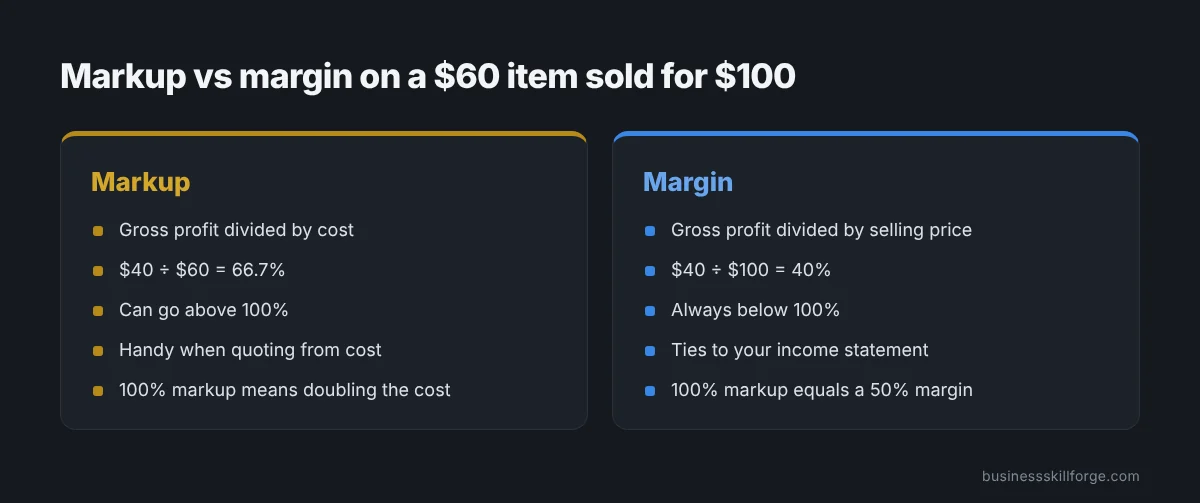
Markup vs margin comes down to what you divide your profit by. Markup is gross profit divided by cost. Margin is gross profit divided by the selling price. Buy an item for $60 and sell it for $100, and you have a 66.7% markup but only a 40% margin. Same $40 of profit, two very different percentages, and confusing them quietly underprices everything you sell.
Markup vs margin: the short version
Both numbers start from the same dollar figure: selling price minus cost, which is your gross profit per unit. The only difference is the base.
- Markup is gross profit as a percentage of cost. It answers: how much did I add on top of what I paid?
- Margin (gross margin) is gross profit as a percentage of the selling price. It answers: how much of every sales dollar do I keep after paying for the product?
Because the selling price is always bigger than the cost (if you’re making money), the margin percentage is always smaller than the markup percentage for the same item. That’s the whole trap. A 40% markup and a 40% margin sound like the same thing, and they are nowhere near each other.
Our glossary entries on markup and gross margin have the one-line definitions if you want them handy. The rest of this guide is about using the two numbers correctly when you set prices.
How to calculate markup and margin
You need two inputs: what the item costs you and what you sell it for.
- Gross profit per unit = Price − Cost
- Markup = (Price − Cost) ÷ Cost
- Margin = (Price − Cost) ÷ Price
Take a small coffee roaster selling 12-ounce bags. Green beans, roasting time, the bag and the label come to $7.50 per bag. It sells wholesale to cafés at $12 and on its own website at $18.
| Channel | Cost | Price | Gross profit | Markup | Margin |
|---|---|---|---|---|---|
| Wholesale | $7.50 | $12.00 | $4.50 | 60.0% | 37.5% |
| Retail (website) | $7.50 | $18.00 | $10.50 | 140.0% | 58.3% |
Wholesale: $4.50 ÷ $7.50 = 60% markup, and $4.50 ÷ $12 = 37.5% margin. Retail: $10.50 ÷ $7.50 = 140% markup, and $10.50 ÷ $18 = 58.3% margin. Notice that markup can go past 100% without anything strange happening. Margin can’t, because you can never keep more than the whole sales dollar.
The same formulas in a spreadsheet
With cost in column B and price in column C, the formulas are short:
- Margin:
=(C2-B2)/C2 - Markup:
=(C2-B2)/B2 - Price from a target margin in D2:
=B2/(1-D2) - Price from a target markup in D2:
=B2*(1+D2)
Format the result cells as percentages and label the column headers clearly. Half the markup and margin mix-ups in small businesses start with a column simply called “%”.
How to convert markup to margin (and back)
If you know one, you can always get the other without knowing the actual cost or price.
- Margin = Markup ÷ (1 + Markup)
- Markup = Margin ÷ (1 − Margin)
A 50% markup is 0.5 ÷ 1.5 = 33.3% margin. A 30% margin is 0.3 ÷ 0.7 = 42.9% markup. Work in decimals and convert to a percentage at the end, and the arithmetic stays clean.

Here’s a cheat sheet for the conversions you’ll use most often:
| Markup on cost | Equivalent margin on price |
|---|---|
| 10% | 9.1% |
| 20% | 16.7% |
| 25% | 20.0% |
| 33.3% | 25.0% |
| 42.9% | 30.0% |
| 50% | 33.3% |
| 66.7% | 40.0% |
| 100% | 50.0% |
| 150% | 60.0% |
| 200% | 66.7% |
| 300% | 75.0% |
Two patterns are worth memorizing. At low percentages the two numbers are close (10% vs 9.1%), so small errors stay small. As the numbers climb, the gap gets wide fast: a 100% markup is only a 50% margin. That 100% markup has a name in retail, “keystone” pricing, which simply means doubling the cost. If you’d rather not do the division by hand, our markup and margin converter does it both ways.
The mistake that costs businesses money
Here’s how the confusion turns into lost profit. A two-person online shop selling kitchen goods decides it wants a 40% gross margin. The pricing spreadsheet, built in a hurry, multiplies every cost by 1.4. That’s a 40% markup, not a 40% margin.
On a single item that costs $60:
- Priced with a 40% markup: $60 × 1.4 = $84. Gross profit $24. Actual margin $24 ÷ $84 = 28.6%.
- Priced for a 40% margin: $60 ÷ 0.6 = $100. Gross profit $40. Margin 40%.
Now scale it to a year in which the shop sells $300,000 worth of goods at cost.
| 40% markup | 40% margin | |
|---|---|---|
| Revenue | $420,000 | $500,000 |
| Cost of goods sold | $300,000 | $300,000 |
| Gross profit | $120,000 | $200,000 |
| Gross margin | 28.6% | 40.0% |
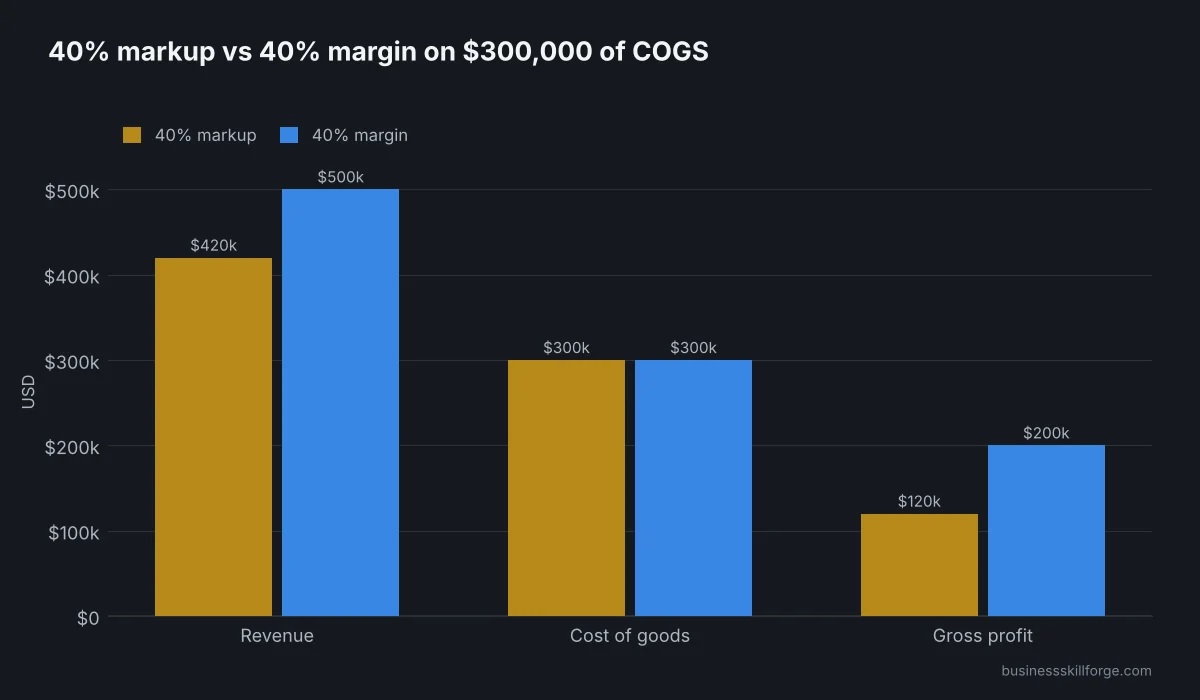
That’s an $80,000 difference in gross profit, assuming the same units sell at either price. In practice a higher price might sell a few fewer units, so the real gap could be smaller. But the owner thought they were running a 40% business and they’re running a 28.6% one, and every plan built on the wrong number is wrong too.
The damage shows up most clearly at break-even. Say the shop’s fixed costs (rent on a small unit, software, insurance, the owners’ pay) are $150,000 a year. Break-even revenue is fixed costs divided by the gross margin:
- At a 28.6% margin: $150,000 ÷ 0.2857 = about $525,000 of sales needed just to cover costs.
- At a 40% margin: $150,000 ÷ 0.40 = $375,000.
At $420,000 of sales, the markup version loses roughly $30,000 for the year ($120,000 gross profit minus $150,000 of fixed costs). Priced correctly, the same volume of goods would have produced $50,000 of profit. You can test your own numbers in our break-even calculator.
How to set a price from a target margin
Once you know the margin you need, pricing is one division: Price = Cost ÷ (1 − target margin). The part people get wrong is the cost.
Use landed cost, not the supplier’s invoice price. Landed cost is everything you pay to get one unit onto your shelf or into your warehouse, ready to sell: the purchase price plus inbound freight, import duty and any packaging you add. Those are part of cost of goods sold, so they belong in the margin calculation.
A small homeware brand imports table lamps:
- Supplier price: $32.00
- Freight per unit: $4.00
- Import duty per unit: $2.50
- Retail box and insert: $1.50
- Landed cost: $40.00
Target margin 45%: $40 ÷ 0.55 = $72.73. Round to $72.99 and the margin is $32.99 ÷ $72.99 = 45.2%.
Now suppose the owner priced off the $32 supplier price instead: $32 ÷ 0.55 = $58.18, rounded to $58.99. Against the real $40 cost, that’s a gross profit of $18.99 and a margin of 32.2%. Thirteen points of margin disappear because freight, duty and a box didn’t make it into the spreadsheet.
Treat card processing fees and marketplace commissions consistently. Some businesses fold them into cost of goods sold and some show them as selling expenses below gross profit. Either is defensible. What matters is that your target margin and your actual reported margin are measured the same way.
Why discounts hurt more than they look
Discounts come off the price, but your cost doesn’t move. So the discount comes entirely out of your gross profit.
Take a product priced at $100 that costs $60, a 40% margin. Give 10% off and you charge $90. Gross profit drops from $40 to $30, which is a 25% cut in profit per unit from a 10% cut in price. To earn the same total gross profit, you need to sell 33.3% more units.
The formula is: extra volume needed = margin ÷ (margin − discount) − 1, with both expressed as a share of the original price. At a 40% margin:
| Discount | Gross profit per unit | Extra units needed to stand still |
|---|---|---|
| 5% | $35 | 14.3% |
| 10% | $30 | 33.3% |
| 15% | $25 | 60.0% |
| 20% | $20 | 100.0% |
| 25% | $15 | 166.7% |

A 20% sale on a 40% margin product has to double unit sales just to break even on gross profit. Sometimes that’s worth it: clearing stock that’s tying up cash, winning a customer who’ll come back. Just run the number before you announce the sale, not after.
Stacked adjustments work the same way. Mark a $100 cost item up 20% to $120, then give 10% off, and you sell it for $108. That’s an 8% markup and a 7.4% margin, not the 10% you might expect from “20 up, 10 off”.
Markup or margin: which one should you use?
Use margin for anything to do with reporting, planning and comparison. Your income statement shows gross profit against revenue, so gross margin is the number that ties to your books, to your break-even point and to the figures a lender or buyer will look at. Our guide to profit margin covers how gross, operating and net margin fit together.
Markup is handy at the point of pricing, when you start from a cost and need a number fast. Plenty of wholesale price lists and trade quotes are built that way. There’s nothing wrong with using markup to set prices, as long as you know what margin each markup produces.
Service businesses run into the same issue. An agency that pays a subcontract developer $50 an hour and bills the client $80 has a 60% markup and a 37.5% margin on that work. If the agency’s overheads need a 45% margin to cover them, that rate is too low, even though “60%” sounds generous.
The practical rule: pick one term for internal use (margin is the safer choice), write it on every spreadsheet header and every pricing document, and convert explicitly whenever you switch. If you’re deciding how to set prices in the first place, our comparison of cost-plus vs value-based pricing picks up where this leaves off.
Common markup and margin mistakes
- Applying a margin target as a markup. Multiplying cost by 1.4 for a “40% margin” is the classic. Divide by 0.6 instead.
- Pricing off the supplier price. Freight, duty and packaging belong in cost. Leave them out and your real margin is lower than the one on your sheet.
- Averaging margins without weighting them. Product A earns a 60% margin on $10,000 of sales and product B earns 20% on $40,000. The simple average is 40%, but the real blended margin is ($6,000 + $8,000) ÷ $50,000 = 28%. Always divide total gross profit by total revenue.
- Confusing gross margin with net margin. A 45% gross margin says nothing about whether you’re profitable after rent, wages and software. Check both.
- Including sales tax or VAT in the price. Sales tax in the US, and VAT or GST in the UK, Canada and Australia, isn’t your revenue. Calculate margin on the price excluding tax.
- Never rechecking costs. When a supplier raises prices by 8% and your selling price stays put, your margin falls. Review costs on your top sellers at least quarterly.
What to do next
Open your pricing spreadsheet and check one thing: is the formula dividing by price or by cost, and does the column header say which? Then pull your 20 best-selling products, put landed cost and current price side by side, and calculate both markup and margin for each. Compare the margins to the target you think you’re hitting.
If they’re short, fix the formula first, then decide product by product whether to raise prices, renegotiate costs or accept the lower margin on purpose. Run any planned discount through the volume table above before it goes live. And when you report numbers to anyone, a partner, a lender or your accountant, quote margin and say so.
Key takeaways
- Markup is gross profit divided by cost, and margin is gross profit divided by selling price, so the margin is always the smaller percentage.
- To price for a target margin, divide cost by (1 − margin); multiplying cost by (1 + margin) gives you a lower margin than you intended.
- Convert with Margin = Markup ÷ (1 + Markup) and Markup = Margin ÷ (1 − Margin); a 100% markup equals a 50% margin.
- Use full landed cost, including freight, duty and packaging, or your real margin will be lower than your spreadsheet says.
- Discounts come straight out of gross profit, and a 20% discount on a 40% margin product needs twice the unit sales to earn the same gross profit.
- Pick margin as your internal standard, label every column clearly and calculate blended margin as total gross profit over total revenue.
Frequently asked questions
Is a 50% markup the same as a 50% margin?
No. A 50% markup means you add half the cost on top, so a $100 cost item sells for $150 and the margin is $50 ÷ $150, or 33.3%. A 50% margin means half of the selling price is profit, so the same $100 item would need to sell for $200, which is a 100% markup.
How do I calculate selling price from cost and a target margin?
Divide the cost by one minus the target margin, with the margin written as a decimal. For a $40 cost and a 45% target margin, the price is $40 ÷ 0.55 = $72.73. Don’t multiply the cost by 1.45; that gives a 45% markup, which is only about a 31% margin.
Can profit margin be more than 100%?
Gross margin can’t exceed 100%, because it measures profit as a share of the selling price and you can’t keep more than the whole price. It only approaches 100% when the cost is close to zero. Markup has no ceiling: buying at $10 and selling at $50 is a 400% markup and an 80% margin.
What does keystone pricing mean?
Keystone pricing is a retail shorthand for setting the selling price at double the cost. That’s a 100% markup, which works out to a 50% gross margin. It’s a quick starting point rather than a rule, since freight, shrinkage, discounts and payment fees can all pull the real margin below 50%.
Should shipping and payment fees be included when calculating margin?
Inbound freight, duty and packaging are part of the cost of getting goods ready to sell, so include them in cost of goods sold. Card fees, marketplace commissions and outbound shipping are handled differently by different businesses. Either approach can work, as long as your target margin and your reported margin use the same definition.
This article is general education, not tax, legal, accounting or investment advice. Rules and thresholds differ by country and change over time, so check the specifics for your situation. See our financial disclaimer.
Get practical finance & accounting tips in your inbox
Join US professionals getting our best guides, templates and tools. Free. Unsubscribe anytime.