Index Funds for Beginners: How They Work and What They Cost
November 7, 2026 · Aditya Gupta
Index funds are mutual funds or exchange-traded funds that try to match the return of a market index, such as a broad stock or bond index, instead of trying to beat it. Because they simply hold what the index holds, they tend to trade less and often cost less to run than actively managed funds. For a beginner, that combination of broad exposure and low cost is the main appeal.
This guide explains what an index fund actually owns, why the fee matters more than most beginners expect, the difference between the mutual fund and ETF versions, and what to check before you put money in. It’s educational, not a recommendation of any particular fund.
What is an index fund?
The SEC’s investor education site defines an index fund as “a type of mutual fund or exchange-traded fund that seeks to track the returns of a market index” (Investor.gov). You can’t buy an index directly, because an index is just a list and a calculation. A fund that copies it is the practical way in.
A market index is a measured basket of securities meant to represent part of a market. The S&P 500, for example, tracks large US companies. Other indexes cover the whole US stock market, international stocks, government bonds, or a single sector.
Some index funds hold every security in their index. Others hold a representative sample. Either way, the fund manager isn’t picking stocks they think will do well. That approach is called passive investing: you accept the market’s return, minus costs, rather than paying someone to try to beat it.
How index funds decide what to own
Every index has rules for what goes in and how much of each holding it contains. The most common rule is weighting by market capitalization. Market capitalization is a company’s share price multiplied by the number of shares outstanding, so bigger companies get a bigger slice.
Here’s a simplified four-company index to show the arithmetic:
| Company | Market value | Weight in index | From a $1,000 investment |
|---|---|---|---|
| Company A | $900 billion | 45% | $450 |
| Company B | $600 billion | 30% | $300 |
| Company C | $300 billion | 15% | $150 |
| Company D | $200 billion | 10% | $100 |
| Total | $2,000 billion | 100% | $1,000 |
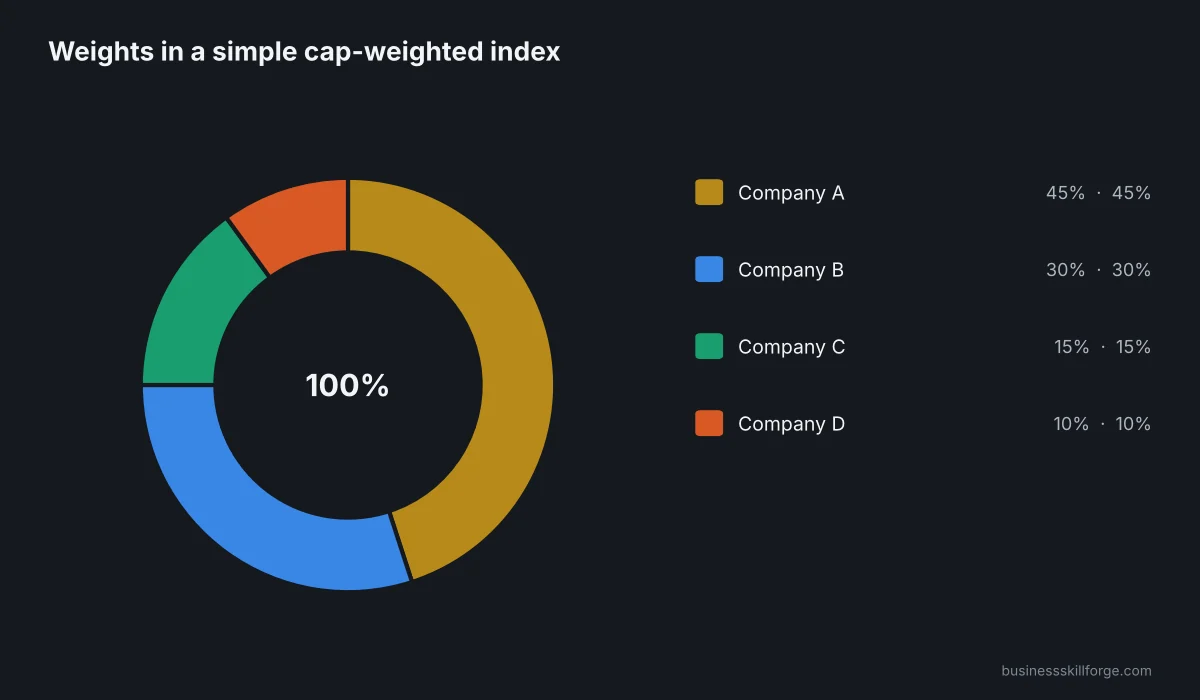
Two things follow from this. First, a cap-weighted fund automatically owns more of whatever has grown, without anyone deciding to buy it. Second, a broad-sounding index can be more concentrated than its name suggests if a handful of very large companies dominate it. Investor.gov’s investor bulletin on index funds suggests asking exactly this question: how is the makeup of the fund’s index determined? Not every index is cap-weighted; some weight by price or give each company an equal share.
Why fees matter so much
The expense ratio is the percentage of a fund’s average net assets used each year to pay its operating expenses. You never see a bill. The fund deducts it from its assets, so it shows up as a slightly lower return.
On $10,000, the yearly cost is easy to work out:
- 0.05% expense ratio: $5 a year
- 0.50% expense ratio: $50 a year
- 1.00% expense ratio: $100 a year
Those numbers look trivial, which is the trap. The fee comes out every year, from a balance that keeps growing, and the money taken is money that never compounds. Investor.gov’s own example on understanding fees takes a $100,000 portfolio growing 4% a year for 20 years: with a 0.25% annual fee it ends near $208,000, at 0.50% near $198,000, and at 1.00% near $179,000.
Here’s the same idea for a beginner investing monthly. Assume $300 a month for 30 years ($108,000 in total contributions) and an illustrative 6% annual return before fees. These are illustrative numbers, not a forecast; real returns vary year to year and can be negative.
| Annual fee | After 10 years | After 20 years | After 30 years |
|---|---|---|---|
| 0.05% | $48,617 | $135,273 | $289,730 |
| 0.50% | $47,508 | $128,660 | $267,278 |
| 1.00% | $46,309 | $121,741 | $244,613 |
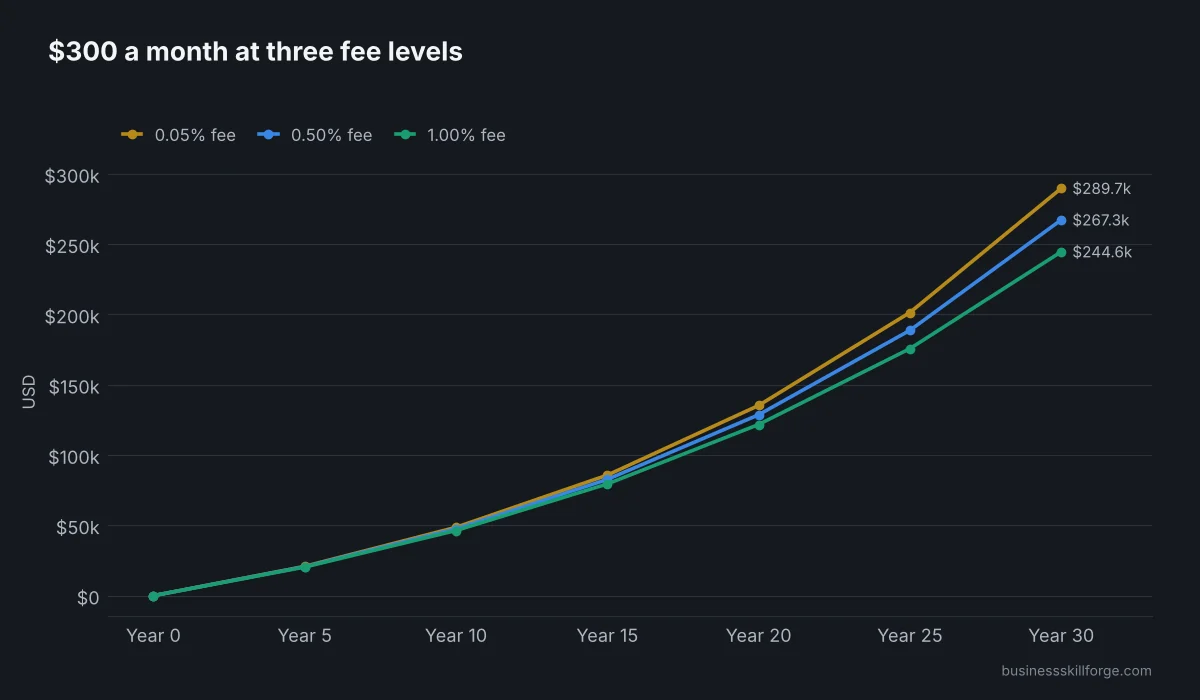
After ten years the gap between the cheapest and most expensive option is about $2,300. After 30 years it’s $45,117. Nothing about the investments changed, only the fee. If you want to see how compounding drives that gap, our complete guide to compound interest walks through the mechanics and shows how to test your own numbers.
A caution from the same Investor.gov bulletin: “not all index funds have lower costs than actively managed funds.” The word “index” in a fund’s name tells you nothing about its fee. Check the number.
Index funds vs actively managed funds
An actively managed fund employs managers and analysts who pick investments, trying to beat a benchmark. That research costs money, and frequent trading adds costs too. An index fund skips the stock picking.
| Index fund | Actively managed fund | |
|---|---|---|
| Goal | Match an index | Beat a benchmark |
| Who picks holdings | The index rules | The fund’s managers |
| Trading | Usually infrequent | Often more frequent |
| Typical cost | Often lower, but check | Often higher |
| Return vs market | Market return minus costs and tracking error | Could be above or below |
Active funds can outperform in a given period. The difficulty for an investor is knowing in advance which ones will, and the higher fee is a hurdle they have to clear every year. Our active vs index fund comparison runs the numbers on that hurdle.
Index mutual funds vs index ETFs
The same index can be tracked by either structure. The main practical differences:
- How you buy. A mutual fund is bought from the fund company at the price set once a day after the market closes. An ETF trades on an exchange throughout the day, like a stock.
- Minimums. Some mutual funds have a minimum initial investment. An ETF’s minimum is usually one share, and many brokers now allow fractional shares.
- Automatic investing. Mutual funds have traditionally made fixed-dollar monthly purchases easy. Some brokers now offer the same for ETFs.
- Taxes. In taxable US accounts, the ETF structure can mean fewer capital gains distributions than a comparable mutual fund, though this varies by fund and doesn’t matter inside a tax-advantaged retirement account.
For a long-term investor, the cost and the index matter more than the wrapper. Our ETF vs mutual fund comparison goes further.
What risks do index funds have?
Low cost doesn’t mean low risk. An index fund carries the same general risks as whatever it tracks. A stock index fund will fall when the stock market falls, and it has no manager who can move to cash or sell a falling holding. That’s the trade-off for low costs.
Other risks the SEC lists: tracking error, which is the gap between a fund’s return and its index’s return, and underperformance caused by fees, trading costs and that tracking error. A fund that holds only a sample of its index is more likely to drift from it.
The practical risk for beginners is behavioral. Stock prices can drop sharply, and selling after a fall locks in the loss. That’s why money you’ll need within a few years, including your emergency fund, generally belongs in savings rather than a stock index fund. Our guide on how big your emergency fund should be covers that layer first.
How many index funds do you need?
Fewer than most beginners think. Because one broad index fund can hold hundreds or thousands of companies, a single fund already gives you diversification, which means spreading money across many holdings so one company’s failure doesn’t sink you. Many long-term investors use just two or three: a broad domestic stock fund, an international stock fund and a bond fund. The split between them, your asset allocation, does more to set your risk than which specific funds you pick.
A worked example: someone investing $300 a month with a 70/30 split between stocks and bonds puts $210 into a stock index fund and $90 into a bond index fund. Once a year they check whether market moves have pushed the split to, say, 76/24, and move money back to 70/30. Some fund companies also offer single all-in-one funds that hold a fixed mix or shift toward bonds as a target date approaches. Those are convenient, but compare their total expense ratio with the cost of the separate funds.
How to get started with index funds
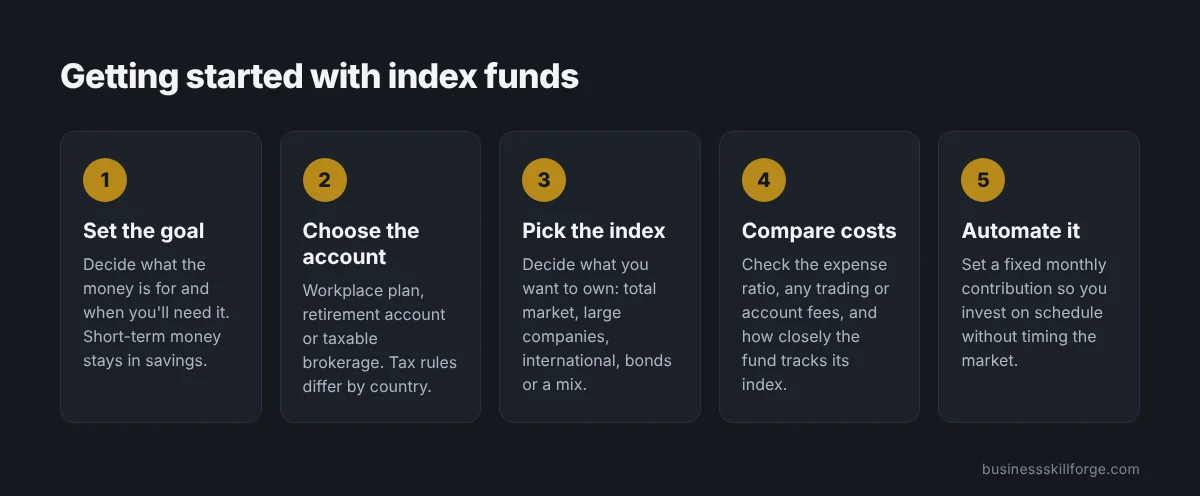
A few notes on these steps. The account comes before the fund. In the US, that might be a workplace 401(k), an IRA or a taxable brokerage account. The UK has ISAs and pensions, Canada has TFSAs and RRSPs, and Australia has superannuation and ordinary brokerage accounts. Tax treatment differs a lot between them, so check your country’s rules. Within a 401(k), your choices are limited to the plan’s menu, which often includes index options.
Many beginners invest a fixed amount on a schedule, such as $300 every month. That’s dollar-cost averaging: you buy more shares when prices are low and fewer when they’re high, and you don’t have to decide when to invest.
Common beginner mistakes
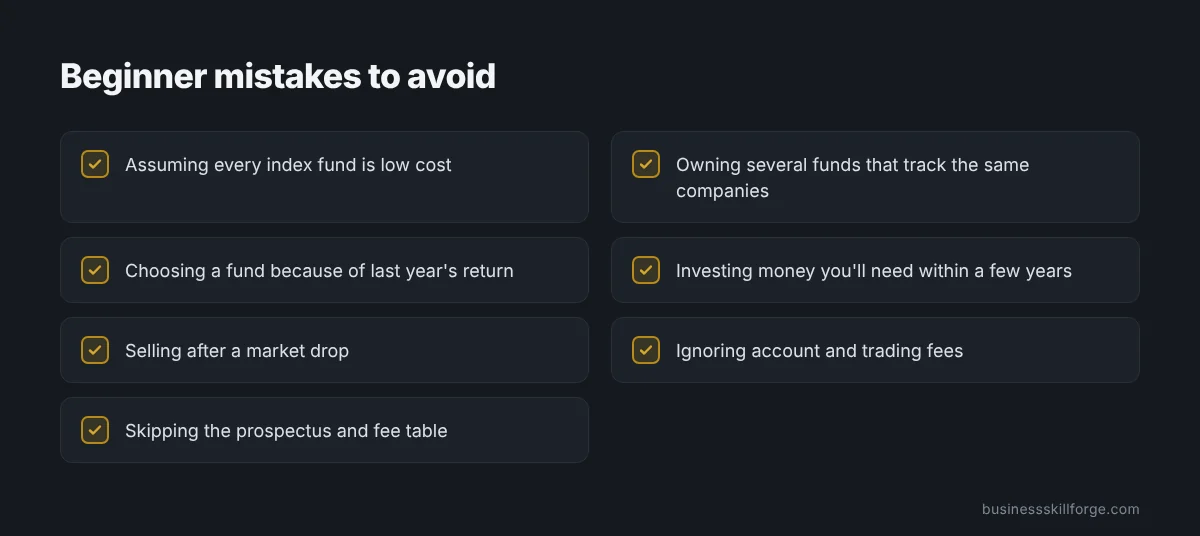
Owning five funds doesn’t mean you’re diversified if all five track large US companies. Look through to the index each one follows. And check the expense ratio before the past returns: past returns don’t predict future ones, but the fee is a cost you’ll pay for certain.
What to do next
Decide what the money is for and when you’ll need it. If it’s more than five years away and your emergency fund and high-interest debt are already handled, look at the index options inside the account you’ll use. For each one, find the index it tracks, its expense ratio and its tracking record against that index, and read the prospectus. If you’re unsure how much risk is right for you, a fee-only adviser can help, and the SEC’s Investor.gov site has free background reading.
Key takeaways
- An index fund is a mutual fund or ETF that tries to match a market index’s return rather than beat it.
- Most stock indexes weight companies by market value, so the largest companies take the biggest share of your money.
- The expense ratio compounds against you: in this article’s illustrative example, a 1.00% fee left $45,117 less than a 0.05% fee after 30 years.
- Not every index fund is cheap, so check the actual expense ratio rather than relying on the word “index.”
- Index funds carry the full risk of the market they track, so keep short-term money and your emergency fund in savings.
Frequently asked questions
How much money do I need to start investing in index funds?
Often very little. Index ETFs can usually be bought one share at a time, and many brokers allow fractional shares, so the minimum can be a few dollars. Some index mutual funds have a minimum initial investment, which varies by fund company. Before starting, make sure you have an emergency fund and no high-interest debt, because those usually come first.
Are index funds safe for beginners?
They are simple, broad and often low cost, but they are not safe in the sense of protecting your money from losses. A stock index fund falls when the market falls, sometimes sharply. Index funds also aren’t covered by FDIC deposit insurance. They suit money you can leave invested for many years, not money you’ll need soon.
What is a good expense ratio for an index fund?
Lower is better, all else equal. Broad-market index funds that track large, widely followed indexes tend to be among the cheapest funds available, while specialized or niche index funds often charge more. The cleanest comparison is between funds that track the same index: if two funds follow the same index with similar tracking, the cheaper one usually leaves you with more.
Is an index fund better than an ETF?
That’s not quite the right comparison, because many ETFs are index funds. An index fund can be structured as a mutual fund or an ETF. The differences are in how you buy (once a day vs during market hours), minimums, automatic investing features and, in taxable US accounts, how often capital gains are distributed. The index and the cost matter more.
Can you lose money in an index fund?
Yes. An index fund owns the securities in its index, so if those prices fall, the fund’s value falls too. Over short periods, stock index funds can lose a significant share of their value. Investors with long time frames accept that risk in exchange for the potential of higher long-term returns than cash, but no return is guaranteed.
Sources
- Investor.gov: Index Funds
- Investor.gov: Investor Bulletin: Index Funds
- Investor.gov: Understanding Fees
- Investor.gov Glossary: Expense Ratio
- FDIC: Insurance Basics (Deposit Insurance Guide)
This article is general education, not tax, legal, accounting or investment advice. Rules and thresholds differ by country and change over time, so check the specifics for your situation. See our financial disclaimer.
Get practical finance & accounting tips in your inbox
Join US professionals getting our best guides, templates and tools. Free. Unsubscribe anytime.