The 50/30/20 Budget Rule, and When It Doesn’t Work
November 6, 2026 · Aditya Gupta

The 50/30/20 budget rule splits your after-tax income three ways: 50% for needs such as housing, groceries, insurance and minimum debt payments, 30% for wants, and 20% for savings and extra debt payments. On $5,000 a month of take-home pay, that’s $2,500, $1,500 and $1,000. It’s a simple starting point, but high housing costs or a large income often call for a different split.
Its appeal is that you only have to track three numbers instead of thirty categories. Its weakness is that the percentages were never meant to fit everyone. This guide shows how to apply the rule properly, the details that trip people up, and how to adjust it when your situation doesn’t match the template.
Where the 50/30/20 rule comes from
The idea is usually traced to the 2005 book All Your Worth: The Ultimate Lifetime Money Plan by Elizabeth Warren and Amelia Warren Tyagi, which divides money into three parts: must-haves, wants, and savings (Simon & Schuster). The 50/30/20 percentages are the version that’s spread most widely since.
A budget is a plan for how your income will be spent and saved over a period. The 50/30/20 rule is a budget built on proportions rather than line items. You don’t decide how much goes to coffee. You decide whether your total wants fit in 30%.
How the 50/30/20 split works
Start with your after-tax income: your take-home pay after income taxes and payroll taxes. Then divide it.
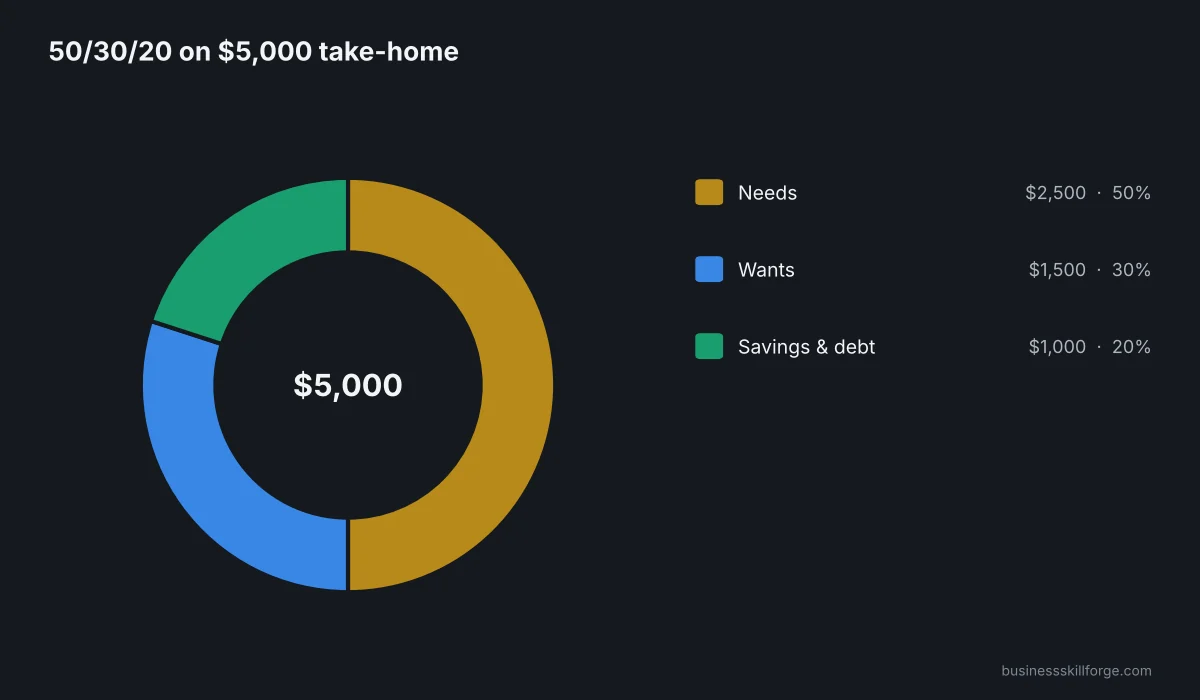
| Bucket | Share | On $5,000 take-home | What goes in it |
|---|---|---|---|
| Needs | 50% | $2,500 | Rent or mortgage, utilities, groceries, insurance, transport to work, childcare, minimum debt payments |
| Wants | 30% | $1,500 | Dining out, entertainment, subscriptions, travel, hobbies, upgrades beyond the basic version |
| Savings and debt | 20% | $1,000 | Emergency fund, retirement saving, investing, extra payments above the minimum on debt |
Notice where debt sits. Minimum payments are needs, because skipping them has real consequences. Anything you pay above the minimum is a choice to get ahead, so it counts toward the 20%.
Handling pre-tax retirement contributions
This is the detail most guides skip. If you contribute to a workplace retirement plan through payroll, that money never reaches your take-home pay. Ignore it and the rule tells you to save 20% on top of what you’re already saving.
The fix is to add pre-tax contributions back. Say your take-home is $5,000 a month and $500 a month goes into your 401(k) before tax. Use $5,500 as your base. The 20% target is $1,100, and $500 of it is already done through payroll, so you need $600 more from your take-home. Needs get $2,750 and wants get $1,650. Our pre-tax to after-tax converter helps if you only know your gross salary.
How to set up a 50/30/20 budget
- Find your real take-home pay. Use your pay stubs, not your salary. If income varies, use the average of your lowest three months from the past year.
- Total your needs. Pull the last two or three months of statements and list only what you couldn’t stop paying without serious consequences.
- Compare needs with 50%. This is the number that tells you whether the rule fits as written.
- Set the savings transfer. Move the 20% out on payday, automatically, before spending starts. That’s paying yourself first.
- Spend the rest freely. Whatever remains after needs and savings is your wants budget. No tracking each latte, as long as the total holds.
A worked month: checking your budget against the rule
Here’s what a real check looks like. The $5,000 take-home household from the table above adds up last month’s statements and finds:
| Bucket | Target | Actual | Actual share | Gap |
|---|---|---|---|---|
| Needs | $2,500 | $2,380 | 47.6% | $120 under |
| Wants | $1,500 | $1,820 | 36.4% | $320 over |
| Savings and debt | $1,000 | $800 | 16.0% | $200 short |
Needs are fine. The problem is that wants ran $320 over, and savings came up $200 short because savings were whatever was left at month end. Auditing every purchase won’t fix that. Moving the transfer to payday will: savings come out first at the full $1,000, and then you see whether wants adjust on their own. Most of the time they do, because you spend what’s in the account. If wants keep overshooting, look at the two or three largest want categories, which usually explain most of the gap.
Run this check monthly for the first three months, then quarterly. The rule is a dashboard, not a straitjacket.
Needs vs wants: where people get it wrong
The rule only works if you sort honestly, and plenty of spending sits in a gray area. A useful test: a need is the cheapest version of something you must have to live and work. Anything above that version is a want.
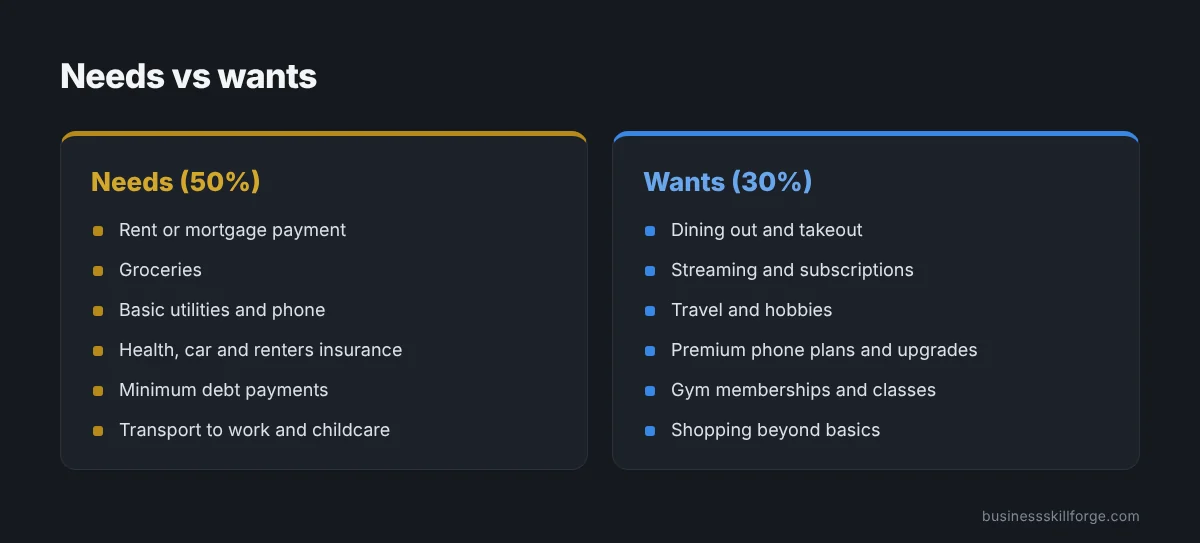
So a basic phone plan is a need; the unlimited plan with a new phone every year is partly a want. Groceries are a need; takeout is a want. A reliable car to get to work is a need; the payment on a much nicer car is part need, part want. You don’t have to split every bill to the dollar, but if you call everything a need, the 50% bucket balloons and the rule stops telling you anything.
When the 50/30/20 rule doesn’t work
The rule assumes your needs fit in half your income. For many households, they don’t.
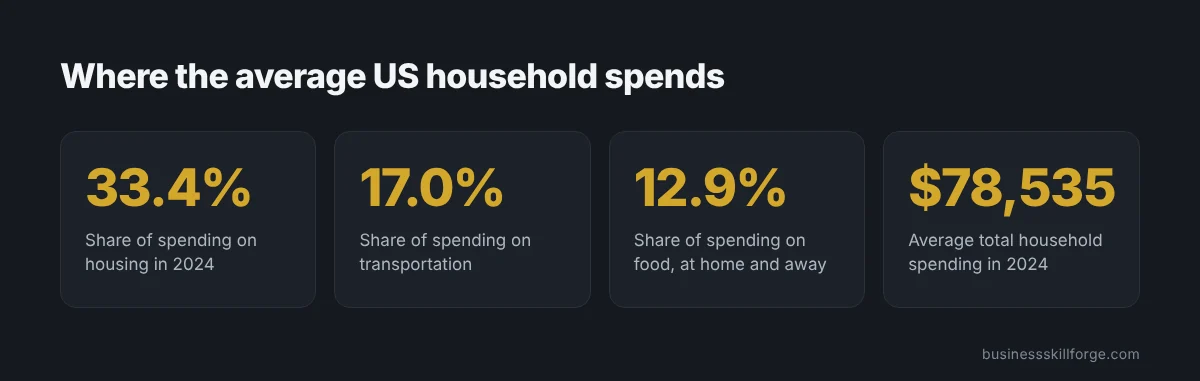
The Bureau of Labor Statistics’ consumer spending data shows how big the fixed costs are. In 2024, housing made up 33.4% of average household spending, transportation 17.0% and food 12.9%, according to the BLS Consumer Expenditure Survey. Housing and transportation alone came to just over half of spending. These are shares of spending, not of take-home pay, and they include some wants (eating out counts as food, for instance), but they show why the 50% needs line is tight for an average household.
Case 1: a renter in a high-cost city
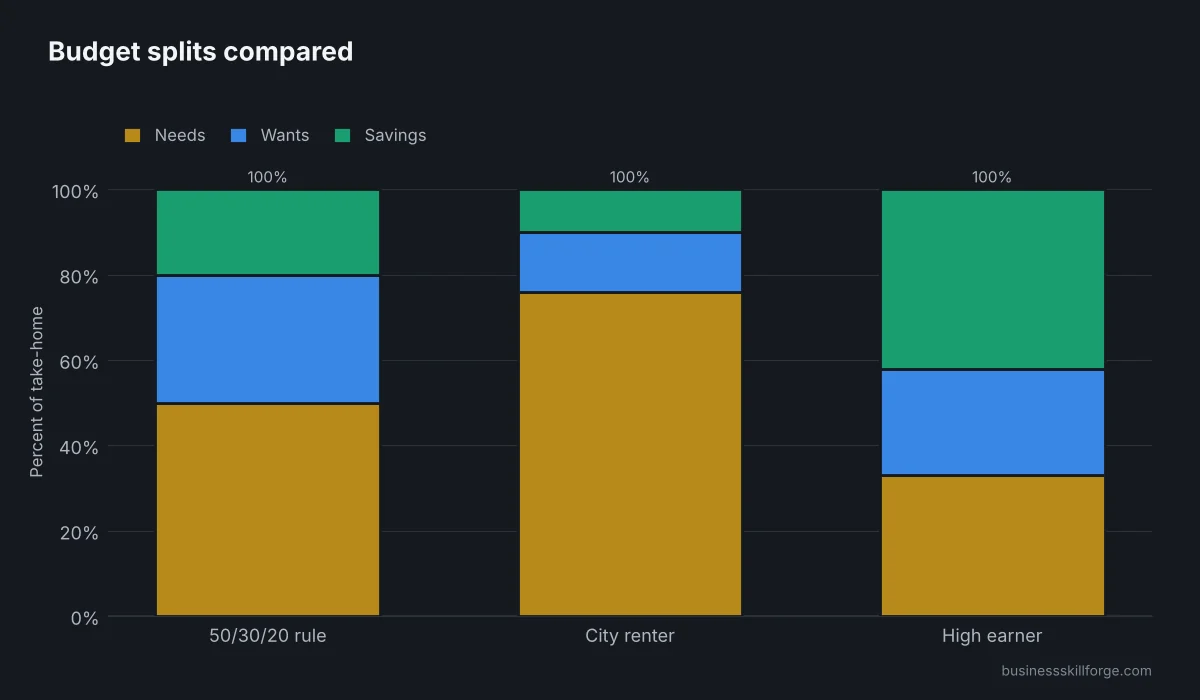
Take a renter with $4,200 a month take-home. Rent is $1,900, utilities $180, groceries $450, transport $300, insurance $220 and minimum debt payments $150. Needs total $3,200, which is 76% of take-home. That leaves $1,000 for everything else.
Forcing 50/30/20 here just produces a budget that fails on day one. A workable version is to accept 76% needs for now, keep wants to about 14% ($600) and save 10% ($400), while working on the big lever: housing. A roommate, a cheaper unit at lease renewal or a move closer to work changes the math far more than cutting subscriptions.
Case 2: a high earner
Now a household with $12,000 a month take-home and $4,000 of needs, 33% of income. The rule says spend $3,600 on wants and save $2,400. That’s 20%, but this household could easily save much more. A split closer to 33/25/42, with $3,000 for wants and $5,000 saved, puts the surplus to work. For high earners, 50/30/20 can act as a ceiling on saving when it should be a floor.
Case 3: debt or a thin emergency fund
If you’re carrying high-interest credit card debt or have no emergency savings, 20% may be too little. Many people temporarily move to something like 50/20/30, trimming wants to push 30% toward debt or the emergency fund until it’s handled. Our guides to how big an emergency fund should be and debt avalanche vs snowball cover where that money should go first.
Variable or self-employed income
If you’re self-employed, “after-tax income” means after setting aside money for income tax and self-employment tax, which nobody withholds for you. Move the tax set-aside to a separate account first, then apply the split to what’s left. Base the plan on lean months, and send anything above that baseline in good months to savings.
Alternatives to 50/30/20
| Approach | How it works | Good for |
|---|---|---|
| Adjusted ratios (60/20/20, 70/20/10) | Same three buckets, percentages that match reality | High-cost areas, early careers |
| Pay yourself first | Set a savings amount, spend the rest without categories | People who hate tracking |
| Zero-based budget | Every dollar assigned to a category before the month starts | Tight budgets, paying off debt |
| Envelope or category caps | Fixed limits for problem categories only | One or two areas that keep running over |
Ratios are a means, not the goal. If a different split gets you saving consistently, use it.
Whichever method you pick, plan for the bills that don’t arrive monthly. A $1,200 annual car insurance premium is $100 a month of needs. $900 of holiday spending is $75 a month of wants. Move those monthly amounts into a separate account so the annual bill doesn’t land on a credit card and throw off three months of budgeting. Couples often run the same split on combined take-home pay, with one joint account for needs and savings and separate accounts for each person’s share of wants.
Common 50/30/20 mistakes
- Using gross salary. The rule is built on take-home pay. Using gross income makes every bucket too big.
- Forgetting payroll savings. Pre-tax retirement contributions count toward the 20%.
- Labeling wants as needs. The premium version of a necessity is partly a want.
- Ignoring irregular costs. Annual insurance, car repairs and holiday spending belong in the budget too. Divide them by 12 and put them in the right bucket.
- Letting spending rise with every raise. Lifestyle inflation is when spending climbs as income does, so savings never grow. Keeping 50/30/20 as income rises allows exactly that; directing part of each raise to savings prevents it.
What to do next
Work out your real take-home pay, add back any pre-tax retirement contributions, and total your needs from last month’s statements. If needs fit in 50%, set up the 20% transfer and use the rule as written. If they don’t, write down the split you actually have, pick a target split you can reach in six to twelve months, and focus on the biggest needs line, usually housing or transport, rather than small wants.
Key takeaways
- The 50/30/20 budget rule splits after-tax income into 50% needs, 30% wants and 20% savings and extra debt payments.
- Add pre-tax retirement contributions back to your take-home pay, and count them toward the 20%.
- Minimum debt payments are needs; anything above the minimum counts as savings.
- In high-cost areas, needs often exceed 50%, so adjust the ratios and work on housing costs rather than forcing the template.
- High earners with modest needs should treat 20% as a floor for saving, not a target.
Frequently asked questions
Is the 50/30/20 rule based on gross or net income?
Net income, meaning your after-tax take-home pay. Using gross income makes every bucket larger than the money you actually receive. One adjustment: if you contribute to a workplace retirement plan before tax, add those contributions back to your take-home pay and count them toward the 20% savings bucket, so you don’t double up on saving targets.
Does rent count as a need in the 50/30/20 budget?
Yes, housing is a need. But if you chose a more expensive place than you need, part of that rent is arguably a want. In practice, most people put all rent under needs and then look at whether housing is pushing needs above 50%. If it is, housing is usually the biggest single lever for making the budget work.
What if my needs are more than 50% of my income?
That’s common, especially in high-cost cities and early in a career. Use an adjusted split that reflects reality, such as 60/20/20 or 70/20/10, rather than abandoning budgeting. Then work on the largest needs over time: housing at your next lease renewal, transport, insurance shopping and refinancing debt. Small wants rarely close a big gap.
Do debt payments go in needs or savings?
Minimum required payments go in needs, because missing them leads to fees, penalty rates and credit damage. Any extra amount you pay above the minimum goes in the 20% savings and debt bucket, because it’s a choice to get ahead. If you have high-interest debt, you might temporarily shift more than 20% toward it by trimming wants.
Is 20% enough to save?
It depends on your goals, age and income. For many people it’s a solid baseline. If you started saving late, want to retire early or have high-interest debt to clear, you may need more. High earners with modest living costs can often save well beyond 20%. Treat 20% as a minimum to aim for, not a ceiling.
Sources
- Simon & Schuster: All Your Worth by Elizabeth Warren and Amelia Warren Tyagi
- BLS, The Economics Daily: Housing and transportation accounted for 50 percent of household spending in 2024
This article is general education, not tax, legal, accounting or investment advice. Rules and thresholds differ by country and change over time, so check the specifics for your situation. See our financial disclaimer.
Get practical finance & accounting tips in your inbox
Join US professionals getting our best guides, templates and tools. Free. Unsubscribe anytime.