How Much Emergency Fund Do You Need? A Way to Size It
October 25, 2026 · Aditya Gupta
Most people need an emergency fund of three to six months of essential expenses, and some need more. Start with what you must pay each month to keep a roof, food, insurance and minimum debt payments going, then multiply by the number of months your income could realistically stop. A dual-income salaried couple can sit near three months; a freelancer or sole earner should aim higher.
That is the short answer. The rest of this guide shows how to turn it into a specific dollar figure for your household, how to adjust it for job risk, where to park the money, and how to build it when you’re starting from zero.
What an emergency fund is, and what it isn’t
An emergency fund is cash you set aside only for unplanned, necessary expenses or a loss of income. A job loss, a $2,400 transmission repair, an urgent flight to a sick parent, a medical bill after the insurance pays its share. The point is that you can pay for these without running up a high-interest credit card balance or selling investments at a bad moment.
It is not the money for things you know are coming. Car insurance renewals, holiday gifts, the annual software subscription and the new laptop you’ll need next year are predictable. Those belong in a sinking fund, which is a separate pot you fill a little each month for a known future cost. Mixing the two is the most common reason emergency funds quietly drain away: the “emergency” turns out to be December.
The Federal Reserve’s annual household survey shows why the cushion matters. In its 2025 survey, 63% of adults said they would cover a hypothetical $400 emergency expense using cash or its equivalent, according to the Fed’s Survey of Household Economics and Decisionmaking. The other 37% would borrow, sell something, or couldn’t cover it at all. That share has sat at 63% for four survey years running.
How to calculate your emergency fund number
The formula is simple. The work is in getting the first number right.
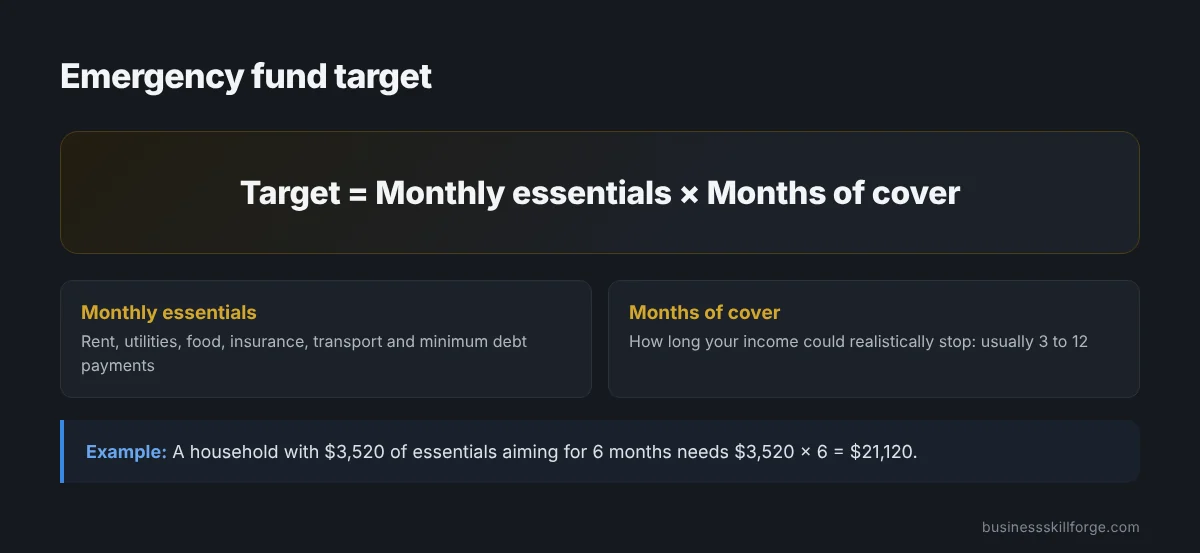
Use essential expenses, not total spending. If you lost your income tomorrow, you’d cancel the streaming services, eat out less and stop the extra payments on your car loan. Your emergency fund only has to cover what’s left. Pull three months of bank and card statements, and list what you would still have to pay.
Here is a worked example for a renting household of two with one car:
| Essential monthly cost | Amount |
|---|---|
| Rent | $1,650 |
| Utilities | $220 |
| Groceries (lean version) | $600 |
| Insurance (health premiums, car, renters) | $310 |
| Transport (fuel, transit, parking) | $280 |
| Minimum debt payments | $240 |
| Phone and internet | $130 |
| Medical and prescriptions | $90 |
| Total essentials | $3,520 |
At three months of cover, this household needs $10,560. At six months, $21,120. Notice what’s missing from the list: dining out, subscriptions, gym membership, retirement contributions and savings transfers. Those stop during an emergency, so they don’t need funding.
Two adjustments people forget. First, if you get health insurance through work, losing the job may raise your premium (in the US, continuing employer coverage often costs far more than the payroll deduction you’re used to), so use the higher figure. Second, include minimum debt payments only, not the extra you normally pay. If you want a quick check on a larger budget, our worked example on an emergency fund for $6,000 in monthly expenses runs the same arithmetic at a higher spending level.
Three months, six months, or more?
The months-of-cover number is really a judgment about how long it would take you to replace your income, plus how likely you are to need the money at all. Five questions do most of the work:
- How many incomes does the household have? Two independent paychecks rarely stop at the same time. One paycheck can.
- How stable is the income? A tenured teacher and a commission-only salesperson have very different risks.
- How long would a job search take? Senior and specialized roles often take longer to fill than entry-level ones.
- Who depends on you? Children, a non-working partner or a parent you support all argue for a bigger cushion.
- What could break? An older car, a house rather than a rental, or a chronic health condition raises the odds of a large bill.
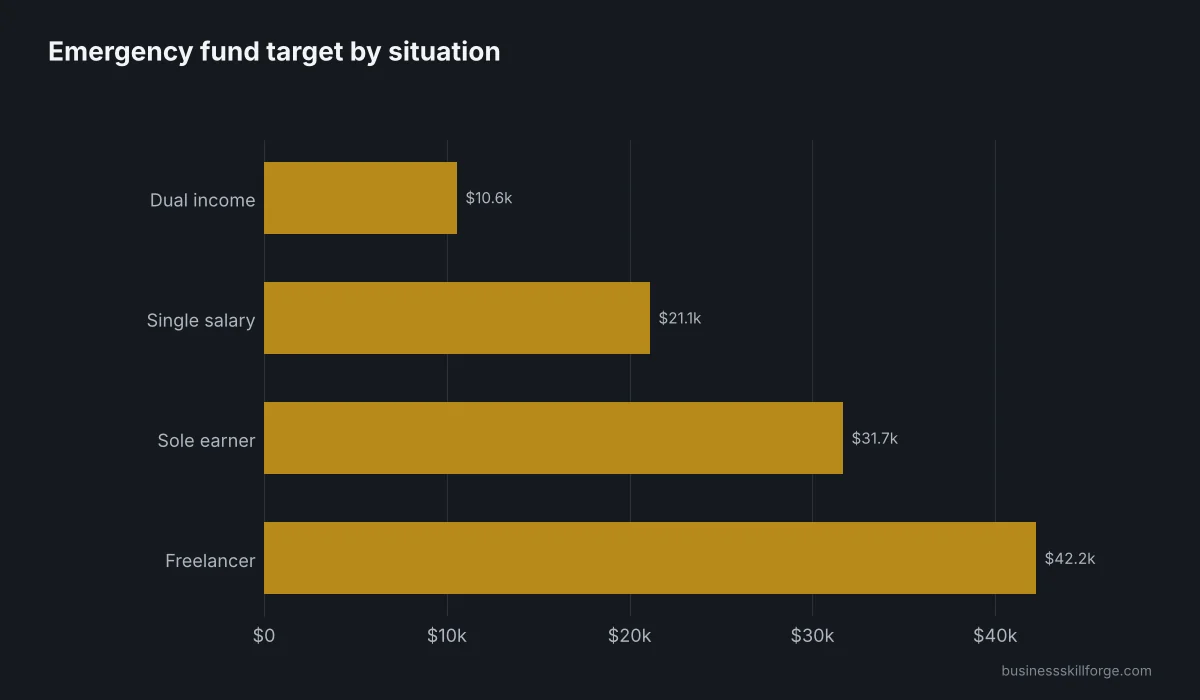
Applied to the $3,520-a-month household above, here’s how the target moves across four common situations:
| Situation | Months of cover | Target at $3,520/month |
|---|---|---|
| Dual income, both salaried, renting | 3 | $10,560 |
| Single salaried earner | 6 | $21,120 |
| Sole earner with children or a homeowner | 9 | $31,680 |
| Freelancer or commission-based income | 12 | $42,240 |
Most salaried people don’t need a year of expenses in cash. Cash held beyond what you need has a real cost: it earns less than long-term investments over time and loses some purchasing power to inflation. Here’s when a bigger fund is justified: your income is lumpy, you’d struggle to find comparable work quickly, or a single bill (a roof, a deductible) could plausibly exceed three months of spending.
Emergency fund rules for freelancers and variable income
If you’re self-employed, size the fund differently in two ways.
First, base it on your lean months, not your average. A freelance designer billing $6,000 in a good month and $2,500 in a slow one has to survive the slow ones. Work out essentials the same way as above, then aim for six to twelve months.
Second, keep tax money out of it entirely. Money set aside for quarterly estimated tax payments is already spoken for. If you count it toward your emergency fund, you’ll find out the hard way in April that the two pots were the same money. Hold a separate tax account and treat the emergency fund as what’s left after taxes.
Many freelancers also keep a one- or two-month income-smoothing buffer in their business account. That evens out late client payments so the personal emergency fund isn’t tapped every time an invoice runs 45 days late. If late invoices are a constant problem, the fix is in your billing process, not a bigger cushion.
Where to keep your emergency fund
The money needs to be safe, quick to reach and separate enough from your checking account that you don’t spend it by accident. That rules out stocks and stock funds: their value can drop 20% or more at exactly the moment the economy is weak and job losses rise, which is when you’re most likely to need the cash.
Common homes for emergency money in the US:
- A high-yield savings account. A high-yield savings account is a bank or credit union savings account that pays a higher rate than a standard account, often online-only. Transfers to checking usually take one to two business days.
- A money market account. Similar to savings, sometimes with check-writing. Our high-yield savings vs money market comparison covers the trade-offs.
- A small amount in checking. Enough for a same-day emergency, such as a tow or a hotel night.
Check the deposit insurance. At FDIC-insured US banks, the standard maximum deposit insurance amount is $250,000 per depositor, per insured bank, per ownership category. The FDIC is explicit that mutual funds (including money market funds), stocks, bonds and Treasury securities are not deposits and aren’t covered. A money market account at a bank is a deposit; a money market fund at a brokerage is an investment. Credit union deposits have a separate federal insurer. In the UK, Canada and Australia, government deposit-guarantee schemes exist too, with their own limits, so check the scheme for your country.
Larger funds can be tiered. Someone holding nine months might keep one month in checking, five in a high-yield savings account, and three in short-term certificates of deposit timed to mature in sequence. The last tier earns a little more and you’d only reach it in a long emergency.
How to build an emergency fund from zero
Six months of expenses can feel impossible from a standing start, so break it into milestones. The first one matters most: a starter fund of around one month of essentials covers most car repairs, medical bills and appliance failures. For the example household, that’s $3,520.
Here’s how long the full six-month target of $21,120 takes at three monthly saving rates, ignoring interest:
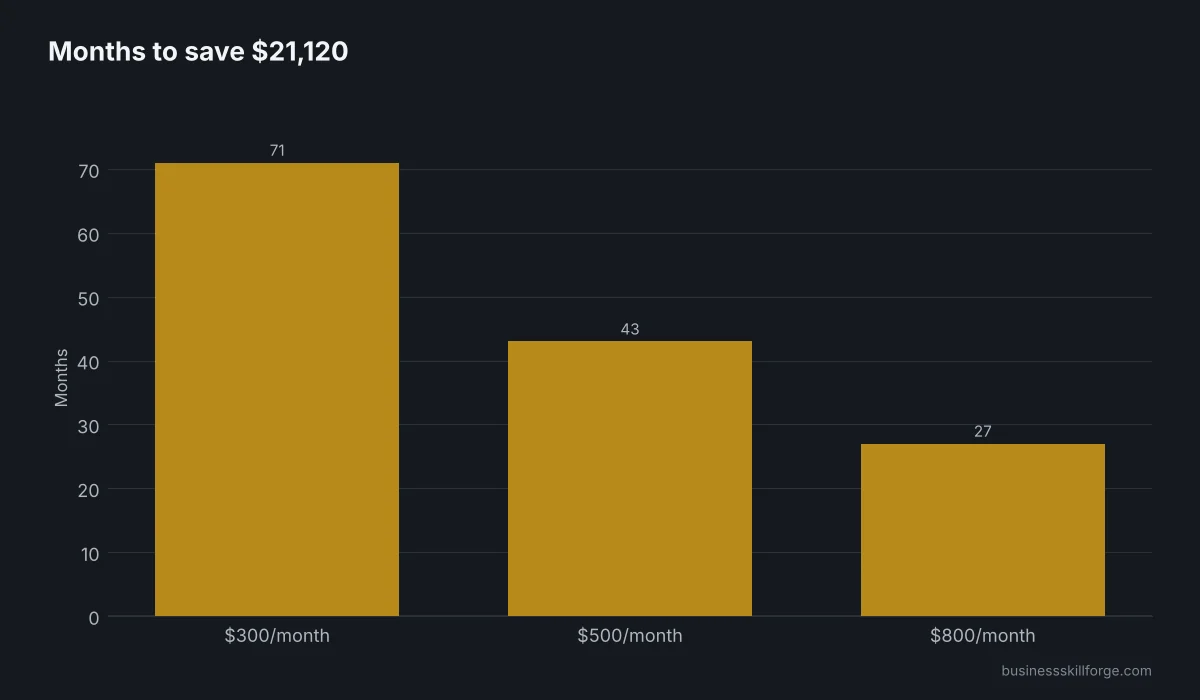
At $300 a month, it takes 71 months, almost six years. At $500, 43 months. At $800, 27 months. Interest helps at the margin: assuming an illustrative 4% annual yield compounded monthly, the same targets take 64, 40 and 26 months. The saving rate matters far more than the interest rate, which is why the steps below focus on getting money in.
- Automate a transfer on payday. Set it to move the day your pay lands, before you can spend it. This is paying yourself first.
- Send windfalls straight in. Tax refunds, bonuses, and cash gifts can cover months of progress at once.
- Raise the transfer after each pay rise. Put half of any raise toward the fund until you hit the target.
- Stop at the target. Once it’s full, redirect the transfer to debt or investing. A fund that keeps growing forever is cash that isn’t working.
Emergency fund or debt payoff first?
This is the real tension for most people. Every dollar in a savings account earning 4% while a credit card charges 24% costs you the difference. On the other hand, a household with no cash at all goes straight back to the credit card when the car breaks down, and the payoff plan collapses.
A sensible middle path: build the starter fund (about one month of essentials, or at least $1,000 to $2,000), then put everything extra toward high-interest debt, then return to finishing the full fund. Our worked example on paying down a $15,000 credit card balance at 24% shows how much interest that debt costs each month, and the guide to the debt avalanche vs snowball covers which balance to attack first. Low-interest debt, such as a fixed-rate mortgage, doesn’t need to be paid off before you finish the fund.
Common emergency fund mistakes
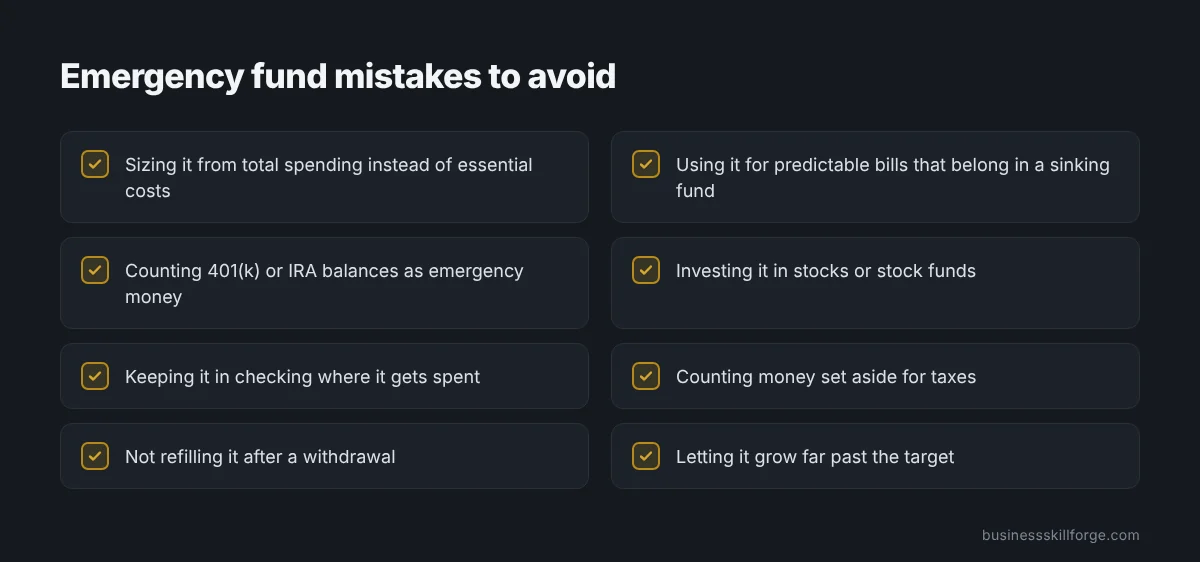
A few deserve more explanation. Counting retirement accounts as emergency money is tempting because the balance is large, but in the US withdrawals from a 401(k) or traditional IRA before age 59½ generally trigger income tax and often a 10% additional tax on early distributions, so $10,000 withdrawn can leave you with far less. Investing the fund for a better return swaps a guaranteed balance for one that can fall when you need it. And skipping the refill after you use it leaves you exposed to the next surprise, which often arrives sooner than you’d like.
Finally, decide in advance what counts as an emergency. A useful test: is it unexpected, is it necessary, and is it urgent? If it fails any of the three, it comes out of your regular budget or a sinking fund.
What to do next
Spend 30 minutes with your last three months of statements and list your essential costs. Multiply by the months of cover that fits your situation, using the table above. Open a separate, insured savings account if you don’t have one, set an automatic transfer, and write the target and the starter milestone somewhere you’ll see them. Then track it alongside everything else you own; our net worth calculator makes the progress visible.
Key takeaways
- Size your emergency fund from essential monthly expenses, not total spending, because discretionary costs stop during an emergency.
- Three months suits stable dual-income households; sole earners need about six, and freelancers or commission earners often need six to twelve.
- Keep the money in insured, easy-to-reach accounts such as a high-yield savings or bank money market account, not in stocks or retirement accounts.
- Build a starter fund of about one month of essentials first, then clear high-interest debt, then finish the full target.
- Your monthly saving rate drives the timeline far more than the interest rate, so automate the transfer on payday.
Frequently asked questions
Is $10,000 enough for an emergency fund?
It depends on your essential monthly costs and income risk. If your essentials are $2,500 a month, $10,000 is four months of cover, which is reasonable for a stable dual-income household. If your essentials are $5,000 a month and you’re the only earner, it’s two months, which is thin. Divide the balance by your monthly essentials to see how many months it actually buys.
Should my emergency fund cover 3 or 6 months?
Three months is usually enough when two people in the household earn stable salaries and could each cover essentials for a while. Six months is a better target for a single earner, a household with children, or anyone in a field where job searches take a long time. Freelancers and commission earners often aim for six to twelve months because their income is less predictable.
Where is the best place to keep an emergency fund?
Keep it somewhere insured, easy to reach within a day or two, and separate from everyday checking. In the US that usually means a high-yield savings account or a money market deposit account at an FDIC-insured bank, or a federally insured credit union. Avoid stocks and stock funds, because their value can fall at the same time you lose income.
Should I build an emergency fund before paying off credit card debt?
Build a small starter fund first, around one month of essentials or at least $1,000 to $2,000, so a surprise bill doesn’t go back on the card. Then put extra money toward high-interest debt, because a card charging 20% or more costs far more than savings earn. Once that debt is gone, return to finishing the full emergency fund.
Can I count my 401(k) as an emergency fund?
It’s better not to. In the US, early withdrawals from a 401(k) or traditional IRA are generally taxed as income and often face an additional 10% tax, so you keep much less than you withdraw. You also lose the future growth on that money. Treat retirement accounts as a last resort, not as part of your emergency fund.
Sources
- Federal Reserve: Adults who would cover a $400 emergency expense using cash or its equivalent (SHED)
- FDIC: Insurance Basics (Deposit Insurance Guide)
- IRS Topic no. 558: Additional tax on early distributions from retirement plans other than IRAs
This article is general education, not tax, legal, accounting or investment advice. Rules and thresholds differ by country and change over time, so check the specifics for your situation. See our financial disclaimer.
Get practical finance & accounting tips in your inbox
Join US professionals getting our best guides, templates and tools. Free. Unsubscribe anytime.