Debt Avalanche vs Debt Snowball: Which Payoff Method Wins?
October 28, 2026 · Aditya Gupta

In the debt avalanche vs debt snowball choice, the avalanche pays off your highest-interest debt first and always costs the least in interest. The snowball pays off your smallest balance first, which can cost more but gives quick wins that help many people stick with it. If your rates are close, the difference is small. If one large balance carries a high rate, the avalanche can save hundreds or thousands.
Both methods share the same foundation, and that foundation does most of the work. The sections below show the setup, two worked examples with every number computed month by month, and a simple way to choose.
How both methods work
The debt avalanche is a repayment plan where you pay the minimum on every debt and put all extra money toward the debt with the highest interest rate. The debt snowball is a repayment plan where you pay the minimum on every debt and put all extra money toward the smallest balance, regardless of rate.
The mechanics after that are identical. When a debt is paid off, its minimum payment doesn’t disappear back into your spending. It rolls into the next target, so the amount you throw at each debt grows over time. That rollover is the snowball (or avalanche) effect, and it’s why both plans finish years sooner than paying minimums.
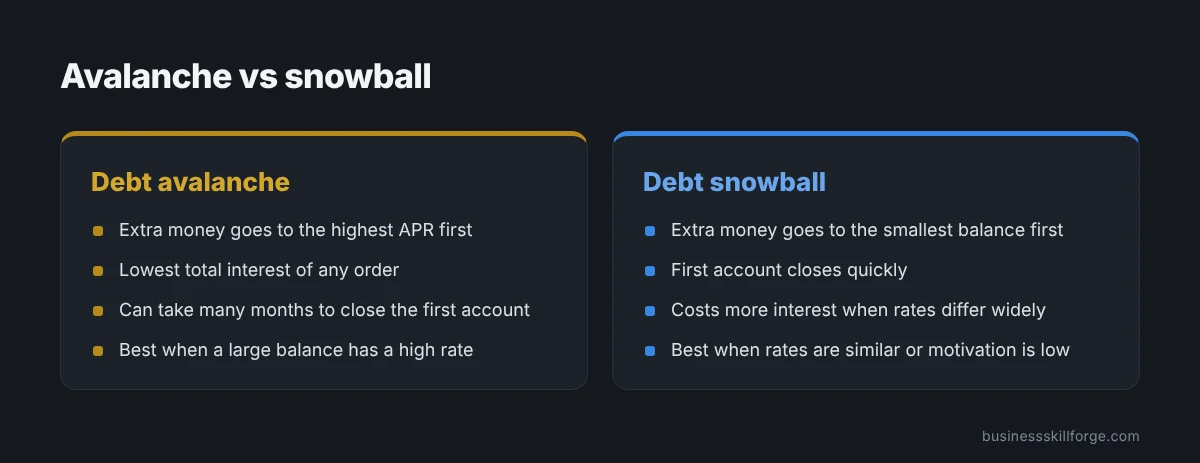
Rank your debts by the right measure. For the avalanche, use each debt’s APR (annual percentage rate), the yearly cost of borrowing including certain fees, which is printed on your statement. For the snowball, use the current balance. If two debts tie, break the tie with the other measure.
Worked example 1: rates that are spread out
Take a household with four debts and $900 a month to put toward them. The minimums add up to $575, so $325 a month is extra.
| Debt | Balance | APR | Minimum |
|---|---|---|---|
| Medical bill (payment plan) | $600 | 0% | $50 |
| Store card | $1,800 | 28% | $55 |
| Credit card | $7,500 | 23% | $190 |
| Car loan | $9,200 | 6.9% | $280 |
| Total | $19,100 | $575 |
The snowball attacks the medical bill first, then the store card, credit card and car loan. The avalanche goes store card, credit card, car loan, and leaves the 0% medical bill on its minimum until it’s gone.
Simulated month by month (interest added monthly, then payments applied), here’s what happens:
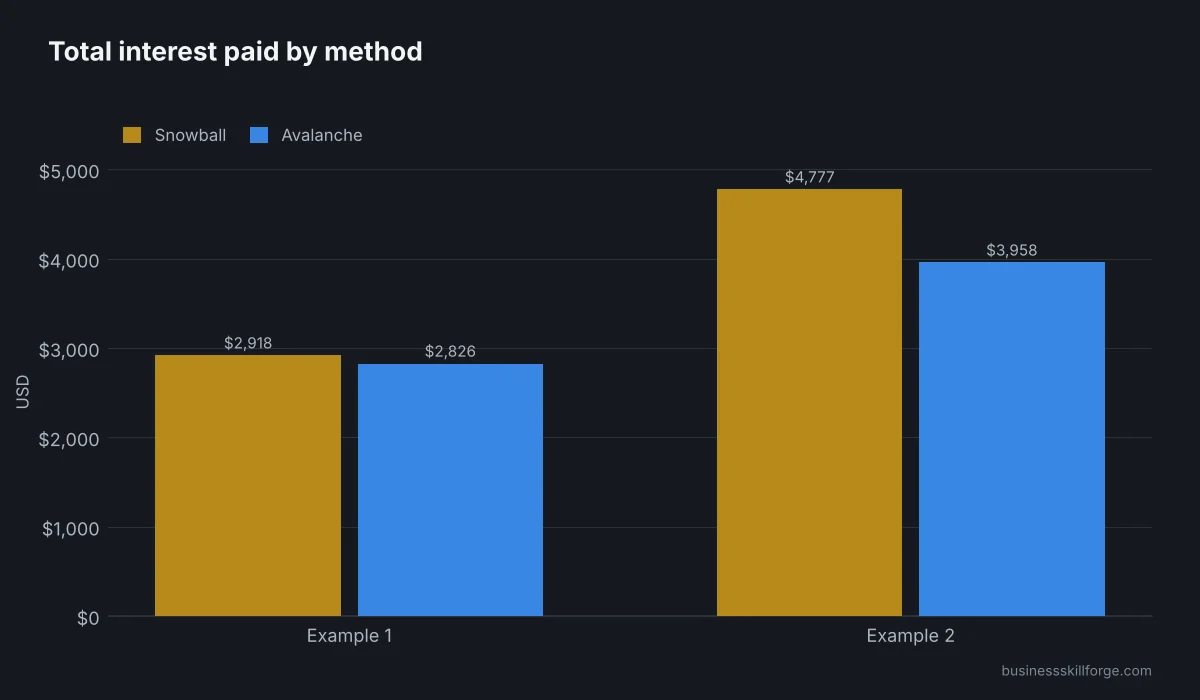
- Snowball: medical bill gone in month 2, store card in month 6, credit card in month 20, car loan in month 25. Total interest paid: $2,918.
- Avalanche: store card gone in month 6, medical bill in month 12 (on its minimum), credit card in month 20, car loan in month 25. Total interest paid: $2,826.
The avalanche saves $92 and both finish in month 25. The snowball’s first win arrives four months earlier. Notice that the store card is gone in month 6 under both plans: the snowball only spends two months on the medical bill before moving on, and the store card’s balance is small enough that the delay barely shows. In this setup, the small balance happens to be interest-free, so paying it early costs almost nothing. For comparison, paying only the minimums on the same four debts would take 75 months and cost $9,307 in interest. The method matters far less than the decision to pay extra every month.
Worked example 2: a big, expensive balance
Now change one thing: the largest balance is also the most expensive. Same $900 a month, minimums of $450, so $450 is extra.
| Debt | Balance | APR | Minimum | First-month interest |
|---|---|---|---|---|
| Personal loan | $2,000 | 9% | $60 | $15 |
| Store card | $3,000 | 18% | $90 | $45 |
| Credit card | $12,000 | 26% | $300 | $260 |
| Total | $17,000 | $450 | $320 |
Look at the last column. The credit card generates $260 of the $320 monthly interest bill. Every month the snowball spends clearing the $2,000 personal loan first, that $260 keeps accruing on the card.
- Snowball: personal loan gone in month 4, store card in month 9, credit card in month 25. Total interest: $4,777.
- Avalanche: credit card gone in month 20, store card in month 23, personal loan in month 24. Total interest: $3,958.
Here the avalanche saves $819 and finishes a month sooner. The cost is patience: you don’t close a single account until month 20, while the snowball closes one in month 4.
Why the snowball still works for many people
On paper, the avalanche always wins or ties on interest. So why does the snowball have so many fans? Because a debt plan only saves money if you keep following it for two years or more, and motivation matters over that stretch.
There’s some evidence for this. Researchers David Gal and Blakeley McShane studied nearly 6,000 clients of a debt settlement firm and found that the number of accounts closed predicted completing the program better than the share of dollars repaid, as summarized by Kellogg Insight. The authors were careful to say dollars still matter, and that the effect is most relevant when interest rates on small and large balances are similar.
So the honest framing is this: the avalanche is cheaper, and the snowball is easier to stick with for some people. If you’ve started and abandoned debt plans before, the extra interest from the snowball may be a fair price for actually finishing.
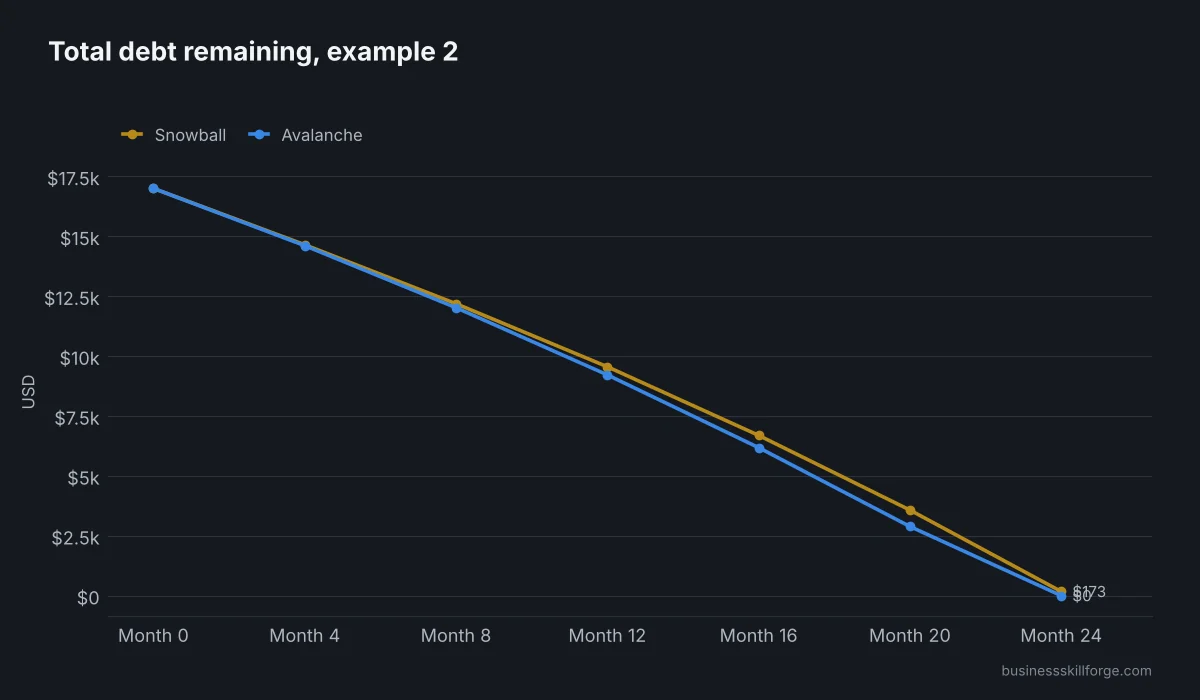
The balance lines in example 2 show why the trade-off feels harder than it is. Total debt falls at nearly the same pace under both methods: $14,648 versus $14,609 after four months, $9,555 versus $9,216 after a year. The avalanche pulls ahead slowly because less of each payment goes to interest.
Debt avalanche vs debt snowball: how to choose
| If this describes you | Lean toward | Why |
|---|---|---|
| Your highest-rate debt is also one of the largest | Avalanche | This is where the interest gap is widest |
| All your rates are within a few points of each other | Snowball | The interest cost is minor, and the early wins are real |
| You have several small balances that each need tracking | Snowball | Fewer accounts means fewer due dates to miss |
| You’ve quit payoff plans before | Snowball | Finishing beats optimizing |
| You’re motivated by numbers and can wait for results | Avalanche | You’ll pay the least interest |
There’s also a hybrid. Clear one or two tiny balances first for momentum, then switch to the avalanche for the rest. In example 2, that would mean paying off the $2,000 personal loan, then going straight at the 26% card. You give up some of the avalanche’s savings, but less than a full snowball.
To compare your own debts, enter them in our debt payoff calculator and run both orders.
How to set up either plan
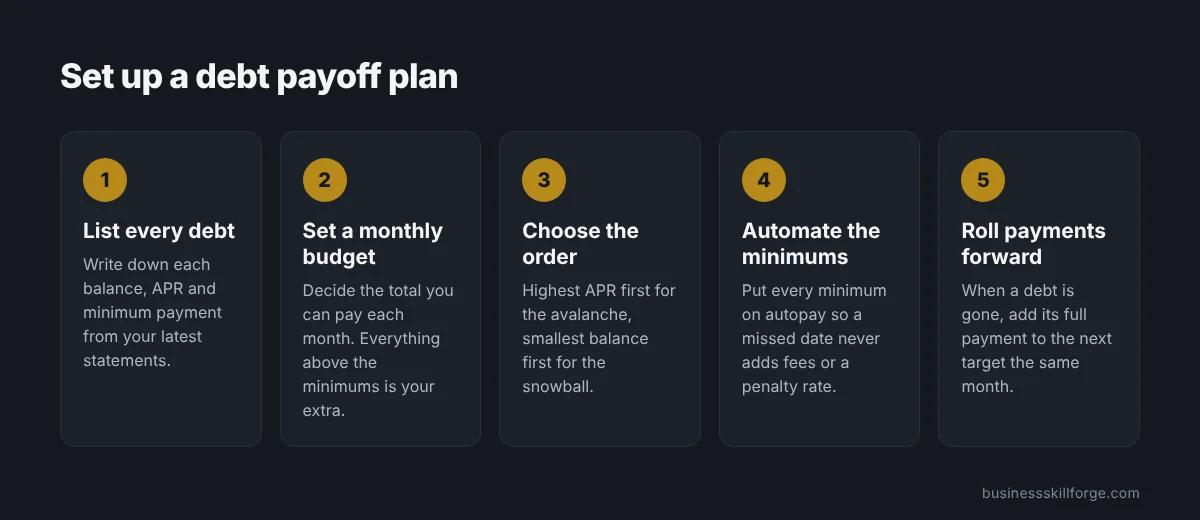
A few details make the plan hold. Set every minimum to autopay so a late fee or a penalty rate never wrecks the math. Pay the extra amount manually, or schedule it right after payday. And keep a small cash cushion before you start: if the car needs $1,200 of work in month three and you have nothing saved, it goes on a card and you’re back where you began. Our guide on how big your emergency fund should be covers the starter amount.
Can you lower the rate instead?
Both methods take your interest rates as fixed. Sometimes they aren’t. Credit card rates are high: in the Federal Reserve’s consumer credit release, the average commercial bank rate on credit card accounts assessed interest was 21.52% in the first quarter of 2026 (Fed G.19). Three ways to cut that:
- Balance transfer card. A balance transfer moves card debt to a new card, often at a low promotional rate for a set period, usually with a transfer fee. It only helps if you can clear the balance before the promotion ends.
- Consolidation loan. Debt consolidation means replacing several debts with one new loan, usually a fixed-rate personal loan that pays off the cards. It helps if the rate is lower and you don’t run the cards back up.
- Ask. Call the card issuer and ask for a lower rate, especially if you’ve paid on time. It costs nothing.
Any of these can be combined with the avalanche or snowball. If you’re carrying a large card balance, our worked case on a $15,000 balance at 24% shows how quickly that interest adds up.
Common mistakes with debt payoff plans
- Not rolling payments forward. When a debt is paid off, its minimum has to move to the next target. Spending it instead kills the effect.
- Ranking by monthly payment. Neither method ranks by minimum payment. Use the rate (avalanche) or the balance (snowball).
- Ignoring promotional rates that expire. A 0% balance that jumps to 27% in five months should be ranked by the rate it’s about to have.
- Adding new debt during the plan. Paying $900 a month while adding $400 a month of new card spending is a $500 plan.
- Prepaying low-rate debt while high-rate debt sits. Extra money on a 4% mortgage while a 25% card carries a balance is the most expensive version of either method.
What to do next
List every debt with its balance, APR and minimum payment. Total the minimums, decide what you can pay each month on top, and run both orders through a calculator. If the avalanche saves only a small amount, pick whichever you’ll stick with. If it saves a lot, start with the avalanche and use a hybrid if motivation fades. Then automate the minimums and schedule the extra payment for payday.
Key takeaways
- The debt avalanche targets the highest interest rate first and always costs the least in total interest.
- The debt snowball targets the smallest balance first and gives earlier wins, which some research links to finishing repayment.
- The gap between the two is small when rates are similar and large when your biggest balance also has the highest rate.
- Paying extra every month matters far more than the order: in example 1, either method cut interest from $9,307 to under $3,000.
- Roll each paid-off minimum into the next debt, keep a starter emergency fund, and stop adding new debt while you pay down the old.
Frequently asked questions
Is the debt avalanche or snowball faster?
With the same monthly budget, the avalanche finishes at the same time or sooner, because less of each payment goes to interest. In this article’s examples, both finished in month 25 in one case, and the avalanche finished a month earlier in the other. The snowball is faster only at closing the first account, which is what makes it feel quicker.
Does the debt snowball hurt your credit score?
The method itself doesn’t. Paying down card balances lowers the share of your available credit you’re using, which generally helps scores. What can hurt is closing credit card accounts once they’re paid off, because that reduces your total available credit. Paying a card to zero and keeping it open, with no new spending, avoids that issue in most cases.
Should I include my mortgage in the debt snowball?
Most people leave the mortgage out. It’s usually the largest balance with one of the lowest rates, so it would come last in either method anyway. Focus the plan on credit cards, personal loans, car loans and similar consumer debt, then decide separately whether extra mortgage payments make sense once that debt is gone.
How much money does the avalanche method save?
It depends on how spread out your rates are and how large the high-rate balance is. In this article’s first example, the avalanche saved $92 compared with the snowball. In the second, where the largest balance carried 26% APR, it saved $819. Run your own debts through a payoff calculator in both orders to see your actual gap.
Can I switch from snowball to avalanche partway through?
Yes, and many people do. A common hybrid is to clear one or two very small balances first for momentum, then send all extra money to the highest-rate debt. The minimums and rollover stay the same; only the target changes. Switching costs nothing, so use whichever order keeps you paying.
Sources
- Kellogg Insight: To Beat Debt, Consider Starting Small (Gal and McShane research)
- Federal Reserve G.19 Consumer Credit release, May 2026
This article is general education, not tax, legal, accounting or investment advice. Rules and thresholds differ by country and change over time, so check the specifics for your situation. See our financial disclaimer.
Get practical finance & accounting tips in your inbox
Join US professionals getting our best guides, templates and tools. Free. Unsubscribe anytime.