The Rule of 72: How to Estimate Doubling Time in Your Head
November 5, 2026 · Aditya Gupta

The rule of 72 is a shortcut for estimating how long it takes money to double at a fixed annual compound rate: divide 72 by the rate. At 6% a year, 72 ÷ 6 = 12 years. At 9%, about 8 years. It works for anything that compounds, including savings, investments, debt and inflation, and it’s accurate to within a few months for rates between about 4% and 12%.
The rule is useful for speed rather than precision: you can do it in your head while someone is quoting you a rate, and immediately get a feel for what that rate means over time. This guide shows how to use it, how accurate it really is, where it breaks down, and a few places it’s more useful than people expect.
How to use the rule of 72
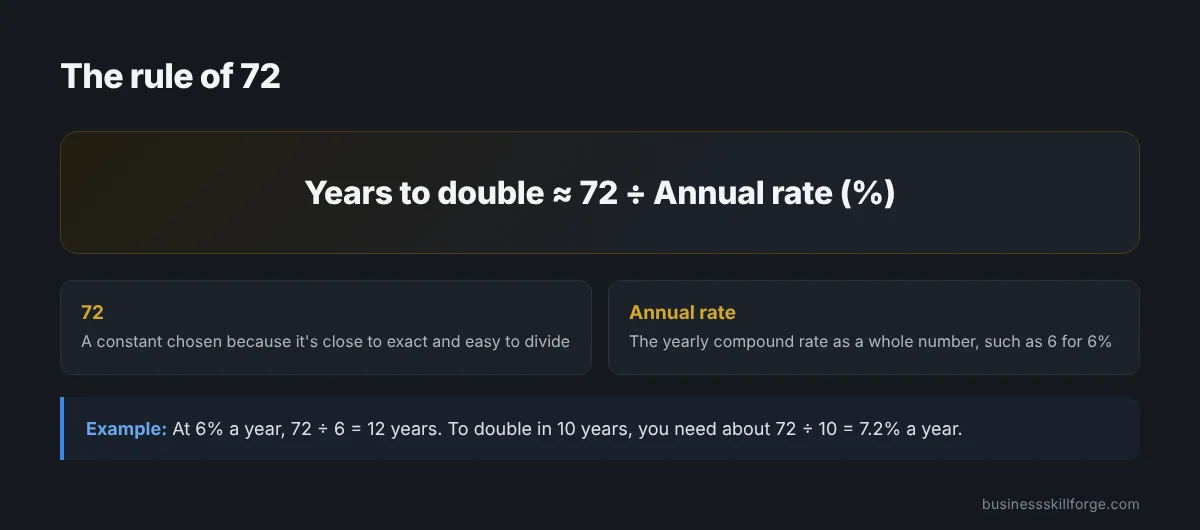
Use the rate as a whole number, not a decimal: 8, not 0.08. The answer is in the same time unit as the rate, so an annual rate gives years. A few quick examples:
- A savings account paying 4%: 72 ÷ 4 = about 18 years to double.
- An investment averaging an illustrative 8% a year: 72 ÷ 8 = about 9 years.
- A goal of doubling your money in 10 years needs about 72 ÷ 10 = 7.2% a year.
That last one shows the rule runs both ways. Divide 72 by the years you have and you get the rate you’d need.
The rule only applies to compound interest, where you earn returns on previous returns. With simple interest, where interest is paid only on the original amount, money doubles in exactly 100 ÷ rate years: 20 years at 5%, not 14.4.
Why doubling time matters: the power of stacking doublings
Once you know the doubling time, you can count doublings. That turns a hard compounding problem into simple multiplication.
Take $10,000 earning an illustrative 8% a year for 36 years. The rule says money doubles every 9 years, so 36 years is four doublings:
| Year | Doublings | Balance (rule of 72) |
|---|---|---|
| 0 | 0 | $10,000 |
| 9 | 1 | $20,000 |
| 18 | 2 | $40,000 |
| 27 | 3 | $80,000 |
| 36 | 4 | $160,000 |
The exact answer, $10,000 × 1.08 raised to the 36th power, is $159,682. The mental estimate is off by about $300.
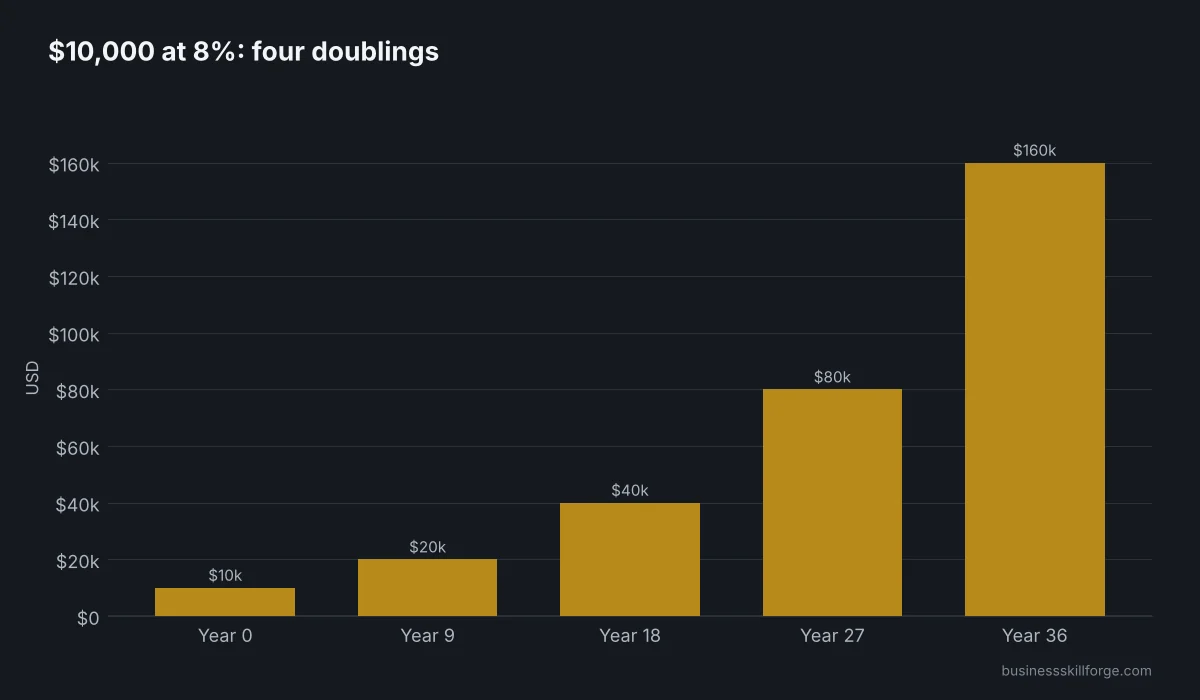
Notice the shape. The first nine years add $10,000. The last nine add $80,000. That’s why starting early matters so much for long-term saving, and why the last decade of a long investment period often produces most of the dollar growth. Our complete guide to compound interest goes further into this curve.
A retirement savings example
Say you’re 30 with $25,000 in a retirement account and you add nothing more. At an illustrative 6% a year, the rule of 72 gives a 12-year doubling time. By 42 that’s roughly $50,000, by 54 roughly $100,000 and by 66 roughly $200,000: three doublings in 36 years. The exact figure is $203,681.
Now start the same $25,000 at 42 instead of 30. By 66 it gets two doublings, about $100,000. Twelve years of delay costs one whole doubling, which here is $100,000. The rule makes the cost of waiting easy to see without a spreadsheet.
A business growth example
The rule isn’t limited to money in an account. A small business growing revenue 15% a year doubles in about 72 ÷ 15 = 4.8 years (exact: 5.0). If revenue is $400,000 today and the owner is planning for a second location, staff or a larger lease, the rule says to expect roughly $800,000 in about five years if that growth rate holds. That gives a quick check on whether a five-year plan is realistic.
How accurate is the rule of 72?
The exact doubling time at an annual compound rate r is ln(2) ÷ ln(1 + r). The rule of 72 is an approximation of that formula, and it’s best near 8%, where it’s almost exact.
| Annual rate | Rule of 72 | Exact (annual compounding) | Difference |
|---|---|---|---|
| 2% | 36.0 years | 35.0 years | +1.0 |
| 4% | 18.0 years | 17.7 years | +0.3 |
| 6% | 12.0 years | 11.9 years | +0.1 |
| 8% | 9.0 years | 9.0 years | 0.0 |
| 10% | 7.2 years | 7.3 years | −0.1 |
| 12% | 6.0 years | 6.1 years | −0.1 |
| 20% | 3.6 years | 3.8 years | −0.2 |
| 36% | 2.0 years | 2.25 years | −0.25 |
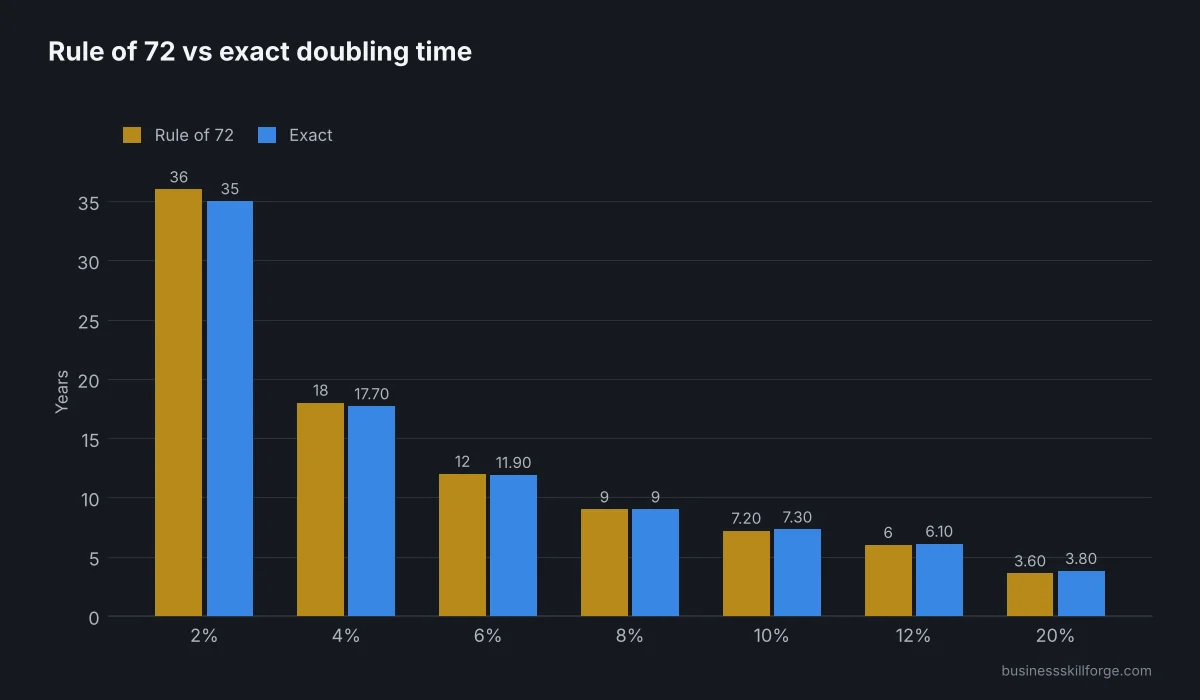
For ordinary personal finance rates, the error is a few months at most. At very low rates the rule overstates the doubling time a little; at high rates it understates it. Neither error is big enough to change a decision.
Rule of 72 vs rule of 70 vs rule of 69.3
You’ll see other numerators. They suit different situations:
- Rule of 72: best for annual compounding at typical rates. 72 also divides cleanly by 2, 3, 4, 6, 8, 9 and 12, which is the real reason it’s popular.
- Rule of 70: slightly more accurate at low rates, so economists often use it for inflation and growth rates of 1% to 3%. At 2%, it gives 35 years, the exact figure.
- Rule of 69.3: exact for continuous compounding, because ln(2) is about 0.693. At 6% it gives 11.55 years, close to the 11.58 years you get with monthly compounding.
Compounding frequency matters a little. Monthly compounding at 6% doubles money in 11.58 years against 11.90 with annual compounding. If you’re comparing accounts with different compounding, convert them to an annual equivalent first; our APR to APY converter does that.
Using the rule of 72 for inflation
The rule works on anything that compounds, including prices. Divide 72 by the inflation rate to get the years until prices double, which is the same as the years until your cash buys half as much.
US consumer prices rose about 3.1% a year on average between 2015 and 2025, based on BLS CPI-U annual averages. At that pace, 72 ÷ 3.1 = about 23 years for prices to double (the exact figure is 22.7). Someone who retires at 65 and lives to 88 could see prices double over their retirement at that rate.
You can also apply it to your real return. If an investment earns an illustrative 7% and inflation runs 3%, the real return is roughly 4%, so purchasing power doubles in about 72 ÷ 4 = 18 years, not the 10 years the nominal rate suggests. Our guide to inflation and real returns covers the exact calculation.
Using the rule of 72 for debt
The rule is just as useful in reverse: it shows how fast unpaid debt grows. In the Federal Reserve’s consumer credit release, the average commercial bank rate on credit card accounts assessed interest was 21.52% in the first quarter of 2026 (Fed G.19). 72 ÷ 21.52 = about 3.3 years. With monthly compounding and no payments, the exact figure is about 3.25 years.
In practice card issuers require minimum payments, so balances don’t grow untouched. But the rule makes the cost vivid: interest at that rate, left alone, doubles a balance in a little over three years. Compare that with 18 years for savings at 4%.
Using it for fees and small rate differences
The rule is good at showing what one percentage point is worth. An illustrative 7% return doubles money in about 10.3 years; 6% takes 12. Over 35 years, the exact difference is large: $10,000 grows to $106,766 at 7% and $76,861 at 6%.
That one point could be a fund fee, an advisory fee, or the gap between two savings accounts. Whenever someone says a fee is “only 1%,” run the rule on your return with and without it.
The same quick check works on savings rates. Here’s how long cash takes to double at different savings yields:
- 0.5%: 72 ÷ 0.5 = 144 years
- 1.5%: 48 years
- 3%: 24 years
- 5%: 14.4 years
At the low end, the rule tells you the money effectively isn’t growing. If inflation is higher than the rate, it’s shrinking in real terms.
Rule of 114 and rule of 144
Two cousins extend the idea. The rule of 114 estimates tripling time: 114 ÷ rate. At 6%, money triples in about 19 years (exact: 18.9). The rule of 144 estimates quadrupling time, which is just two doublings: at 8%, 144 ÷ 8 = 18 years, exactly what the rule of 72 gives for two 9-year doublings.
Where the rule of 72 breaks down
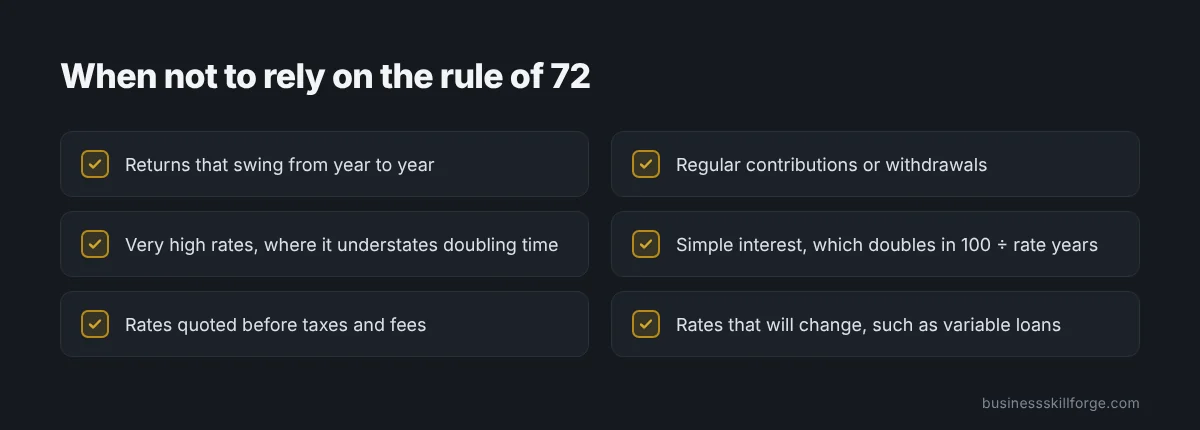
The biggest limitation for investors is that real returns aren’t steady. A portfolio that averages 8% might gain 20% one year and lose 10% the next. The rule assumes the same rate every year, so it describes an average path, not what you’ll actually experience. For anything with regular contributions, withdrawals or variable rates, use a proper calculation. Our compound interest calculator handles contributions.
Volatility also means the average rate overstates growth. A portfolio that gains 20% and then loses 20% has an average return of 0%, but $10,000 becomes $12,000 and then $9,600, a 4% loss. The rule of 72 should be fed the compound annual growth rate, not a simple average of yearly returns, or it will make doubling look faster than it was. Losses also need bigger gains to recover: a 50% drop needs a 100% gain just to get back to where you started.
What to do next
Try the rule on three numbers in your own finances: the rate on your savings, the rate on your most expensive debt and current inflation. The savings figure shows how slowly safe cash grows, the debt figure shows how quickly an unpaid balance compounds, and the inflation figure shows how long until your cash buys half as much. If the debt doubles faster than your savings, paying it down is usually the first priority.
Key takeaways
- The rule of 72 estimates doubling time by dividing 72 by the annual compound rate, so 6% doubles money in about 12 years.
- It’s accurate to within a few months for rates between about 4% and 12%, and almost exact at 8%.
- It applies to anything that compounds: savings, investments, inflation and debt.
- At a credit card rate of about 21.5%, an unpaid balance doubles in a little over three years.
- It assumes a constant rate and no contributions or withdrawals, so use a full calculation for real plans.
Frequently asked questions
How long does it take to double money at 10%?
Using the rule of 72, 72 divided by 10 gives 7.2 years. The exact figure with annual compounding is about 7.27 years, so the estimate is off by less than a month. With monthly compounding, it’s slightly faster, about 6.96 years. Remember that 10% is an assumption: real investment returns vary from year to year, so actual doubling time can be quite different.
Why is it 72 and not 70?
Both are approximations. 72 is closest to exact around 8%, a common rate for long-term examples, and it divides evenly by 2, 3, 4, 6, 8, 9 and 12, which makes mental math easy. 70 is more accurate at low rates such as 1% to 3%, so it’s often used for inflation and economic growth. 69.3 is exact for continuous compounding.
Does the rule of 72 work for debt?
Yes. It shows how fast a balance would grow if you made no payments. At a 24% credit card rate, 72 divided by 24 is 3 years. Real cards require minimum payments, so balances don’t usually grow untouched, but the rule is a quick way to see how expensive a rate is compared with what your savings earn.
What is the rule of 72 for inflation?
Divide 72 by the inflation rate to estimate how many years it takes prices to double, which is also how long it takes cash to lose half its purchasing power. At 3% inflation, that’s about 24 years. At 2%, about 36 years. It helps put long-term goals and retirement income needs in perspective.
Is the rule of 72 accurate?
For rates between about 4% and 12%, it’s within a few months of the exact answer, which is accurate enough for quick decisions. It’s almost exact at 8%. It overstates doubling time slightly at very low rates and understates it at high rates. It also assumes a constant rate with no contributions or withdrawals, so use a calculator for detailed plans.
Sources
- U.S. Bureau of Labor Statistics: CPI for All Urban Consumers (CPI-U), all items, series CUUR0000SA0
- Federal Reserve G.19 Consumer Credit release, May 2026
This article is general education, not tax, legal, accounting or investment advice. Rules and thresholds differ by country and change over time, so check the specifics for your situation. See our financial disclaimer.
Get practical finance & accounting tips in your inbox
Join US professionals getting our best guides, templates and tools. Free. Unsubscribe anytime.