Payback Period vs ROI: How to Judge a Business Investment
October 29, 2026 · Aditya Gupta
The payback period is how long an investment takes to earn back what it cost, measured in cash. Return on investment (ROI) is the total gain an investment produces as a percentage of its cost. Payback tells you how quickly your money comes back and how exposed you are in the meantime. ROI tells you how much you make in total. Good decisions use both.
Payback period vs ROI: what each one answers
Both metrics start from the same inputs: what you spend upfront and the cash the investment brings in afterward. They just ask different questions.
- Payback period is the time it takes for cumulative cash inflows to equal the initial investment. It answers: how long is my money at risk?
- ROI is net gain divided by cost. It answers: how much do I make for every dollar I put in?
A small business owner deciding whether to buy a new machine, open a second location or run a marketing campaign usually cares about both. A fast payback protects cash and limits the damage if your forecast turns out to be wrong. A high ROI means the investment is worth doing at all.
How to calculate the payback period
When the cash inflows are even
If the investment brings in roughly the same amount each year, the formula is one division:
Payback period = Initial investment ÷ Annual cash inflow
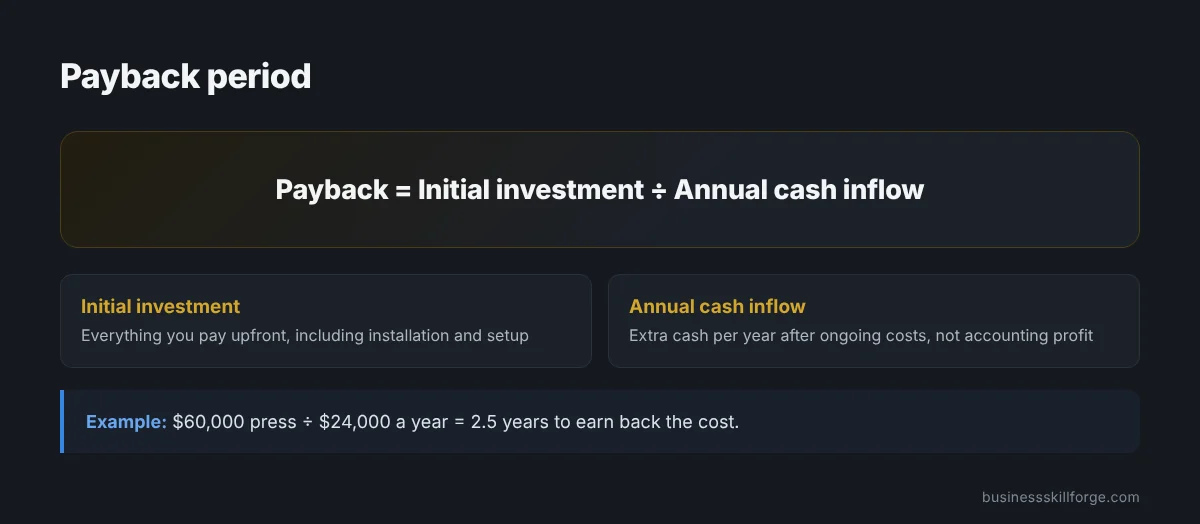
A print shop is considering a $60,000 digital press. It expects the press to add $24,000 a year in net cash (extra revenue from jobs it currently turns away, minus ink, paper, maintenance and the operator’s time) for three years, after which the technology will be dated. Payback = $60,000 ÷ $24,000 = 2.5 years.
Use cash flows, not accounting profit. Depreciation isn’t a cash cost, so don’t subtract it from the inflows. Do include every real cash cost the investment adds, including maintenance, extra staff hours, software subscriptions and financing costs if you’re borrowing to fund it.
When the cash inflows are uneven
Most investments don’t pay back evenly. They start slowly while you learn to use them or build demand, then pick up. For those, track cumulative cash flow year by year until it turns positive.
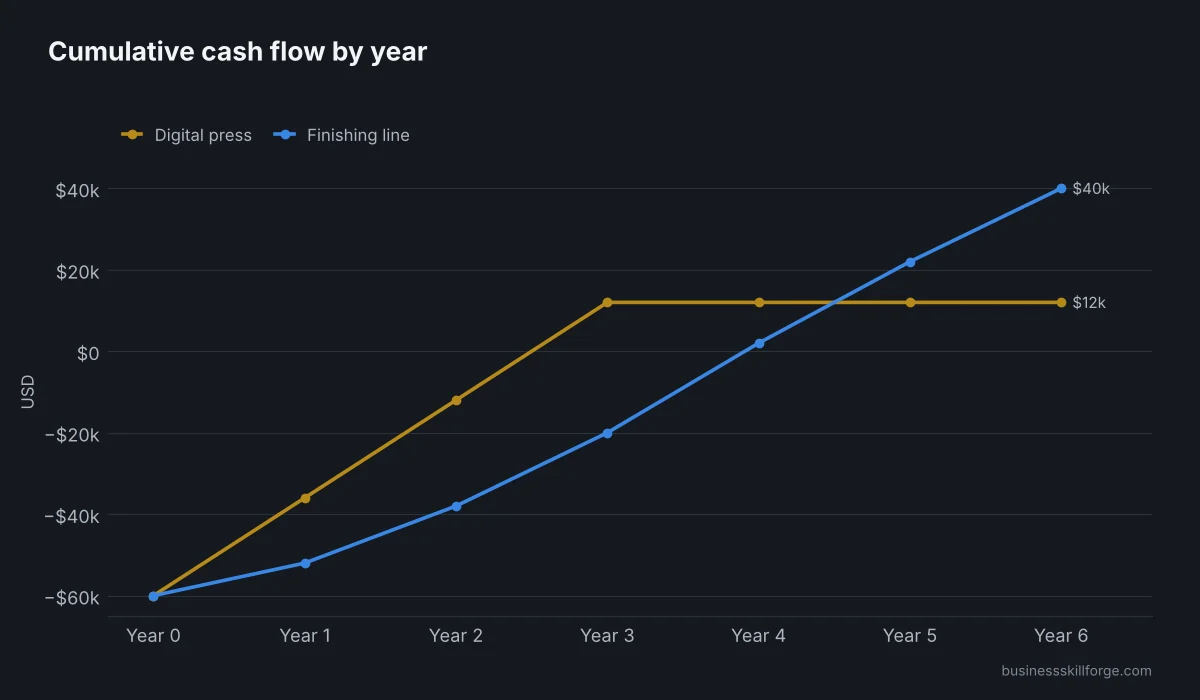
The same print shop is also considering $60,000 of automated finishing equipment (cutting, folding and binding). It will take a while to move work onto it, so savings grow over time:
| Year | Digital press: cash flow | Press: cumulative | Finishing line: cash flow | Finishing: cumulative |
|---|---|---|---|---|
| 0 | −$60,000 | −$60,000 | −$60,000 | −$60,000 |
| 1 | $24,000 | −$36,000 | $8,000 | −$52,000 |
| 2 | $24,000 | −$12,000 | $14,000 | −$38,000 |
| 3 | $24,000 | $12,000 | $18,000 | −$20,000 |
| 4 | $0 | $12,000 | $22,000 | $2,000 |
| 5 | $0 | $12,000 | $20,000 | $22,000 |
| 6 | $0 | $12,000 | $18,000 | $40,000 |
The finishing line is still $20,000 short at the end of year 3. Year 4 brings in $22,000, so it takes 20,000 ÷ 22,000 = 0.91 of year 4 to close the gap. Payback = 3 + 0.91 = 3.91 years, or just under four years. Our payback period calculator does this year-by-year count for you.
Use months for smaller purchases
For smaller spends, measure payback in months. Say a bookkeeping tool costs $3,600 a year and saves the office manager 10 hours a month. Valued at $30 an hour, that’s $300 a month, so the tool pays for itself in 12 months. Be honest about the saving, though: time saved is only worth cash if it’s used for paid work or replaces overtime or an outside contractor. If the hours just disappear into a quieter afternoon, the payback is longer than the arithmetic says.
How to calculate ROI
The basic formula is:
ROI = (Total cash returned − Investment cost) ÷ Investment cost
- Digital press: ($72,000 − $60,000) ÷ $60,000 = 20% over three years.
- Finishing line: ($100,000 − $60,000) ÷ $60,000 = 66.7% over six years.
On payback, the press wins: 2.5 years against 3.91. On ROI, the finishing line wins by a mile: 66.7% against 20%. This is the classic conflict, and it’s why using only one metric leads to bad calls. Payback ignores everything that happens after the money is back, so it can’t see the finishing line’s strong years 5 and 6. Total ROI ignores timing, so it treats a dollar in year 6 the same as a dollar in year 1. Our ROI glossary entry covers the variations you’ll see quoted.
Annualize ROI before comparing projects of different lengths
A 66.7% return over six years and a 20% return over three aren’t directly comparable. A quick fix is to look at the annualized return: the yearly rate that would produce the same result. The internal rate of return does this properly, accounting for exactly when each dollar arrives. For these two projects it works out to about 9.7% a year for the press and about 14.8% for the finishing line. The finishing line still comes out ahead, but by a smaller margin than 66.7% vs 20% suggests. If you want to understand where those figures come from, our guide to internal rate of return walks through it, and the ROI calculator handles the basic version.
Discounted payback: adding the time value of money
Simple payback treats $24,000 received in year 3 as worth the same as $24,000 today. It isn’t: money today could be paying down debt or earning interest elsewhere. Discounted payback fixes that by converting each year’s cash flow to today’s dollars before adding it up.
Using an 8% discount rate (a stand-in for what the shop’s money could earn or what it costs to borrow; use your own):
| Measure | Digital press | Finishing line |
|---|---|---|
| Investment | $60,000 | $60,000 |
| Total cash returned | $72,000 | $100,000 |
| Simple payback | 2.5 years | 3.91 years |
| Discounted payback at 8% | 2.90 years | 4.74 years |
| Total ROI | 20.0% | 66.7% |
| Net present value at 8% | $1,850 | $14,825 |
| Internal rate of return | 9.7% | 14.8% |
Discounting lengthens both paybacks, and it shows how thin the press’s return really is. In present-value terms the press earns back its cost with only $1,850 to spare. The finishing line clears its cost by $14,825. Our explainer on net present value goes through the discounting arithmetic step by step.
Which one should you use?

Use payback period as a filter and ROI (ideally in the form of NPV or IRR) to rank.
- Lean on payback when cash is tight or the future is uncertain. A business with three months of cash in the bank may not survive a four-year payback, however good the eventual return. The same applies to anything exposed to fast change: technology, fashion, a single large customer.
- Lean on ROI, NPV or IRR when you can afford to wait and the cash flows are reasonably predictable, such as equipment with a long, well-understood life or a property you own.
- Set a maximum payback that fits your situation, then pick the highest-return option among those that pass. Many small businesses use a rule like “nothing over three years” for equipment. Pick a number that reflects how much risk you can carry, not a figure someone else uses.
For the print shop: if cash is comfortable, the finishing line is the better investment. If the owner has a loan renewal coming up in 18 months and needs to rebuild cash quickly, the press’s shorter payback might be worth giving up the extra return. Neither answer is wrong; they reflect different constraints.
Marketing ROI: use gross profit, not revenue
ROI is quoted constantly for marketing, and it’s often calculated wrong. Say a $10,000 campaign brings in $30,000 of sales for a business with a 40% gross margin.
- Revenue-based “ROI”: ($30,000 − $10,000) ÷ $10,000 = 200%. This ignores the cost of the goods sold.
- Gross-profit ROI: the sales produce $12,000 of gross profit. ($12,000 − $10,000) ÷ $10,000 = 20%.
A 200% ROI and a 20% ROI lead to very different budget decisions. Always measure the return as the profit the investment generates, not the revenue. If the campaign also brought in repeat customers, you can add the gross profit from their later orders, as long as you’re consistent. Our $10,000 marketing ROI example works through a similar case.
Common mistakes with payback and ROI
- Using profit instead of cash. Depreciation, accruals and other non-cash items distort payback. Work from cash in and cash out.
- Forgetting ongoing costs. Maintenance, training, insurance, software fees and the time your staff spend running the new thing all reduce the inflows.
- Ignoring what happens after payback. A short payback doesn’t make an investment good if it stops producing cash right after.
- Comparing total ROI across different time spans. Annualize, or use IRR or NPV.
- Optimistic forecasts. Run a downside case with inflows 25% lower than expected. If the payback blows out past what you can tolerate, think again.
- Leaving out tax. Tax on extra profits, and tax relief on the investment itself, both affect cash. Rules differ between the US, UK, Canada and Australia, so ask your accountant how the investment will be treated.

What to do next
Pick the investment you’re weighing and write down its upfront cost and your best estimate of the net cash it will bring in each year, after every ongoing cost. Calculate the simple payback, then the total ROI. Run a downside case with lower inflows. If you’re comparing two options of different lengths, add NPV or IRR. Then set a maximum payback you’re comfortable with, given your cash position, and check whether the investment fits within it.
Key takeaways
- The payback period is the time it takes for cumulative cash inflows to equal the initial investment; for even inflows, divide the cost by annual cash inflow.
- ROI is net gain divided by cost, and it measures how much an investment makes in total, not how fast.
- The two can disagree: in the example, the press paid back in 2.5 years with a 20% ROI, while the finishing line took 3.91 years but returned 66.7%.
- Discounted payback, NPV and IRR account for the time value of money and give a fairer comparison between projects of different lengths.
- Use payback as a risk filter and ROI, NPV or IRR to rank the options that pass it.
- Always measure returns in cash or gross profit, never revenue, and include every ongoing cost the investment adds.
Frequently asked questions
What is a good payback period for a small business investment?
There’s no single standard. It depends on how much cash you have, how predictable the returns are and how long the asset will last. Many owners set a maximum, such as three years for equipment, and reject anything longer. The payback should always be comfortably shorter than the useful life of whatever you’re buying.
What is the difference between payback period and ROI?
Payback period measures time: how many months or years until cumulative cash inflows equal the cost. ROI measures size: the net gain as a percentage of the cost. An investment can have a quick payback and a low ROI, or a slow payback and a high ROI, so it’s worth calculating both before deciding.
How do you calculate payback period with uneven cash flows?
Add up the cash inflows year by year until the running total reaches the initial investment. Count the full years before that point, then add the fraction of the next year needed to close the gap. If you’re $20,000 short after year 3 and year 4 brings in $22,000, payback is 3 + 20,000 ÷ 22,000 = 3.91 years.
What is discounted payback period?
Discounted payback is the payback period calculated after converting each year’s cash inflow into today’s dollars using a discount rate. Because future dollars are worth less, discounted payback is always longer than simple payback. In the article’s example, an 8% discount rate stretches a 2.5-year payback to about 2.9 years.
Is ROI the same as profit?
No. Profit is a dollar amount, while ROI expresses the net gain as a percentage of what you invested, so you can compare investments of different sizes. To calculate ROI correctly, use the profit or cash the investment generates, not the revenue. A campaign that produces $30,000 of sales at a 40% margin on $10,000 of spend has a 20% ROI, not 200%.
This article is general education, not tax, legal, accounting or investment advice. Rules and thresholds differ by country and change over time, so check the specifics for your situation. See our financial disclaimer.
Get practical finance & accounting tips in your inbox
Join US professionals getting our best guides, templates and tools. Free. Unsubscribe anytime.