How to Create a Small Business Budget That You’ll Use
November 4, 2026 · Aditya Gupta

A small business budget is a month-by-month plan of the revenue you expect, the costs you’ll pay and the profit and cash left over. To create one, start from last year’s actual numbers, forecast revenue from the things that drive it, sort costs into variable and fixed, spread everything across the months, then check whether cash covers the slow ones.
What a small business budget is (and isn’t)
A budget is a plan for a set period, usually your financial year, broken into months. It is not a forecast you update every week, and it isn’t a wish list. It’s the set of numbers you commit to at the start of the year so you have something to measure the real results against.
Most small businesses need two views of the same plan:
- An operating budget shows revenue, costs and profit, the way your income statement does.
- A cash budget adjusts that profit for things that move cash but don’t hit the P&L the same way: loan principal repayments, equipment purchases, tax set-asides and non-cash costs like depreciation.
You can build both in one spreadsheet. The example below does exactly that for a seasonal business, because seasonality is where budgets earn their keep.
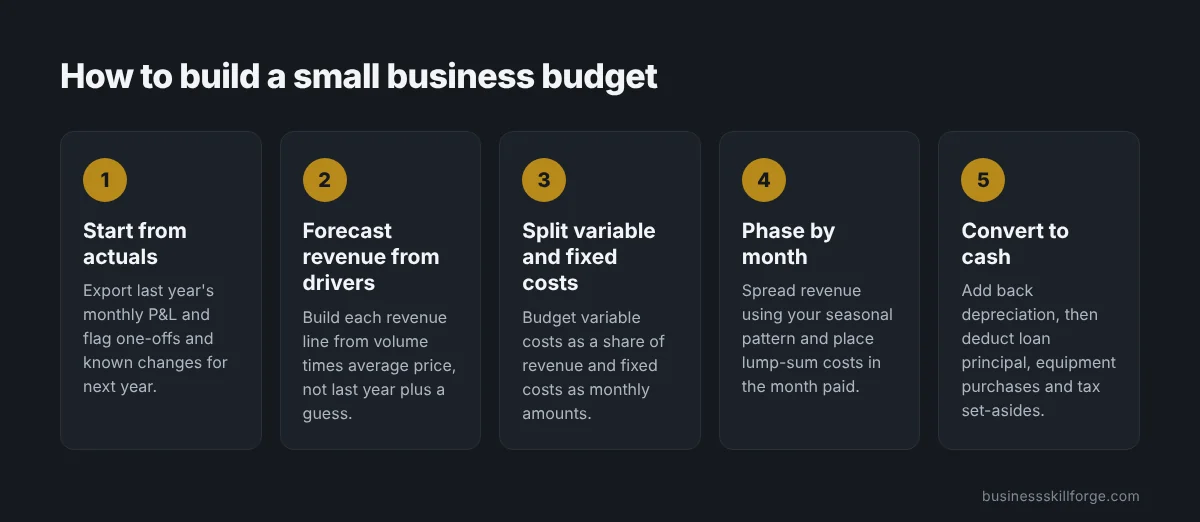
How to create a small business budget in five steps
The steps below follow one business from a blank sheet to a monthly cash plan. Use your own numbers as you go.
Step 1: Start from last year’s actual numbers
Export the last 12 months of your profit and loss by month from your accounting software. If your books are behind, catch them up first. A budget built on guesses about the past is a guess about a guess.
Go through each line and ask two questions. Was this a normal year for this line, or was there a one-off (a big repair, a lost client, a pandemic-sized shock)? And will this cost change next year because of something you already know about, such as a rent review, a new hire or a price increase from a supplier? Note the answers next to each line. That’s most of your thinking done.
Step 2: Forecast revenue from its drivers
The weakest way to budget revenue is “last year plus 10%”. The better way is to build it from the few things that actually produce it: number of customers, jobs or units, multiplied by the average price.
Take a landscaping company run by the owner with one full-time crew lead and seasonal helpers in spring and summer. It has three revenue lines:
| Revenue line | Driver | Budget |
|---|---|---|
| Design and installation projects | 26 projects × $10,000 average | $260,000 |
| Maintenance contracts | 55 clients × $1,600 per season | $88,000 |
| Winter work (snow clearing, cleanups) | Based on last two winters | $32,000 |
| Total revenue | $380,000 |
Driver-based revenue is easier to check during the year. If you’re behind in June, you can see whether it’s because you’ve won fewer projects or because the average job is smaller, and those need different fixes.
Step 3: Split costs into variable and fixed
A variable cost rises and falls with sales volume. A fixed cost stays roughly the same whether you have a busy month or a quiet one. Separating them matters because variable costs should be budgeted as a share of revenue, and fixed costs as a monthly amount.
For the landscaping company:
| Line | Type | Basis | Annual budget |
|---|---|---|---|
| Materials (plants, stone, mulch) | Variable | 25% of project revenue | $65,000 |
| Seasonal crew wages and payroll costs | Variable | Hours planned per project | $52,000 |
| Fuel, dump and disposal fees | Variable | Last year, adjusted for volume | $15,000 |
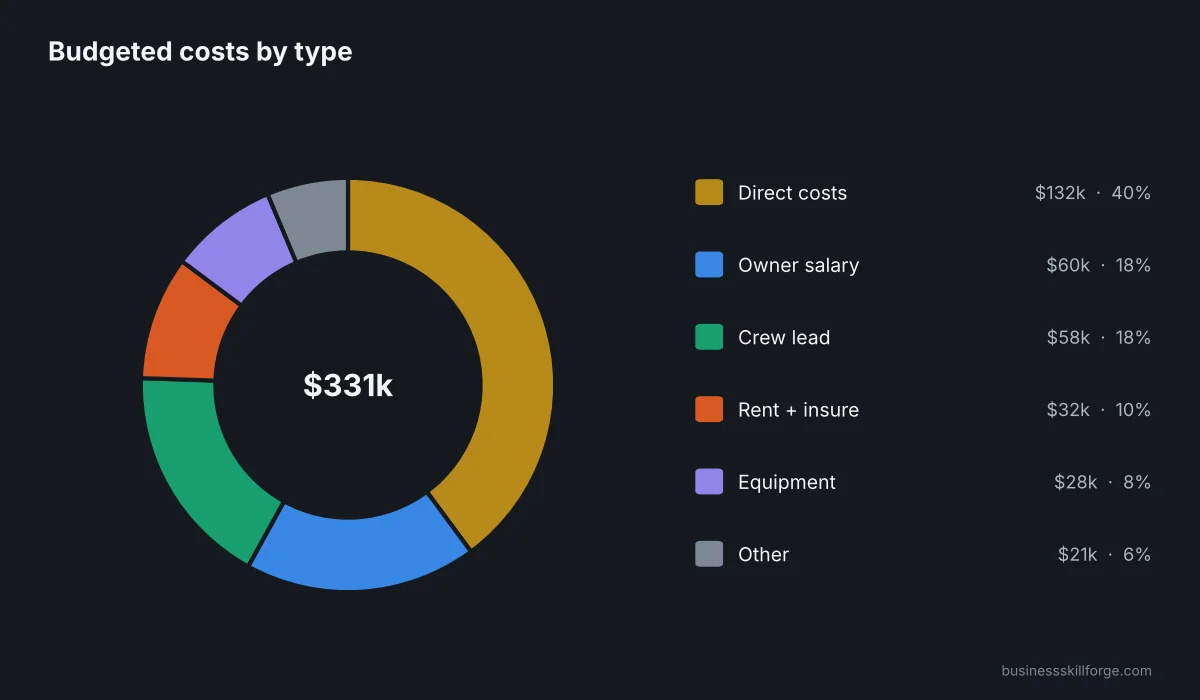
| Total direct costs | $132,000 | ||
| Gross profit | 65.3% of revenue | $248,000 | |
| Crew lead wages and payroll costs | Fixed | Salary plus employer costs | $58,000 |
| Owner salary | Fixed | Set at the start of the year | $60,000 |
| Yard and shop rent | Fixed | Lease | $18,000 |
| Insurance | Fixed | Renewal quotes | $14,000 |
| Vehicle and equipment maintenance | Fixed | Last year plus known repairs | $12,000 |
| Depreciation | Fixed (non-cash) | Asset schedule | $16,000 |
| Marketing | Fixed | Planned spend | $6,000 |
| Phone, software, accounting | Fixed | Subscriptions and fees | $7,000 |
| Contingency | Fixed | About 4% of overheads | $8,000 |
| Total overheads | $199,000 | ||
| Operating profit | $49,000 |
Three choices in that table are worth copying. The owner’s pay is budgeted as a real cost, so the $49,000 is profit after the owner has been paid. Employer payroll costs (payroll taxes in the US, employer National Insurance in the UK, CPP and EI in Canada, superannuation in Australia) are included in each wage line rather than forgotten. And there’s an explicit contingency line instead of padding every other number.
Step 4: Spread the budget across the months
An annual budget divided by 12 hides the thing most small businesses need to see: when the money comes in. The landscaping company earns most of its revenue between April and October. Its overheads arrive every month regardless.
Phase revenue using last year’s monthly pattern, adjusted for anything you know has changed. Variable costs follow revenue (here they run at about 34.7% of it). Fixed costs are spread evenly, except for anything paid in lumps, like an annual insurance premium, which you place in the month it’s paid in the cash view.
| Month | Revenue | Total costs | Operating profit |
|---|---|---|---|
| Jan | $12,000 | $20,752 | −$8,752 |
| Feb | $12,000 | $20,752 | −$8,752 |
| Mar | $18,000 | $22,836 | −$4,836 |
| Apr | $38,000 | $29,783 | $8,217 |
| May | $48,000 | $33,257 | $14,743 |
| Jun | $46,000 | $32,562 | $13,438 |
| Jul | $40,000 | $30,478 | $9,522 |
| Aug | $38,000 | $29,783 | $8,217 |
| Sep | $40,000 | $30,478 | $9,522 |
| Oct | $42,000 | $31,173 | $10,827 |
| Nov | $26,000 | $25,615 | $385 |
| Dec | $20,000 | $23,531 | −$3,531 |
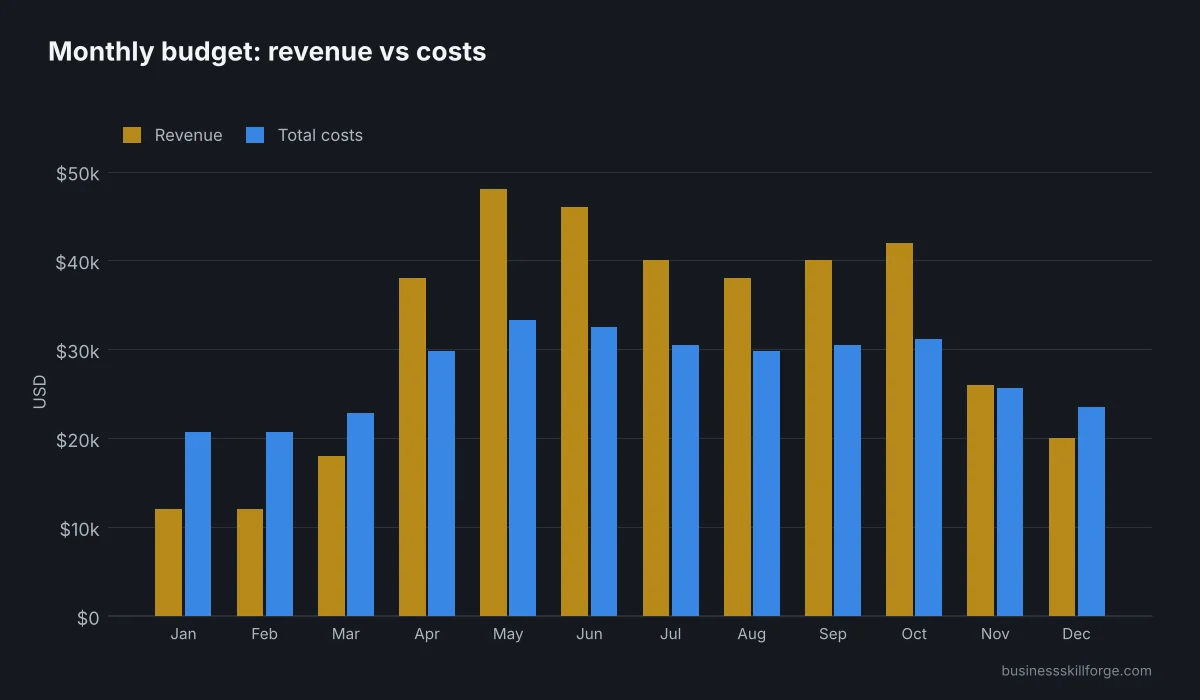
The year makes $49,000, but January to March lose a combined $22,340. A business that ends December with less than that in the bank has a problem in February, even though the annual plan looks healthy. This is the core lesson of cash flow vs profit, and the monthly budget makes it visible a year in advance.
Step 5: Turn the profit budget into a cash budget
Operating profit isn’t the same as cash in the bank. Adjust it for the items that move cash differently:
| Item | Amount |
|---|---|
| Operating profit | $49,000 |
| Add back depreciation (non-cash) | +$16,000 |
| Equipment loan principal repayments | −$14,000 |
| New commercial mower (bought in March) | −$12,000 |
| Income tax set-aside (estimate from your accountant) | −$12,000 |
| Net cash generated for the year | $27,000 |
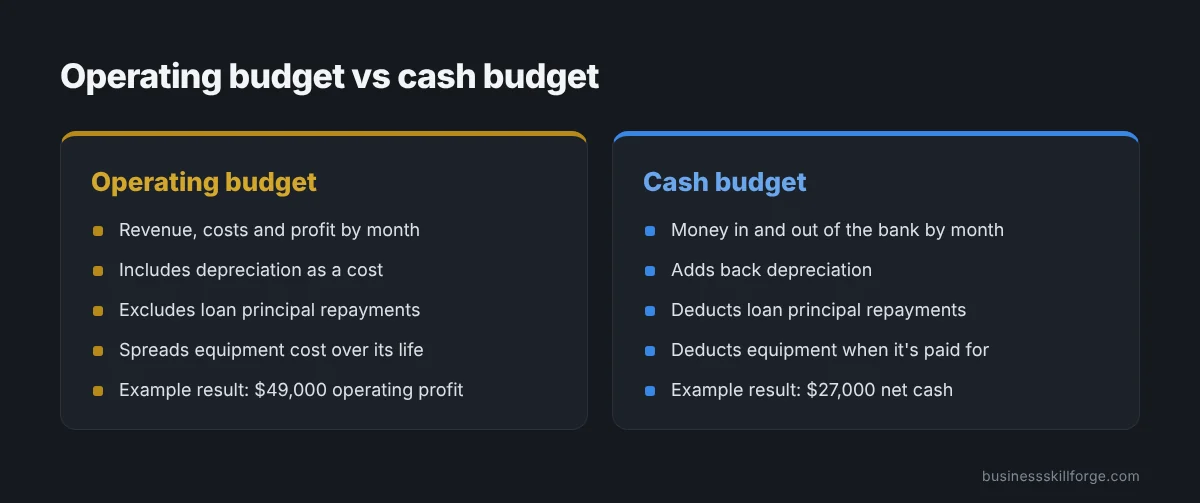
Loan principal and equipment purchases don’t appear as expenses on the P&L (the equipment shows up through depreciation over several years), but they leave your bank account all the same. Put the mower in March and the cumulative cash low point in the first quarter grows from about $21,800 to about $33,800 (before any tax set-aside paid in those months). That number tells the owner how much cash to hold going into January, or how big a line of credit to arrange before it’s needed. For week-by-week detail inside a tight stretch like that, a 13-week cash flow forecast picks up where the budget leaves off.
Which budgeting method should you use?
| Method | How it works | Best for |
|---|---|---|
| Incremental | Last year’s figures plus or minus a percentage | Stable businesses with few changes; quick but carries old waste forward |
| Driver-based | Revenue and variable costs built from volume × price or rate | Most small businesses; easy to update and explain |
| Zero-based | Every cost line justified from zero each year | A one-off clean-up when overheads have crept up |
Most owners do best with a blend: driver-based for revenue and variable costs, incremental for stable fixed costs, and a zero-based review of subscriptions and discretionary spend every couple of years.
Common budgeting mistakes
- Budgeting revenue first and costs as whatever’s left. Build both independently, then see if the result is acceptable. If it isn’t, change the plan, not the arithmetic.
- Leaving out the owner’s pay. If the owner’s salary isn’t in the budget, the “profit” is really unpaid wages.
- Ignoring timing. Annual insurance, quarterly tax payments and equipment purchases land in specific months. Put them there.
- No contingency. Something always goes wrong. A named contingency line is more honest than quietly padding every estimate.
- Building it and never opening it again. A budget that isn’t compared to actual results each month is just a spreadsheet.
How to use the budget during the year
Each month, once your books are closed, put actual results next to budget for every line and calculate the difference in dollars and percent. Then focus on the few variances that are both large and unexplained.
Say May comes in at $41,000 of revenue against a $48,000 budget, $7,000 or 14.6% short. Check the driver: were fewer projects completed, or were they smaller? Then check whether variable costs fell with revenue. If materials came in at budget even though project revenue dropped, margins are slipping and that needs a look. Our guide to budget vs actual variance analysis walks through this review in detail.
Don’t rewrite the budget every time reality differs. Keep the original as your yardstick, and if something big changes (you lose your largest client, or you hire earlier than planned), make a separate revised forecast alongside it.
What to do next
Block out an afternoon. Export last year’s monthly P&L, write down the two or three drivers behind your revenue, and sort every cost line into variable or fixed. Phase it by month using last year’s pattern, add a contingency line and convert it to a cash view with loan repayments, planned purchases and tax set-asides. Find your lowest cumulative cash month and decide now how you’ll cover it. If you’d rather not start from a blank sheet, our finance templates give you a ready-made structure.
Key takeaways
- A small business budget is a monthly plan of revenue, costs, profit and cash, built from last year’s actual numbers and adjusted for what you know will change.
- Forecast revenue from its drivers, such as number of jobs times average price, so you can see why you’re ahead or behind during the year.
- Budget variable costs as a share of revenue and fixed costs as monthly amounts, and include the owner’s pay and employer payroll costs.
- Phasing the budget by month shows seasonal cash gaps: the example business earns $49,000 for the year but loses $22,340 from January to March.
- Convert operating profit to a cash budget by adding back depreciation and deducting loan principal, equipment purchases and tax set-asides.
- Compare actual results with budget every month and investigate the large, unexplained variances rather than rewriting the plan.
Frequently asked questions
How do I create a budget for my small business?
Start with last year’s monthly profit and loss. Forecast revenue from its drivers, such as jobs times average price. Split costs into variable, budgeted as a share of revenue, and fixed, budgeted monthly. Spread everything across the 12 months using your seasonal pattern, add a contingency line, then adjust for loan repayments, equipment purchases and tax to see your cash position.
What should be included in a small business budget?
Include every revenue stream, direct costs like materials and job-related labor, overheads such as rent, insurance, software and marketing, the owner’s pay, employer payroll costs and a contingency line. For the cash view, add loan principal repayments, planned equipment purchases and money set aside for income tax, and remove non-cash costs such as depreciation.
How much should a small business set aside for contingency?
There’s no fixed rule. Many owners pick a modest percentage of overheads, a few percent, and adjust it based on how volatile their costs have been. The point is to show the buffer as its own line rather than padding every estimate, so you can see when you’ve used it and why.
What is the difference between a budget and a forecast?
A budget is the plan you set at the start of the year and keep as a fixed yardstick. A forecast is your current best estimate of how the year will turn out, updated as new information arrives. Comparing actual results to the budget shows how far you’ve drifted from the plan, while the forecast tells you where you’re likely to land.
How often should I review my business budget?
Compare actual results with your budget every month, once the books for that month are closed. Look at the differences in dollars and percentages and investigate the large ones you can’t explain. Revisit the full plan quarterly, and prepare a revised forecast if something significant changes, such as losing a major customer or adding staff.
This article is general education, not tax, legal, accounting or investment advice. Rules and thresholds differ by country and change over time, so check the specifics for your situation. See our financial disclaimer.
Get practical finance & accounting tips in your inbox
Join US professionals getting our best guides, templates and tools. Free. Unsubscribe anytime.