CAC and LTV Explained: Customer Acquisition Cost vs Value
November 5, 2026 · Aditya Gupta
Customer acquisition cost (CAC) is what you spend in sales and marketing to win one new customer. Lifetime value (LTV) is the gross profit that customer brings in over the whole time they stay. Compare the two to see whether growth makes you money: if a customer costs $180 to win and earns you $400 in gross profit, each new sale pays back more than twice over.
What CAC and LTV actually measure
Most businesses track revenue and profit by month. CAC and LTV look at the same money from a different angle: one customer at a time. That view is often called unit economics, and it answers a question your monthly P&L can’t: if you spend another $10,000 on marketing next month, will the customers it brings in be worth it?
- Customer acquisition cost is total sales and marketing spend in a period divided by the number of new customers won in that period.
- Customer lifetime value is the average gross profit a customer generates from their first purchase until they leave.
- The LTV to CAC ratio is lifetime value divided by acquisition cost. It tells you how many dollars of gross profit you get back for each dollar spent winning customers.
These metrics matter most for businesses with repeat customers: subscriptions, service retainers, software, repeat-purchase e-commerce. A wedding photographer who sees each client once has a CAC worth knowing, but LTV is just the profit on one job.
How to calculate customer acquisition cost
The formula is simple: CAC = sales and marketing costs for the period ÷ new customers acquired in the period. The work is in deciding what goes on top of the fraction.
Take an online skincare brand that sells a $40-a-month subscription box. In one quarter it spends:
| Cost | Quarter |
|---|---|
| Paid social and search ads | $18,000 |
| Part-time marketing contractor | $6,000 |
| Email platform, design tools, creative | $3,000 |
| Total acquisition spend | $27,000 |
| New subscribers in the quarter | 150 |
| CAC | $180 |
$27,000 ÷ 150 = $180 per new customer. If the brand had counted only the ad spend, it would have reported $120, which flatters the number by a third.

Blended CAC vs paid CAC
Those 150 customers didn’t all come from ads. Say 90 came through paid campaigns and 60 arrived through referrals, word of mouth and organic search. The $180 figure is a blended CAC: all spend over all new customers.
Blended CAC is fine for a big-picture check, but it hides the cost of the channel you can actually scale. The ad spend alone works out to $18,000 ÷ 90 = $200 per paid customer, before any share of the contractor or the tools. If the plan is to double the ad budget, the next customers will cost at least $200 each, probably more as you reach less interested audiences. Use paid CAC for budget decisions and blended CAC for the overall health check.
Should the founder’s time count?
In a small business the owner often does most of the selling. If you spend ten hours a week on sales calls, that time has a cost even if no salary line shows it. You don’t have to put it in the official number, but work out a second version with your time priced at what you’d pay someone else to do it. Otherwise CAC will jump the day you hire your first salesperson, and you’ll think something broke.
How to calculate customer lifetime value
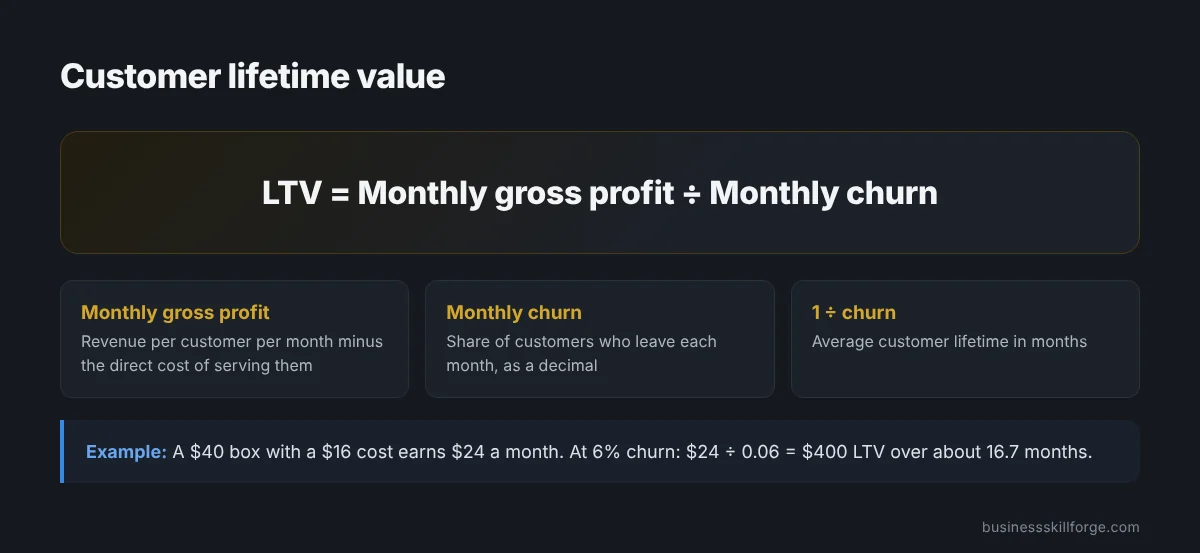
The version that works for most small businesses is: LTV = average monthly gross profit per customer ÷ monthly churn rate.
Back to the skincare box. Each box sells for $40. Product, packaging, fulfilment and shipping cost $16, so gross profit is $24 a month, a 60% gross margin. Each month about 6% of subscribers cancel. Your monthly churn rate is the share of customers at the start of a month who leave during it.
Dividing 1 by the churn rate gives the average customer lifetime: 1 ÷ 0.06 = 16.7 months. So LTV = $24 ÷ 0.06 = $400.
Use gross profit, not revenue
This is the most common way LTV gets inflated. Calculated on revenue, the same customer looks worth $40 ÷ 0.06 = $667, and the LTV to CAC ratio jumps from 2.2 to 3.7. But you don’t get to keep the $16 that goes on product and shipping each month, so it can’t be used to pay back what you spent acquiring the customer. Revenue-based LTV is the reason some businesses with great-looking ratios still run out of cash. If gross margin is a fuzzy number for you, our guide to markup vs margin sorts that out first.
How sensitive LTV is to churn
Churn sits in the denominator, so small changes swing the result hard. Holding gross profit at $24 a month and CAC at $180:
| Monthly churn | Average lifetime | LTV | LTV : CAC |
|---|---|---|---|
| 3% | 33.3 months | $800 | 4.4 : 1 |
| 4% | 25.0 months | $600 | 3.3 : 1 |
| 6% | 16.7 months | $400 | 2.2 : 1 |
| 8% | 12.5 months | $300 | 1.7 : 1 |
| 10% | 10.0 months | $240 | 1.3 : 1 |
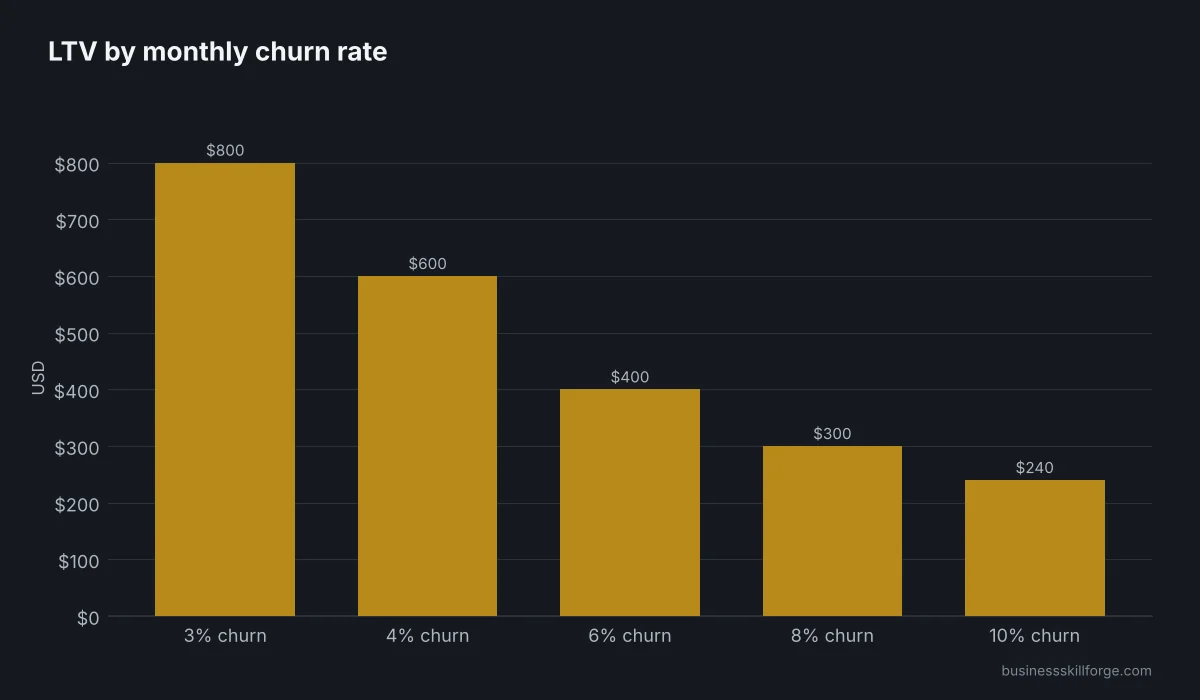
Cutting churn from 6% to 4% adds $200 of lifetime value per customer without spending a dollar more on acquisition. That’s why retention work often pays better than another ad campaign.
Be careful with long lifetimes
Low churn produces very long implied lifetimes. A business IT support firm with 1.5% monthly churn has an implied average lifetime of more than five years. That may be true, but you’re forecasting a long way out, and a dollar of gross profit in year five is worth less than one today. A sensible fix is to cap the lifetime at three years (or whatever horizon you’d defend to a lender) and calculate LTV over that window only.
What is a good LTV to CAC ratio?
The ratio you’ll most often see quoted in startup writing is 3:1, meaning three dollars of lifetime gross profit for every dollar spent on acquisition. Treat it as a conversation starter, not a law. The ratio you need depends on your overheads and how quickly the money comes back.
- Below 1:1 you lose money on every customer before paying rent or wages. Growth makes things worse.
- Around 1:1 to 2:1 each customer covers their acquisition cost, but there’s little left for fixed costs. Common in early months, risky if it lasts.
- Around 3:1 usually leaves room for overheads and profit.
- Well above 5:1 sounds great, but it can mean you’re underinvesting in growth and could afford to spend more to win customers faster.
The skincare brand at 2.2:1 isn’t in trouble, but it doesn’t have much slack. If ad costs rise 20%, its paid CAC goes from $200 to $240 and the paid-channel ratio drops to about 1.7:1.
CAC payback: how long until a customer pays for themselves
LTV tells you how much comes back. Payback tells you how long it takes, and that’s what drives cash flow. The simple version is CAC ÷ monthly gross profit per customer: $180 ÷ $24 = 7.5 months.
That simple version assumes nobody leaves. In reality some customers cancel in month two, so the average gross profit per acquired customer shrinks each month. With 6% monthly churn, cumulative gross profit per customer acquired builds like this:
| Month | Cumulative gross profit per customer acquired |
|---|---|
| 3 | $68 |
| 6 | $124 |
| 9 | $171 |
| 10 | $185 |
| 12 | $210 |
| 24 | $309 |
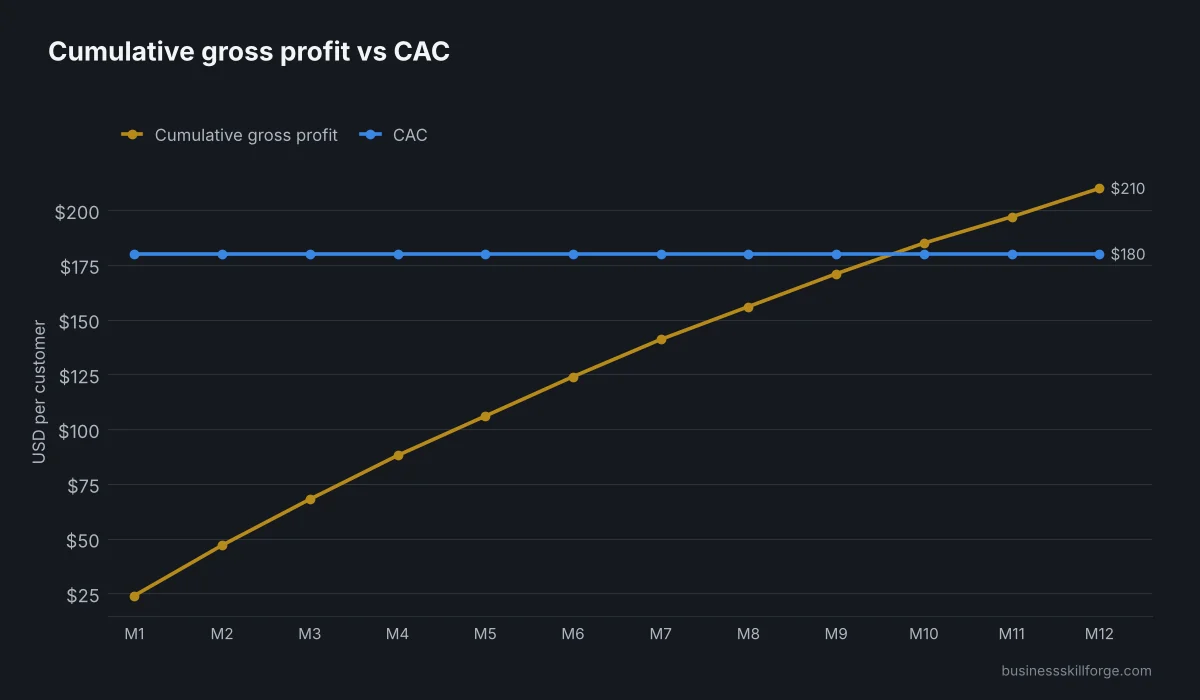
The $180 is recovered in month 10, not month 7.5. And after two full years, only $309 of the $400 lifetime value has arrived. Every month between spending on acquisition and earning it back is a month your cash is tied up. A business growing fast on a 10-month payback needs a cash cushion or financing to fund that gap, which is why profitable-on-paper companies can still struggle to pay bills. Our guide to payback period and ROI covers the same logic for other investments.
How to improve your LTV to CAC ratio
There are only five levers, and they’re worth checking in this order because the first ones are usually cheapest.
- Reduce churn. Find out why people cancel. Better onboarding, a pause option instead of cancel, or annual plans with a discount can all move it.
- Raise gross profit per customer. A price increase, cheaper packaging or a better shipping rate goes straight into LTV.
- Add expansion revenue. Upsells and add-ons raise the monthly gross profit of customers you already paid to acquire.
- Cut wasted acquisition spend. Calculate CAC by channel. One channel usually costs far more per customer than the others.
- Lean on referrals. Referred customers come in with a low acquisition cost, and a modest referral reward is often cheaper than paid ads.
Common CAC and LTV mistakes
- Leaving costs out of CAC. Ads alone aren’t acquisition cost. Include contractors, sales salaries or commissions, tools and agency fees.
- Mismatched timing. If you sell on a long cycle, this quarter’s spend may produce next quarter’s customers. For B2B sales cycles of a few months, compare spend with customers won one period later, or use a rolling six-month average.
- Using revenue instead of gross profit for LTV. It overstates value by whatever your cost of goods is.
- Averaging across very different customers. Monthly and annual subscribers, or small and large clients, churn at different rates. Calculate by segment when they differ.
- Trusting a churn rate from three months of data. Early churn rates bounce around. Recalculate as more months come in.
What to do next
Pull last quarter’s sales and marketing costs and your count of new customers, and work out blended CAC. Then split it by your two or three biggest channels. Calculate monthly gross profit per customer from your actual cost of goods, divide by churn, and cap the lifetime if it runs past three years. Finally, work out payback in months.
If you want to test a specific spend, our $10,000 marketing ROI example walks through the return on a single campaign. Recalculate CAC and LTV every quarter, and take a falling ratio seriously before it shows up in the bank balance.
Key takeaways
- Customer acquisition cost is total sales and marketing spend divided by new customers won in the same period, including tools, contractors and salaries.
- Lifetime value should be built on gross profit, not revenue: monthly gross profit per customer divided by the monthly churn rate.
- Blended CAC includes free customers from referrals and organic search, so use paid-channel CAC when deciding how much more to spend on ads.
- LTV is very sensitive to churn: in the example, cutting monthly churn from 6% to 4% raises LTV from $400 to $600.
- A 3:1 LTV to CAC ratio is a common reference point, but payback time matters as much, because cash spent on acquisition takes months to come back.
Frequently asked questions
What is the formula for customer acquisition cost?
Customer acquisition cost equals your total sales and marketing spend for a period divided by the number of new customers you won in that period. If you spent $27,000 on ads, a marketing contractor and tools in a quarter and gained 150 customers, your CAC is $180. Include salaries, commissions, agencies and software, not just ad spend.
How do you calculate customer lifetime value for a small business?
For repeat or subscription customers, divide the average monthly gross profit per customer by your monthly churn rate. A customer generating $24 of gross profit a month with 6% monthly churn has an LTV of $400. For one-off purchase businesses, multiply gross profit per order by the average number of orders a customer places.
What is a good LTV to CAC ratio?
A ratio of about 3:1 is the reference point most often quoted, meaning three dollars of lifetime gross profit for every dollar spent on acquisition. Below 1:1 you lose money on each customer. Very high ratios can mean you’re underspending on growth. Look at payback time as well, since a good ratio with a long payback can still strain cash.
Should LTV use revenue or profit?
Use gross profit. Revenue includes the money you spend on product, delivery and other direct costs, which isn’t available to pay back acquisition spend. Using revenue can make a 2.2:1 business look like a 3.7:1 business, which leads to overspending on marketing. Gross profit per customer is the honest measure of what each customer contributes.
What is CAC payback period?
CAC payback period is how many months of gross profit from a customer it takes to recover what you spent acquiring them. The simple version is CAC divided by monthly gross profit per customer. Because some customers leave early, the real payback across a group of new customers is longer, so model churn if the number matters for cash planning.
This article is general education, not tax, legal, accounting or investment advice. Rules and thresholds differ by country and change over time, so check the specifics for your situation. See our financial disclaimer.
Get practical finance & accounting tips in your inbox
Join US professionals getting our best guides, templates and tools. Free. Unsubscribe anytime.