Petty Cash Management: How to Set It Up and Keep It Honest
November 7, 2026 · Aditya Gupta

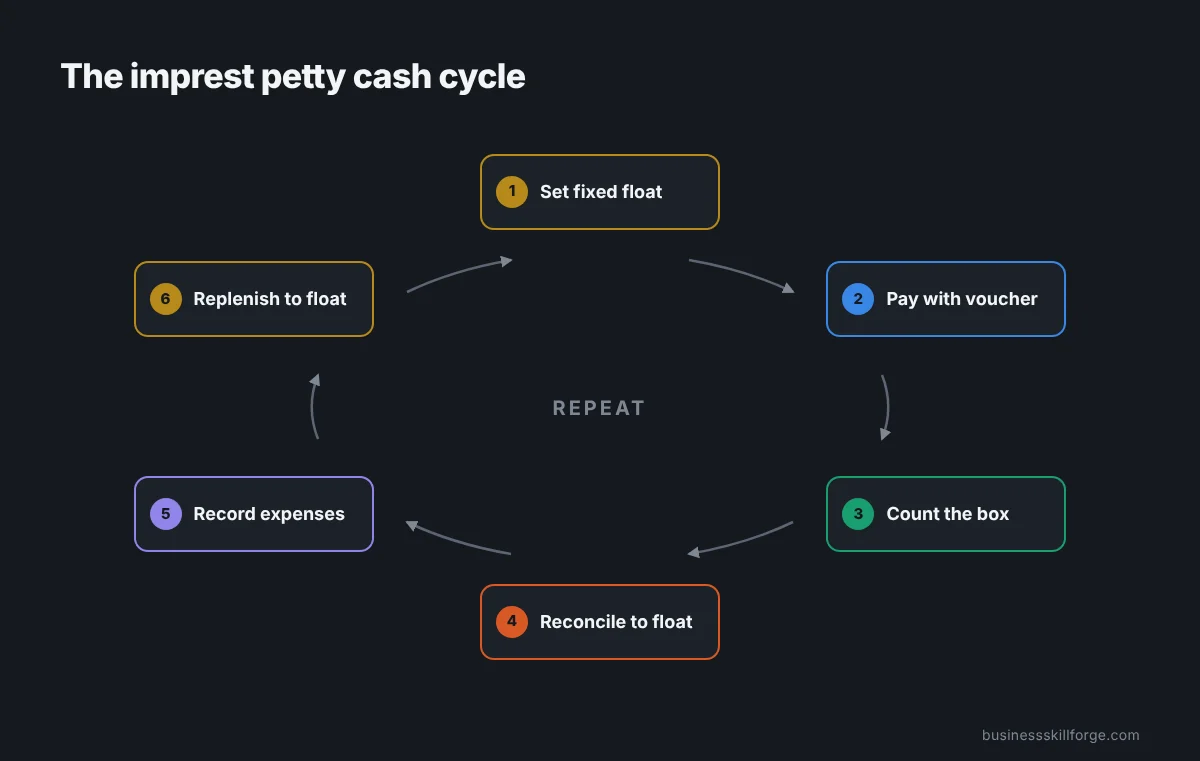
Petty cash is a small, fixed amount of cash a business keeps on hand for minor purchases like postage, parking or office supplies. The cleanest way to run it is the imprest system: set a fixed float, pay out only against a receipt or voucher, then top it back up to the same amount and record the expenses when you replenish.
Done this way, petty cash takes about 15 minutes a month and always balances. Done loosely, it becomes the one account nobody can explain at year-end. This guide covers sizing the fund, the journal entries, a full worked replenishment, cash over and short, and the controls that keep the box honest.
How a petty cash fund works
The imprest system is a method where the petty cash fund has a fixed balance, and at any moment the cash in the box plus the receipts for what’s been spent should add up to that balance. If you set up a $300 fund, then $74 in cash plus $226 of receipts is a correct box. $74 in cash plus $200 of receipts means $26 is missing.
That fixed-balance rule is what makes petty cash controllable. You don’t record each $8 parking payment in the books as it happens. You record the expenses in one batch when you replenish, using the receipts as support. The petty cash account in your general ledger stays at $300 month after month, and only changes if you deliberately make the fund bigger or smaller.
Compare that with a “fluctuating” approach where people add and remove cash whenever they like and someone tries to record each movement. It can work in theory, but in practice nobody records the $20 that went in from the owner’s wallet, and the box stops matching the books within weeks.
How big should a petty cash fund be?
Size the fund to cover roughly four to six weeks of small cash spending, so you replenish about once a month, ideally as part of your month-end routine. Too small and you’re topping up every few days. Too large and you have cash sitting in a drawer that’s harder to protect and tempting to borrow from.
Here’s how a small architecture office sized its fund. It tracked cash purchases for six months before setting a float:
| Month | Cash spending |
|---|---|
| January | $210 |
| February | $245 |
| March | $190 |
| April | $280 |
| May | $225 |
| June | $236 |
| Average | $231 |
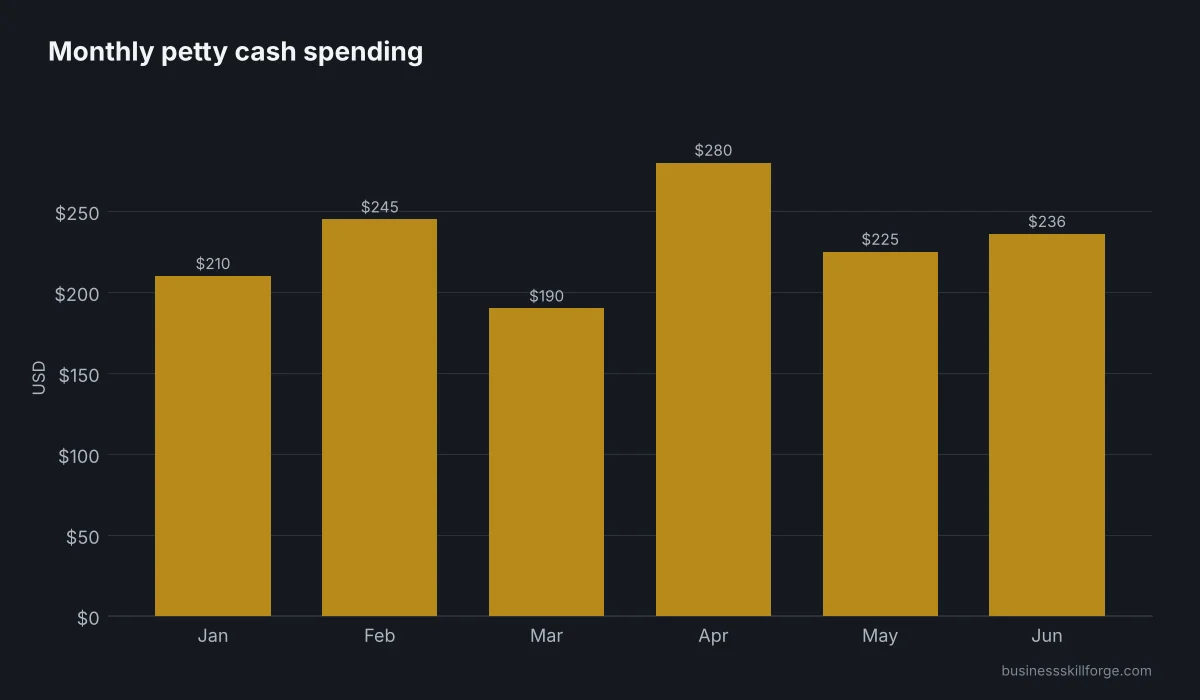
Average monthly spending was $231 and the busiest month was $280. A $300 fund covers even the peak month with a little room, so the office set the float at $300 and replenishes at month-end, or sooner if cash drops below $60. If you have no history, start with a modest amount like $150 or $200 and adjust after two or three months.
How to set up petty cash, step by step
- Pick one custodian. One named person holds the key and is accountable for the balance. A backup can step in during absences, but the box gets counted at handover.
- Set a per-purchase limit. Something like $50 per purchase keeps larger spending on a card or invoice, where it’s easier to track.
- Write down what petty cash is for. Postage, parking, small supplies, a delivery tip. Not wages, not contractor payments, not loans to staff.
- Create the account. Add a “Petty cash” asset account to your chart of accounts, under current assets alongside your bank accounts.
- Fund it. Withdraw the float from the business bank account and record the transfer.
The setup entry is a simple journal entry that moves money from one asset to another:
| Account | Debit | Credit |
|---|---|---|
| Petty cash | $300.00 | |
| Business checking | $300.00 |
No expense is recorded here. You’ve just moved $300 from the bank into a drawer. Expenses come later, when you replenish.
Changing the size of the fund
If the fund turns out to be too small, increase it with a second transfer entry: debit petty cash and credit checking for the increase. Going from $300 to $400 is a $100 entry, and from then on the float, the count target and the general ledger balance are all $400. Shrinking the fund works the other way: deposit the excess back in the bank, debit checking and credit petty cash. These are the only entries that should ever change the petty cash account. If you see any other activity in it, something has been coded there by mistake, often a bank feed rule that matched a cash withdrawal to petty cash when it was really an owner’s draw. Review that account whenever you do your monthly bank reconciliation.
Recording petty cash: a worked replenishment
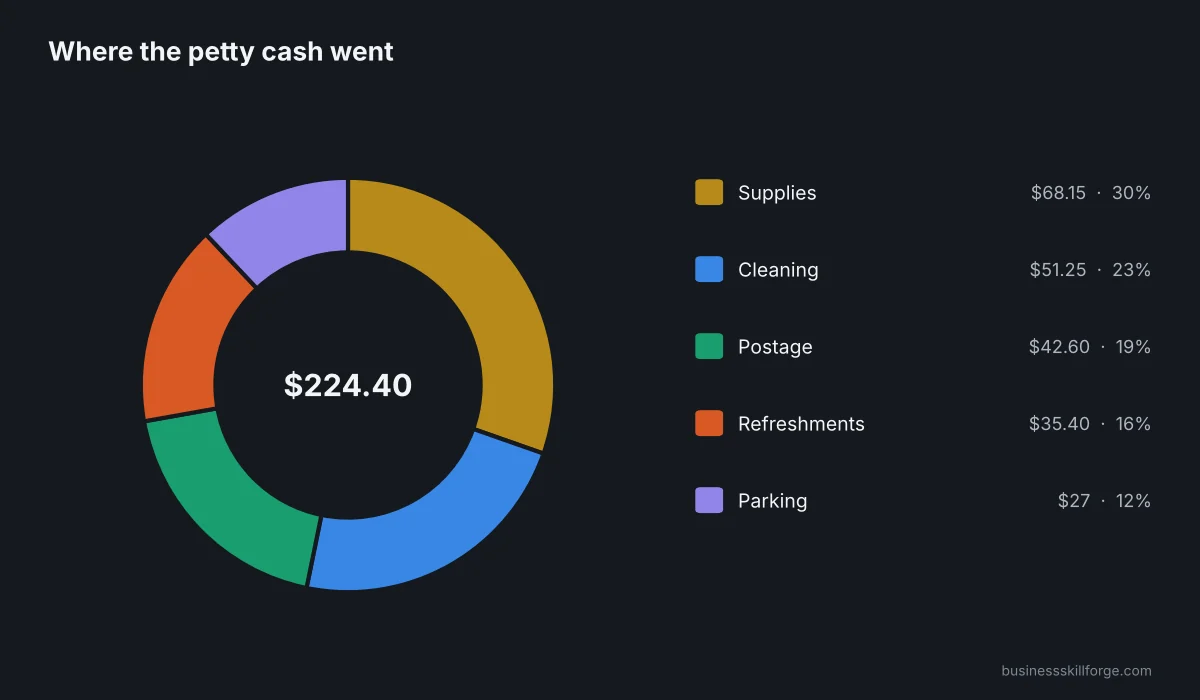
Every payment out of the box should have a voucher (a small slip with the date, amount, purpose and the person’s signature) with the receipt stapled to it. At month-end, the architecture office’s custodian adds up the vouchers by category:
| Category | Vouchers |
|---|---|
| Postage and delivery | $42.60 |
| Office supplies | $68.15 |
| Client meeting refreshments | $35.40 |
| Parking | $27.00 |
| Cleaning supplies | $51.25 |
| Total vouchers | $224.40 |
The fund is $300, so the box should hold $300 − $224.40 = $75.60. The custodian counts $74.10. The box is $1.50 short.
To bring the box back to $300, the office withdraws $300 − $74.10 = $225.90 from the bank. The replenishment entry records each expense category from the vouchers, the $1.50 shortage, and the cash that came out of the bank:
| Account | Debit | Credit |
|---|---|---|
| Postage and delivery | $42.60 | |
| Office supplies | $68.15 | |
| Meals and refreshments | $35.40 | |
| Parking and travel | $27.00 | |
| Cleaning and maintenance | $51.25 | |
| Cash over and short | $1.50 | |
| Business checking | $225.90 |
Notice what isn’t in the entry: the petty cash account itself. It started at $300 and it ends at $300. The expenses hit the profit and loss statement in the month they were replenished, which is why replenishing at month-end matters. If you replenish on the 9th of the next month, those costs land in the wrong period unless you post an accrual.
Handling cash over and short
Cash over and short is an expense (or, rarely, income) account that absorbs small, unexplained differences in a cash count. A $1.50 shortage on $224 of spending usually means a rounding error, a lost coin or a receipt that didn’t match the cash handed over. Book it and move on.
What you shouldn’t do is let differences accumulate silently. Set a tolerance, say $5 a month, and investigate anything above it. A pattern matters more than any single month: a box that’s short $3, then $8, then $15, then $22 is telling you something about who has access to it.
Overages need the same attention. A box with more cash than it should have often means someone paid for something personally and was reimbursed without a voucher, or a voucher was written but the cash never left the box.
Controls that keep petty cash honest
Petty cash is small, but it’s also the easiest money in the business to take, and the controls that protect it cost almost nothing.
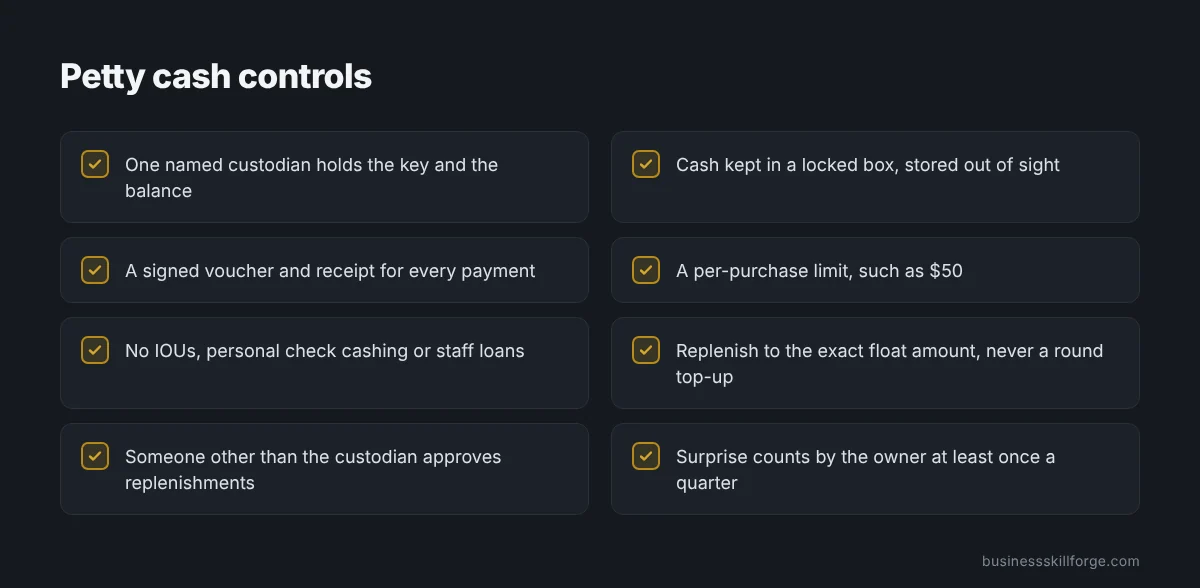
The control people skip most often is the surprise count. Once a quarter, someone other than the custodian (the owner, usually) counts the box with the custodian present and checks that cash plus vouchers equals the float. It takes five minutes, and knowing it can happen at any time is a deterrent in itself.
Separation of duties matters even in a tiny business. The custodian shouldn’t approve their own replenishment or write vouchers for their own reimbursements without a second signature. In a two-person company that second person is the owner.
Common petty cash mistakes
- IOUs in the box. An IOU is a loan to an employee recorded on a scrap of paper. If staff advances are allowed, run them through payroll or a proper receivable, not the cash box.
- Paying contractors from petty cash. In the US, payments to contractors may have information-reporting requirements. Pay them by check or bank transfer so there’s a clean trail.
- Topping up with a round number. Putting in “another $200” instead of the exact amount to restore the float breaks the imprest system, because the box no longer has a known target.
- Recording withdrawals as one “petty cash expense.” Coding the $225.90 replenishment to a single miscellaneous account loses the category detail you need for budgeting and tax.
- Not counting at month-end. Skipping the count means the cash over and short figure only appears once a year, when it’s too late to find the cause.
Several of these show up in our wider list of common bookkeeping mistakes and how to fix them, especially the habit of mixing personal and business money.
Do you need petty cash at all?
Plenty of small businesses don’t. If almost every purchase can go on a business debit or credit card, a card with a low spending limit gives you a bank record for every transaction and nothing to count. Staff who buy something with their own money can submit an expense claim and be reimbursed by bank transfer.
Petty cash still earns its place in a few situations: retail and hospitality businesses that already handle cash, offices where small cash purchases are frequent, and places where card acceptance is patchy. If you keep it, keep it small and keep it on the imprest system.
What to do next
If you already have a petty cash box, count it today and compare cash plus receipts with the amount you think the fund holds. If they don’t agree, record the difference to cash over and short, reset the float to a fixed amount and start the imprest routine from this month.
Then add the petty cash count and replenishment to your month-end close checklist, right next to the bank reconciliation, so the expenses always land in the right month.
Key takeaways
- Run petty cash on the imprest system: a fixed float, vouchers for every payment, and a top-up back to the same amount.
- Size the fund to cover four to six weeks of small cash spending so you replenish about once a month.
- Record expenses by category when you replenish, and leave the petty cash account balance unchanged unless you resize the fund.
- Book small count differences to cash over and short, set a tolerance, and investigate any pattern of growing shortages.
- One custodian, a per-purchase limit and occasional surprise counts are the controls that matter most.
Frequently asked questions
Is petty cash an asset or an expense?
Petty cash is a current asset. The cash in the box belongs to the business, just like money in a bank account, so it sits on the balance sheet. The purchases paid from it become expenses when you replenish the fund and record each category from the vouchers. Under the imprest system, the asset balance stays fixed at the float amount.
How much petty cash should a small business keep?
Keep enough to cover about four to six weeks of small cash purchases, so you replenish roughly once a month. Track cash spending for a few months, then set the float slightly above your busiest month. If you have no history yet, start small and adjust after two or three months, because the right number depends entirely on how much you actually spend in cash.
What is the journal entry to replenish petty cash?
Debit each expense account for the total of its vouchers, debit or credit cash over and short for any counting difference, and credit the bank account for the amount withdrawn to restore the float. The petty cash account itself isn’t touched, because the replenishment brings the box back to the same fixed balance it started with.
What happens if petty cash is short?
Recount, check every voucher against its receipt and look for a missing slip first. If the difference is small and still unexplained, record it to a cash over and short account when you replenish. Set a tolerance such as $5 a month, and investigate larger or repeated shortages, since a growing pattern usually points to a control problem rather than rounding.
Can I use petty cash to pay employees or contractors?
It’s best not to. Wages should go through payroll so taxes and withholding are handled correctly, and contractor payments are easier to document for tax reporting when paid by bank transfer or check. Petty cash works best for small, one-off purchases with a receipt, such as postage, parking or office supplies, under a set per-purchase limit.
This article is general education, not tax, legal, accounting or investment advice. Rules and thresholds differ by country and change over time, so check the specifics for your situation. See our financial disclaimer.
Get practical finance & accounting tips in your inbox
Join US professionals getting our best guides, templates and tools. Free. Unsubscribe anytime.